

CFO-Level Analysis Cadence & Outputs
| Analysis Type | Cadence | Output | Decision Driven |
|---|---|---|---|
| Cash flow forecast (13-week) | Weekly | Rolling liquidity view | Hire freeze, debt draw, AR push |
| P&L variance vs. budget | Monthly | Variance commentary | OpEx cuts, re-forecast |
| Unit economics review | Monthly | CAC, LTV, payback by segment | Channel mix, pricing |
| Pricing & margin analysis | Quarterly | Margin by SKU/customer | Price changes, SKU rationalization |
| Scenario planning | Quarterly | Best/base/downside model | Headcount, capex commitments |
| Working capital review | Monthly | DSO/DPO/DIO trends | Collections push, supplier terms |
| Cohort & retention analysis | Quarterly | Revenue retention by cohort | Product investment, churn fixes |
Most business owners treat their monthly profit-and-loss statement like a rearview mirror. It shows where you’ve been, but tells you almost nothing about where you’re headed. CFO-led financial analysis flips that model entirely. Instead of waiting for quarterly reports to reveal problems that already cost you money, it puts forward-looking, strategy-driven insights at the center of every major decision. For SMEs competing in fast-moving markets, this shift from reactive to proactive financial management isn’t a luxury. It’s the difference between growing deliberately and guessing your way forward.
Table of Contents
- What is CFO-led analysis?
- The CFO skill set: What expertise drives analysis?
- How CFO-led analysis improves business decision-making
- CFO-led analysis in action: Frameworks, tools, and SME use cases
- The overlooked power and risk of CFO-led analysis
- Supercharge your SME with CFO-level expertise
- Frequently asked questions
Key Takeaways
| Point | Details |
|---|---|
| CFO-led analysis essentials | It focuses on real-time, actionable insights so you can make better business decisions at speed. |
| Unique SME value | Small and medium businesses benefit from proactive, scenario-driven financial analysis, not just periodic reports. |
| Balance speed and rigor | Quality insights require efficient but disciplined analysis—avoid shortcuts that could hide financial risks. |
| Tools and frameworks matter | Using CFO-level frameworks and modern tools enables agility and more accurate forecasting. |
What is CFO-led analysis?
CFO-led analysis is the practice of applying senior financial leadership to interpret business data in ways that directly inform strategy. It goes well beyond preparing financial statements or checking compliance boxes. A CFO frames financial data around the questions that actually matter to your business: Where is margin eroding? Which clients or products drain cash? What does the next 90 days look like if revenue slows by 20%?
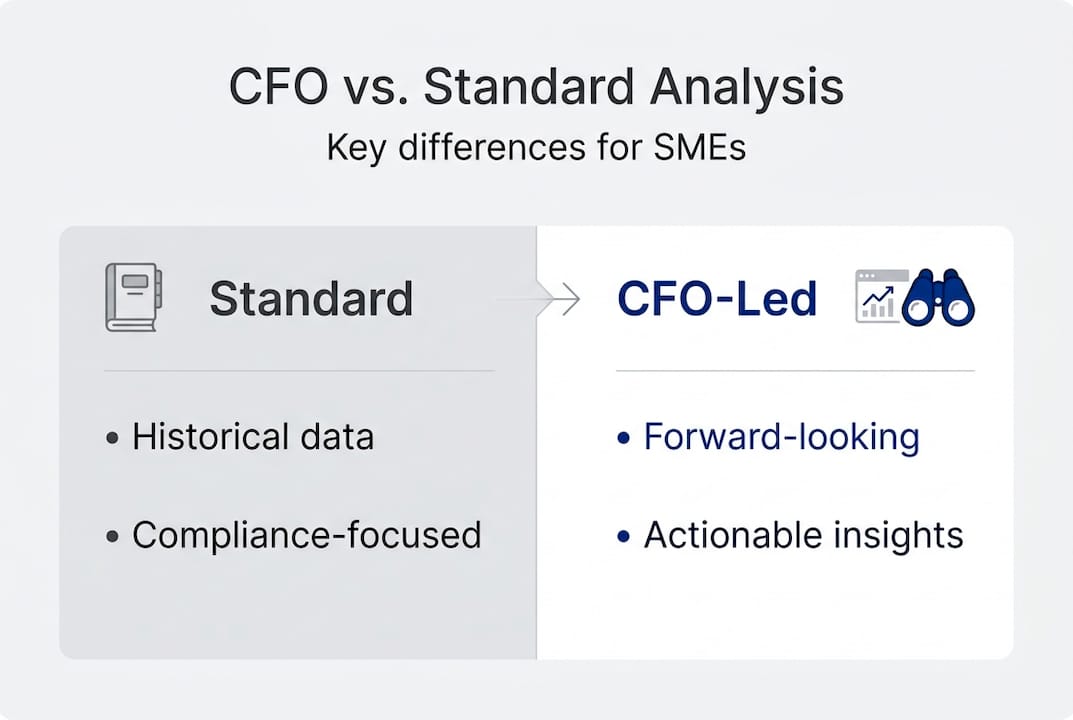
Here’s what makes CFO-led analysis distinct from standard financial review:
- Forward-looking by design. Instead of explaining what happened last quarter, it models what’s likely to happen next.
- Customized to your strategy. Analysis is built around your specific growth goals, cost structure, and risk tolerance, not a generic template.
- Grounded in scenario modeling. CFOs run multiple “what if” scenarios so you can make decisions with full visibility into the range of outcomes.
- Tied to real-time metrics. Rather than waiting for month-end close, CFO-led analysis tracks live KPIs that signal problems early.
Standard financial analysis typically focuses on historical data, compliance reporting, and accurate bookkeeping. It answers, “What happened?” CFO-led analysis answers, “What should we do next and why?”
For SMEs, this distinction is critical. Research shows that CFOs influence accounting conservatism, shaping how quickly bad news surfaces in financial reports. That means the quality of your financial insight is directly tied to how your CFO structures and interprets the analysis, not just the numbers themselves.
If you’ve noticed that your current financials feel disconnected from the real pressures in your business, it may be time to review the signs your business needs a CFO. And if you’re weighing whether a full-time hire is necessary, the value of CFO services for SMEs makes a strong case for flexible, outsourced options.
Pro Tip: Define your analysis scope around specific decision points, not just financial periods. Instead of asking “How did Q2 go?”, ask “What’s driving the margin gap in our top product line, and what are our options?”
The CFO skill set: What expertise drives analysis?
Not all financial professionals deliver the same level of insight. The gap between a bookkeeper, a controller, and a CFO isn’t just seniority. It’s a fundamentally different way of engaging with financial data.

CFOs combine technical accounting knowledge with strategic forecasting, stakeholder communication, and scenario-building skills. They’re trained to balance speed against depth. Move too fast, and analysis quality suffers. Move too slow, and decisions get made without the right information. Research confirms that powerful CFOs influence the efficiency and quality trade-off in financial analysis, which is why who leads your analysis matters as much as the process itself.
| Area | Accountant/Controller | CFO |
|---|---|---|
| Primary focus | Accuracy and compliance | Strategy and growth |
| Reporting style | Backward-looking | Forward-looking |
| Key deliverable | Financial statements | Forecasts, scenarios, KPIs |
| Decision support | Historical summaries | Action-ready recommendations |
| Risk management | Flags past issues | Models future risks |
Strategic decisions a CFO-led analysis directly supports include:
- Pricing strategy based on real margin analysis across products or services
- Investment timing tied to cash flow cycles and projected returns
- Cost management by identifying underperforming cost centers
- Hiring decisions grounded in revenue-per-employee and capacity modeling
- Fundraising readiness based on clean financial models and clear growth story
Understanding these bookkeeper vs CFO differences helps clarify why upgrading your financial leadership changes the quality of every business decision downstream. Pairing that leadership with consistent tracking of key financial metrics for SMEs creates a feedback loop that keeps strategy grounded in reality.
Pro Tip: When you meet with your financial team, don’t just ask for numbers. Ask, “What action should we take based on this data?” If they can’t answer that, your analysis process needs upgrading.
How CFO-led analysis improves business decision-making
The real value of CFO-level insight shows up when your business faces a fork in the road. Should you expand to a new market? Cut a product line? Take on debt to fund growth? Here are five concrete ways CFO-led analysis makes those calls sharper.
- Cash flow optimization. A CFO maps the timing of inflows and outflows to prevent cash gaps before they happen, not after payroll is at risk.
- Risk identification. By stress-testing your financials against adverse scenarios, CFO-led analysis spots vulnerabilities that look fine on a standard P&L.
- Scenario planning. You get three versions of the future (base, upside, downside) so decisions are never made on a single assumption.
- Investment timing. CFOs align capital spending with projected cash availability and revenue cycles, preventing overextension.
- Rapid response to market shifts. When conditions change fast, real-time tracking means you can adjust pricing, spending, or staffing before damage compounds.
“Balancing efficiency and analysis quality is crucial to avoid impaired decision-making in rapidly shifting business environments.”
This balance matters especially when liquidity tightens. Monthly reviews are fine during stable periods, but they’re dangerously slow during a cash crunch. Connecting your financial data to a financial dashboard lets you track these signals continuously rather than waiting for month-end surprises. For SMEs working to protect margins while scaling, pairing CFO insight with disciplined SME profitability management creates a compounding advantage.
Pro Tip: During any period of cash flow stress, review your cash flow statement daily. A single large receivable delay can cascade into payroll risk within days if you’re not tracking it.
CFO-led analysis in action: Frameworks, tools, and SME use cases
CFO analysis isn’t abstract. It runs on specific frameworks and tools that translate raw financial data into clear guidance.
The two cash flow methods compared:
| Method | Approach | Best use case |
|---|---|---|
| Indirect method | Starts from net income, adjusts for non-cash items | Annual planning, investor reporting |
| Direct method | Tracks actual cash inflows and outflows | Tight liquidity, daily or weekly monitoring |
Research on CFO power and conditional conservatism shows that flexible, real-world analysis often requires shifting between these methods depending on business conditions. When cash is tight, the direct method gives you the granular, transaction-level visibility you need.
Core frameworks CFOs apply include:
- Scenario modeling: Build three financial futures (optimistic, base, pessimistic) and map your decisions to each.
- Variance analysis: Compare actual results to budget and forecast, then explain the gaps with specific business causes.
- Rolling forecasts: Replace static annual budgets with forecasts that update monthly, keeping your plan current.
- Key metric tracking: Focus on 5 to 8 metrics that directly predict business health: gross margin, burn rate, days sales outstanding, and similar.
Tech tools that support CFO-level analysis in SME environments include ERP integrations like NetSuite or QuickBooks Online, cash flow platforms like Float or Pulse, and business intelligence dashboards such as Fathom or Spotlight Reporting.
A practical example: an SME with 60-day receivables and 30-day payables will experience a chronic cash gap. A CFO using the direct method and a rolling forecast can model that gap precisely, then recommend invoice financing, adjusted payment terms, or a credit facility before the business hits a wall. A complete cash flow forecasting guide walks through exactly this kind of scenario. For project-based businesses in particular, cash flow for project-based businesses offers industry-specific strategies that map directly to CFO-level planning.
The overlooked power and risk of CFO-led analysis
Here’s what most articles on CFO analysis won’t tell you: more financial sophistication can actually introduce new blind spots if you’re not careful.
When CFOs are empowered and well-aligned with business goals, they drive agile, forward-looking analysis that genuinely accelerates growth. They cut through noise, prioritize the right metrics, and give leadership the confidence to act. That’s the upside most people talk about.
But there’s a tension worth naming. Research suggests that powerful CFOs may reduce accounting conservatism to present results more favorably, which can delay recognition of financial trouble. In practice, this shows up as over-optimistic forecasts, slow acknowledgment of a declining product line, or deferred write-downs that make the balance sheet look healthier than it is.
The lesson isn’t to distrust your CFO. It’s to build a structure where financial rigor and strategic agility coexist. Establish regular three-way reviews between the CEO, CFO, and board or advisory group. Require that bad news surfaces as fast as good news. Reward early warnings, not just polished forecasts. The SMEs that get the most out of CFO-led analysis are those that treat it as a discipline, not just a service.
Supercharge your SME with CFO-level expertise
CFO-led analysis gives you something rare: the ability to see your business clearly and act before problems become crises. It replaces gut-feel decisions with structured, data-backed strategy.
At John Galt Finance, we bring that level of insight directly to SMEs that aren’t ready for a full-time CFO but can’t afford to operate without one. Our custom financial modeling process is built around your specific business, not a template. We offer ongoing KPI tracking, cash flow forecasting solutions, and hands-on CFO support tailored for businesses in your revenue range. Explore our essential financial models or reach out to start with a business health check today.
Frequently asked questions
How is CFO-led analysis different from regular financial analysis?
CFO-led analysis is proactive and forward-looking by design, using forecasting and scenario planning tied to your business goals, whereas standard financial analysis focuses on historical reporting and compliance.
When should an SME consider shifting to high-frequency financial tracking?
If your business is experiencing cash flow stress or rapid change, shift to weekly or even daily cash tracking for the real-time visibility needed to respond before problems escalate.
Does CFO-led analysis apply only to large companies?
No. SMEs gain strategic and operational value from CFO-level insight just as much as large firms, particularly when it comes to cash flow control, smarter planning, and identifying growth opportunities.
What are the risks of relying solely on CFO-led analysis?
Excessive CFO influence can delay recognizing bad news, so pairing CFO analysis with independent reviews and board-level checks keeps financial reporting honest and timely.
Recommended
- Why SMEs Need CFO Services: Unlock Growth and Clarity
- Financial management for SME profitability: 5 key steps
- Strategic finance best practices: SME owner’s guide to growth
- Essential financial metrics to track for SMB growth: 2026
FAQ
What’s the difference between bookkeeping reports and CFO-led analysis?
Bookkeeping reports show you what already happened (P&L, balance sheet, AR aging). CFO-led analysis explains why it happened, what it predicts, and what to do about it. A P&L says “gross margin dropped 3 points.” A CFO analysis says “gross margin dropped because customer mix shifted toward Segment C, which has 12-point lower margin. Recommend price adjustment by July 1 or de-emphasize the channel.”
Which financial analysis matters most for SMBs?
In order of impact for $1M-$20M businesses: (1) 13-week cash flow forecast, (2) unit economics by customer/channel, (3) pricing and margin analysis, (4) working capital cycle, (5) cohort retention (for recurring revenue businesses). These five drive 80% of executable decisions. Everything else is supporting context.
How do I make sure financial analysis actually drives decisions?
Tie every analysis to a specific decision and owner. Don’t produce a margin report unless someone is empowered to change pricing or kill SKUs. Don’t run a cash flow forecast unless someone can pull levers (collect AR, delay AP, draw credit). Reports without owners become wallpaper. Best practice: every monthly finance pack ends with a “Decisions Needed” page listing 3-5 items.
What KPIs should I see on my dashboard daily?
For most SMBs: (1) cash balance and 30-day forward forecast, (2) MTD revenue vs. monthly target, (3) gross margin run rate, (4) AR over 60 days, (5) one or two operating KPIs specific to your model (e.g., MRR for SaaS, ad ROAS for e-commerce, billable utilization for agencies). Five numbers, one screen, updated by 8am.
How long does it take to build CFO-level analysis from scratch?
With a fractional CFO and a competent bookkeeper, you can have a clean monthly close, 13-week cash flow, and basic KPI dashboard within 30-45 days. Unit economics, cohort analysis, and pricing models typically add another 30-60 days. Full strategic finance stack (close + forecast + scenarios + cohort + pricing + board pack) is usually a 90-120 day build for a business at $2-10M revenue.