

Financial Model Audit Benchmarks
| Metric | Benchmark |
|---|---|
| Models with at least one material error | ~88% (FAST Standard / PwC research) |
| Average errors per 1,000 formulas | 2-5 |
| Cost of an outsourced model audit | $3,500-$25,000 depending on complexity |
| Time to audit a 3-statement model | 1-3 weeks |
| Acceptable formula error rate post-audit | <0.1% material errors |
| Audit timing (key trigger events) | Pre-fundraise, pre-M&A, post-acquisition, annual |
| Common error categories | Hardcodes, sign errors, broken links, circular logic, formula inconsistency |
| Reduction in deal break risk | 30-50% lower with audited model |
Most business owners believe their financial models are basically correct. They built them carefully, the numbers add up, and the spreadsheet has been running the same way for two years without obvious problems. That confidence is exactly where the risk lives. The question of why audit financial models is not abstract for small and medium-sized businesses. A single overwritten formula, a flawed revenue assumption, or a miscalibrated AI forecast can send a hiring plan, a loan application, or a pricing decision completely off course. This guide walks through the risks, the process, and the real business case for treating audits as a core management tool.
Table of Contents
- Why audit financial models: understanding the risks and regulatory landscape
- Core components of effective financial model audits for SMBs
- Common pitfalls in financial modeling and how auditing prevents costly mistakes
- Integrating financial model audits into SMB decision-making and governance
- A fresh perspective: why SMBs must rethink the role of model audits beyond compliance
- Enhance your business decisions with expert financial model audits and CFO support
- Frequently asked questions
Key Takeaways
| Point | Details |
|---|---|
| Model risk explained | Financial model audits reveal errors and assumptions that could lead to costly decisions if unchecked. |
| Validation essentials | Core audit components include conceptual soundness, backtesting, sensitivity checks, and ongoing monitoring. |
| Common pitfalls | Unaudited models often suffer from formula overwrites, manual fixes, and hidden AI biases. |
| Governance matters | Integrating audits into SMB policies strengthens controls and builds board confidence. |
| Audit as advantage | Effective audits transition from compliance tasks to strategic tools for SMB growth and trust. |
Why audit financial models: understanding the risks and regulatory landscape
Model risk is a formal term worth knowing. It refers to the potential for financial loss or bad decisions that result from errors in how a model is built, what data it uses, or how its outputs are interpreted. For banks, this concept is heavily regulated. But the same logic applies to any SMB using a financial model to guide strategy.
Common sources of model risk include:
- Errors in data inputs such as using outdated sales figures or misclassified expense categories
- Flawed assumptions like projecting 20% annual growth without evidence to support it
- Formula errors including broken links between spreadsheet tabs or logic applied to the wrong cell range
- Misuse of outputs where a model built for one purpose is repurposed for a different decision it was never designed for
Regulators have increasingly emphasized this issue beyond the banking world. The Federal Reserve’s updated model risk guidance specifically stresses proportional auditing based on model complexity and potential impact. The takeaway for SMBs is not that you need banking-grade compliance. It is that independent validation identifies limitations and errors before they influence decisions, reducing the kind of model risk that leads directly to financial loss.
Understanding your exposure to business financial risks starts with knowing where your models might be lying to you. Even well-intentioned models drift. Staff changes, business pivots, and pasted-in data all introduce errors that compound quietly over time.
Now that the risks and regulatory context are clear, let’s explore the core components of effective financial model auditing.
Core components of effective financial model audits for SMBs
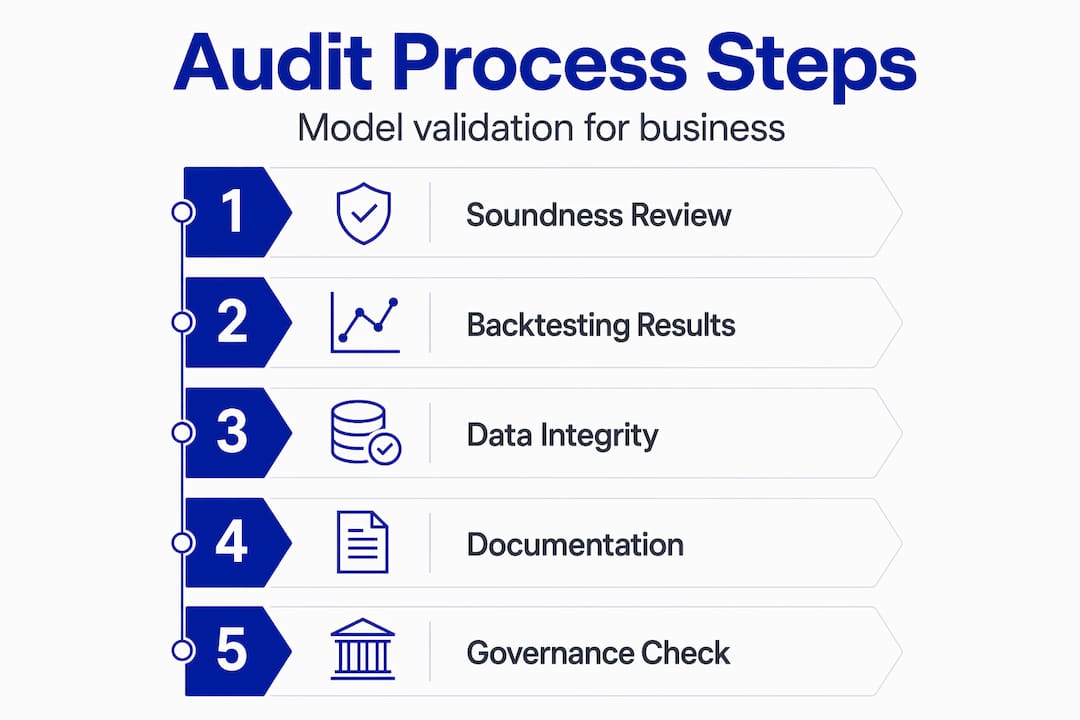
A model audit is not a single pass through a spreadsheet looking for typos. It involves several distinct activities, each targeting a different failure point.
- Validation checks whether underlying assumptions, formulas, and data inputs are accurate and internally consistent. This includes tracing each formula back to its source and confirming logic matches the business reality it is meant to represent.
- Backtesting compares what the model predicted to what actually happened. If your cash flow model projected $180,000 in Q3 and the actual figure was $140,000, the gap deserves explanation, not just a shrug.
- Sensitivity analysis tests how outputs change when key inputs shift. What happens to your runway if revenue drops 15%? What if supplier costs rise by 8%? This reveals which assumptions carry the most risk.
- Ongoing monitoring tracks whether model performance degrades over time. Markets change, customer behavior shifts, and a model that was accurate in 2023 may be structurally outdated in 2026.
- Risk tiering focuses audit effort where it matters most. A model driving a $2 million capital raise deserves more scrutiny than a simple monthly expense tracker.
Updated interagency guidance confirms that model validation should include conceptual soundness evaluation, backtesting, sensitivity analysis, and ongoing monitoring performed at least annually for high-risk models.
Pro Tip: Set a concrete threshold for triggering a model review. If a key metric like revenue forecast accuracy drops more than 10% from historical actuals, that is an automatic flag for revalidation. Waiting for the annual cycle is too slow when a model is actively driving decisions.
A periodic financial health check should incorporate these audit components, not treat them as separate activities. They belong together.
Having established audit components, we move to understanding common audit challenges and how to address them to ensure accuracy.
Common pitfalls in financial modeling and how auditing prevents costly mistakes
The most damaging errors in financial models are almost never obvious. They hide inside formulas that look right, inside assumptions that nobody questions because they have always been there.
Typical issues that audits uncover include:
- Overwritten formulas where someone manually typed a number into a formula cell, breaking the calculation chain
- Circular references that create phantom numbers by looping calculations back into themselves
- Unbalanced balance sheets where assets, liabilities, and equity do not reconcile correctly
- Hardcoded outputs where results are pasted as static values after being manually adjusted at some point
- Inconsistent time periods where monthly and annual figures are mixed in ways that distort comparisons
“Most spreadsheet model failures stem from poor handoffs and edits over time, not Excel flaws.” Auditing ensures formulas remain consistent and inputs stay controlled.
This is a critical point. The problem is not your software. It is the dozen small edits made by different people over 18 months, none of whom documented what they changed or why.
AI-driven models introduce a different category of risk. They can look polished and generate sophisticated outputs while harboring structural bias or training data that does not reflect your actual business context. The visual presentation of a well-formatted AI model output is not evidence of its accuracy.

Pro Tip: Before any board presentation or major financial decision, run a 25-point audit on the underlying spreadsheet. Check every formula on the first and last row of each data range, trace every external link, and confirm no cells in formula columns contain static values. This takes about 90 minutes and catches the errors that cost thousands.
For context on which model types carry the highest stakes, reviewing the essential financial models your business should be running helps you prioritize your audit effort.
With pitfalls clear, let’s discuss how to integrate audit insights into your SMB decision-making process.
Integrating financial model audits into SMB decision-making and governance
Audit findings only create value when they connect to actual decisions. A report filed and forgotten does not reduce risk. The goal is to build a governance structure where audit insights directly influence how your business uses its models.
Core practices that embed audits into governance include:
- Written model use policies that specify who can edit models, what approval is required before a model is used in a major decision, and how version control is managed
- Assigned validation roles held by someone independent from whoever built the model. This does not require hiring a new employee. It can be a part-time CFO, a financial advisor, or an external firm.
- Revalidation triggers beyond the annual cycle, including major business changes like entering a new market, acquiring a client segment, or replacing a key revenue stream
- Audit dashboards that track model risk ratings, validation status, and any open remediation items so nothing falls through the cracks
The following table outlines a practical governance structure for SMBs managing multiple financial models.
| Role | Responsibility | Key output |
|---|---|---|
| Model owner | Builds and maintains the model | Documented assumptions and change log |
| Independent validator | Reviews logic, tests assumptions | Validation report with findings |
| Finance lead or CFO | Interprets results, advises decisions | Risk-adjusted recommendations |
| Business owner or board | Approves model for use in key decisions | Formal sign-off or escalation |
Auditing AI financial models confirms models work as intended, strengthening internal controls, compliance, and protection against bias and reputational risks. That applies whether you are running a machine learning forecast or a standard Excel DCF model.
Building this kind of structure does not require a large finance team. It requires clear roles, documented policies, and regular checkpoints. Strong financial controls are not bureaucracy. They are what separates businesses that catch problems early from those that discover them at the worst possible moment.
Understanding integration leads naturally to recommendations and expert insights on optimizing financial model auditing.
A fresh perspective: why SMBs must rethink the role of model audits beyond compliance
Here is the uncomfortable reality most financial articles skip: the majority of SMBs treat model audits, when they do them at all, as a compliance formality. Something to check off before a bank meeting or an investor conversation. Then the audit is filed away and the model goes back to running exactly as it did before.
That framing misses the entire point.
Kavin Anburaj, a recognized expert in AI financial oversight, has noted that one corrupted data input can invalidate all outputs from an otherwise sound model, urging businesses to embed AI controls as a foundation of trust rather than a periodic review. The same principle holds for any financial model, AI-powered or not.
What we see at John Galt Finance is that business owners who go through a thorough model audit often make three to five significant changes to how they present their financials to lenders and investors. Not because the numbers were wrong on the surface, but because the audit exposed assumptions that were optimistic without basis, or dependencies between variables that nobody had mapped out explicitly.
That kind of clarity is not a compliance benefit. It is a competitive advantage.
Pro Tip: Stop scheduling model audits as one-time events tied to funding rounds or year-end. Build a quarterly review into your normal finance cadence. Even a 30-minute check against recent actuals will catch drift before it becomes distortion.
The businesses that grow sustainably on good financial decisions are not the ones with the most sophisticated models. They are the ones who trust their models because they have done the work to verify them. A well-audited model lets a CFO or owner walk into a board meeting and say “here is what we know, here is what we assumed, and here is our confidence level” without hedging every sentence.
That kind of confidence does not come from building a better spreadsheet. It comes from a custom financial modeling process that includes validation as a built-in step, not an afterthought.
Enhance your business decisions with expert financial model audits and CFO support
If you have reached this point and recognized gaps in how your current models are built, validated, or used, you are not alone. Most growing businesses outpace their financial infrastructure before they notice the strain.
John Galt Finance provides CFO-led financial analysis that connects audit findings directly to business strategy, so you are not just getting a list of errors. You are getting a roadmap for sharper decisions. Our financial health check service includes model validation, performance monitoring, and risk assessment built around your actual business, not a generic template. And if your models need rebuilding from the ground up, our custom financial modeling services are designed for businesses with 5 to 50 employees that need institutional-quality analysis without the cost of a full-time CFO.
Frequently asked questions
Why is auditing financial models important for small businesses?
Auditing helps small businesses identify and fix errors before those errors drive bad decisions, ensuring every strategic call is grounded in accurate data. Independent validation reduces model risk from incorrect outputs that can lead directly to financial loss.
How often should financial model audits be performed?
High-risk models should be validated at least annually, but ongoing monitoring between full audits is just as important. Annual validation for high-risk models is the minimum standard, not the ceiling.
What are common errors found in financial model audits?
The most frequent issues are overwritten formulas, unbalanced sheets, circular references, and manually hardcoded outputs. Most model failures trace back to poor handoffs and undocumented edits, not the original build.
Can AI-driven financial models be trusted without audits?
No. AI models can appear accurate while hiding structural bias or training data problems that only a thorough audit will surface. Auditing AI models confirms they work as intended and protects against reputational and compliance risks.
Who should conduct the financial model audit?
The validator must be independent from whoever built the model, with no stake in validating a particular outcome. Independence in validation is non-negotiable to prevent rubber-stamp approvals that leave real risks buried inside the model.
Recommended
- Essential types of financial models every business owner needs
- Unlock business growth with a custom financial modeling process
- Outsourced financial modeling: cut costs, gain expert insights
- Financial Planning for Business Owners: A Practical Guide | John Galt
FAQ
When should I audit my financial model?
Always before a transaction: fundraising, M&A, bank financing, major capex commitment. Also annually for any model used in board reporting. An undetected error in a model used for an acquisition can cost millions.
What does a model audit actually check?
Three layers: (1) mechanical integrity (formulas, links, balance sheet ties to cash flow), (2) logical integrity (revenue drivers make sense, assumptions are internally consistent), (3) presentation quality (clear inputs, scenarios, outputs). A good audit produces a written report with errors and fixes.
How do I avoid building errors into my own model?
Five disciplines: (1) one tab for inputs, never hardcode in calc tabs, (2) consistent color coding (blue inputs, black formulas), (3) every row sums correctly to a check cell, (4) balance sheet check (assets = liabilities + equity), (5) version control with date in filename.
Can I audit my own model?
You can do a basic self-review (re-trace formulas, check totals), but you can’t audit your own logic; you’ll miss the same assumption errors that created the issue. For high-stakes models, always get a fresh set of eyes – ideally a senior FP&A professional or fractional CFO.
How much does a bad model cost?
Documented cases: JP Morgan London Whale ($6B partly traced to Excel errors), TransAlta ($24M loss from a cut-and-paste error), Eastman Chemical ($25M lawsuit settlement). For SMBs, the typical cost is a deal that breaks at diligence or a board decision based on overstated cash flow. See our business valuation guide for context on model use in transactions.