

Cash Flow Improvement Benchmarks
| Metric | Benchmark |
|---|---|
| Median DSO (B2B SMB, US) | 40-50 days |
| Best-in-class DSO | 25-35 days |
| Median DPO | 30-45 days |
| Cash freed per 10-day CCC improvement (at $5M revenue) | ~$137,000 |
| SMBs that fail due to cash flow problems | 82% (US Bank study) |
| Early payment discount (typical) | 2/10 net 30 (2% off if paid in 10 days) |
| Effective annual rate of declining 2/10 net 30 | ~36% |
| SMBs with a written cash policy | ~25% |
Your revenue is growing, your sales team is crushing targets, and your product is flying off the shelf. Then your bank account runs dry. This scenario is more common than most owners want to admit, and it happens because revenue and cash flow are not the same thing. A profitable business can still fail when cash is tied up in unpaid invoices, slow-moving inventory, or poorly timed expenses. This article walks you through CFO-level strategies, from understanding your core metrics to using modern forecasting tools, so you can diagnose what’s draining your cash and take deliberate steps to fix it.
Table of Contents
- Understand your cash flow fundamentals
- Identify and address cash flow obstacles
- Strategic actions to boost cash flow
- Forecasting, technology, and verification
- Rethinking cash flow: What most owners overlook
- Accelerate your cash flow: Find tailored solutions
- Frequently asked questions
Key Takeaways
| Point | Details |
|---|---|
| Monitor key metrics | Tracking DSO, CCC, and Current Ratio monthly helps you spot cash flow trouble early. |
| Address bottlenecks | Identify and resolve obstacles like slow receivables and customer concentration to improve cash flow. |
| Build cash reserves | Maintain 3-6 months of operating expenses to ensure you can weather downturns and growth periods. |
| Leverage technology | Use forecasting tools and automation for regular monitoring and faster response. |
| Think proactively | Strategic habits—planning, reserve building, and scenario analysis—are crucial for sustainable cash flow. |
Understand your cash flow fundamentals
Before you can fix a cash flow problem, you need to know what you’re measuring. Cash flow is simply the movement of money in and out of your business over a given period. Positive cash flow means more is coming in than going out. Negative cash flow means the opposite, and it can cripple operations even when your income statement looks healthy.
Here are the key metrics every business owner should track:
- Cash flow from operations (CFO): Cash generated by your core business activities, excluding financing and investments.
- Accounts Receivable (AR): Money your customers owe you. High AR means cash is sitting outside your business.
- Accounts Payable (AP): Money you owe suppliers. Strategically managing AP helps you hold cash longer.
- Days Sales Outstanding (DSO): How many days, on average, it takes to collect payment after a sale.
- Cash Conversion Cycle (CCC): The total time from spending cash on operations to collecting it back from customers.
- Current Ratio: Current assets divided by current liabilities. Indicates short-term financial health.
The table below shows target ranges for each metric:
| Metric | Target Range | What It Signals |
|---|---|---|
| DSO | Under payment terms (e.g., under 35 for Net 30) | Speed of collections |
| CCC | 30 to 45 days for service businesses | Operational efficiency |
| Current Ratio | 1.5 to 2.0 | Liquidity health |
| Cash Reserve | 3 to 6 months of operating expenses | Business resilience |
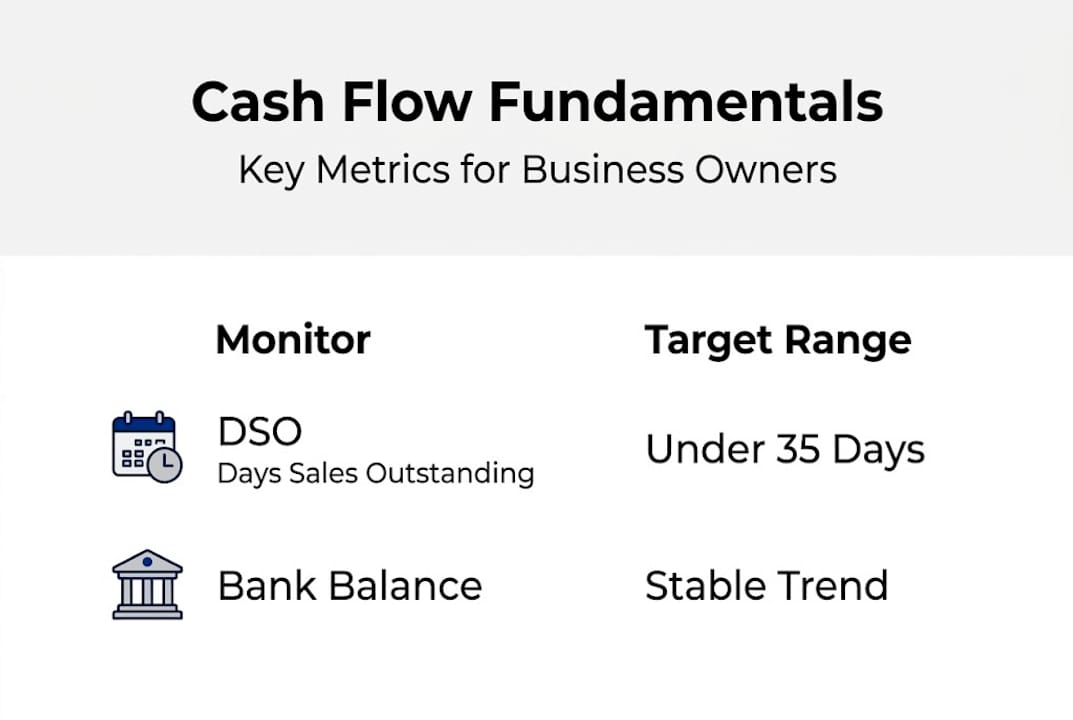
According to cash flow benchmarks, DSO under 35 days for Net 30 terms, a CCC between 30 and 45 days for service companies, and a Current Ratio between 1.5 and 2.0 are the targets you should be hitting. If your numbers fall short, something in your operations is leaking cash.

Common pitfalls that skew these numbers include offering loose payment terms without follow-up, letting invoices age past 60 days, keeping too little reserve, and mixing personal and business expenses. Start tracking business KPIs monthly to catch early warning signs before they become emergencies.
Pro Tip: Schedule a monthly 30-minute cash flow review. Look at your AR aging report, your bank balance trend, and your upcoming AP obligations. This one habit can prevent most cash emergencies.
If you want to see how a real company went from stress to stability, this predictable cash flow case study shows exactly how the process works in practice.
Identify and address cash flow obstacles
With metrics in place, the next step is spotting and solving obstacles that drain cash. Most small and mid-size businesses face the same recurring culprits, even if the symptoms look different across industries.
The most common obstacles include:
- Slow receivables: Customers paying late stretches your DSO and creates gaps between your obligations and income.
- High fixed overhead: Rent, payroll, and subscriptions that don’t flex with revenue can crush cash during slow periods.
- Seasonality: Predictable slow seasons become crises when you haven’t built reserves ahead of time.
- Customer concentration: Relying heavily on one or two clients creates dangerous exposure. If one delays payment or leaves, your cash flow collapses.
Service businesses and manufacturers face different versions of these problems. This comparison illustrates the difference:
| Factor | Service businesses | Manufacturing businesses |
|---|---|---|
| Primary cash risk | Slow AR collections | Inventory carrying costs |
| Overhead flexibility | Higher (less physical assets) | Lower (equipment, materials) |
| Seasonality exposure | Moderate | High |
| Cash cycle | Shorter | Longer |
Research into cash flow risk patterns confirms that seasonal industries must build peak reserves and credit lines well in advance, service firms generally manage cash cycles more efficiently than manufacturers, and over-leverage combined with customer concentration are leading causes of business failure.
Practical remedies for these obstacles:
- Renegotiate payment terms with suppliers to delay outflows.
- Require deposits or milestone payments on large service contracts.
- Diversify your client base to reduce dependency on any single customer.
- Automate invoice reminders to reduce late payments without awkward follow-up calls.
- Explore bridge financing options to cover gaps during slow seasons rather than waiting until you’re out of options.
For a deeper look at balancing inflows and outflows, the working capital management strategies guide walks through the practical steps. You can also review how to approach mitigating financial risks before they escalate.
Pro Tip: Set a cash reserve target before your busy season ends. Aim to have at least two months of operating expenses tucked away before your slow season starts.
Strategic actions to boost cash flow
Once obstacles are managed, put strategic actions in place for sustainable cash flow improvement. This is where you move from reactive firefighting to deliberate financial management.
Here are the steps to take in order:
- Tighten your AR process. Send invoices immediately after delivery. Set automated reminders at 7, 14, and 30 days past due. Consider small early-payment discounts (like 2% for payment within 10 days) to accelerate collections.
- Extend AP strategically. Pay on the last acceptable day, not the first. This keeps cash working for you longer without damaging supplier relationships.
- Automate invoicing and payment collection. Tools that auto-charge stored payment methods eliminate delays caused by manual follow-up.
- Restructure expensive debt. High-interest short-term loans drain cash fast. Refinancing into longer-term, lower-rate facilities reduces monthly obligations and frees up operating cash.
- Adjust your sales approach. Not every sale improves cash flow. Chasing low-margin, slow-paying clients can actually hurt your position.
- Run monthly scenario plans. Model best-case, base-case, and worst-case cash flows using your cash flow forecasting essentials to prepare decisions in advance.
“Sell selectively, build 3 to 6 months of reserves, and use lines of credit before a crisis, not during one.”
That quote captures the growth paradox many owners miss: chasing top-line revenue without managing cash timing creates the illusion of success while quietly building fragility. Knowing the right time for withdrawals is equally important as growing revenue.
Pro Tip: Apply for a revolving line of credit when your business is performing well. Banks approve credit based on health, not need. Waiting until you’re in a crunch often means you can’t qualify.
Forecasting, technology, and verification
To ensure lasting improvement, the right tools and verification practices make cash flow maintainable. Forecasting is not about predicting the future perfectly. It’s about reducing surprises and creating a decision-making framework you can act on.
Key benefits of cash flow forecasting include:
- Early warning of shortfalls: A 13-week rolling forecast shows you exactly when cash will run low, giving you time to act.
- Smarter timing decisions: You can schedule large purchases, hiring, or debt payments around your strongest cash periods.
- Investor and lender confidence: Accurate, forward-looking cash flow models signal that you run a managed, professional operation.
- Scenario flexibility: Model the impact of losing a major client or winning a large contract before it happens.
Here’s how leading forecasting tools compare:
| Tool | Best for | Key features |
|---|---|---|
| Float | Small service businesses | Bank feed sync, scenario modeling |
| Fathom | Growing SMBs | KPI dashboards, multi-currency |
| Pulse | Freelancers and small teams | Simple visual cash flow tracking |
| Excel/Google Sheets | Custom models | Fully flexible, no subscription cost |
The role of AI and automation in forecasting is growing fast. Strategic businesses are moving from reactive working capital loans to proactive term financing, and using AI tools to flag AR collection issues before they age. Reactive financing (borrowing when you’re already in trouble) tends to cost more and solve less.
Verification steps to keep your data honest:
- Reconcile your bank statements to your cash flow forecast weekly.
- Compare actual cash flows to projections monthly and note variances.
- Review your AR aging report and follow up on anything over 30 days.
- Track your key financial numbers consistently, not just when something feels wrong.
Pro Tip: Set automated alerts in your accounting software for when your cash balance drops below a defined threshold. This gives you a built-in early warning system without manual checking.
Rethinking cash flow: What most owners overlook
Here’s the uncomfortable reality: most business owners treat cash flow as a financial problem when it’s really a planning problem. The mechanics of AR and AP are simple. The discipline to act before a crisis is where most people fall short.
We see this pattern constantly at John Galt Finance. An owner focuses entirely on sales growth, assuming more revenue automatically means more cash. But growth consumes cash. Hiring, fulfillment, inventory, and delayed collections all accelerate during growth phases, often faster than payments arrive. This is why some of the most dangerous moments for a business happen right after a big win.
The owners who manage cash best share one trait: they plan for the downside while the business is doing well. They build reserves during strong quarters, run scenario plans quarterly, and review KPIs monthly rather than waiting for their accountant’s annual report. If you’re not sure whether your business needs this level of strategic support, reviewing when you need a CFO can clarify the decision quickly.
Reactive solutions, like borrowing during a crunch, are expensive and rarely fix the root cause. Strategic habits are what separate businesses that scale from those that stall.
Accelerate your cash flow: Find tailored solutions
Understanding cash flow strategy is one thing. Applying it to your specific business, industry, and growth stage is another.
John Galt Finance works with small and mid-size businesses to build real cash flow systems, not generic advice. Our cash flow forecasting guide gives you a practical framework to start forecasting today. If you want a broader financial strategy, the financial planning guide covers how to align cash management with long-term growth goals. And if you want to see what’s possible, this client case study shows how one business went from unpredictable cash to full financial control in 30 days. The right support makes the difference between managing a crisis and preventing one.
Frequently asked questions
What is the first step to improving cash flow?
Start by pulling your cash flow statement and checking your DSO against your terms. This single metric often reveals exactly where cash is getting stuck.
How much cash reserve should a business keep?
Most financial experts recommend 3 to 6 months of operating expenses as a reserve. Start building toward this target during strong revenue periods.
What tools can help with cash flow forecasting?
Software like Float, Fathom, and Pulse offer scenario planning and alerts. AI-powered forecasting tools are increasingly available for small businesses and reduce the manual work involved in tracking.
Should I prioritize paying debt or building reserves?
Balance both strategically. Pay down high-interest debt aggressively while routing a fixed percentage of revenue into reserves each month.
How can I avoid customer concentration issues?
Diversify your client base intentionally. Avoiding over-concentration means no single client should represent more than 20 to 25 percent of your total revenue.
Recommended
- Cash Flow Forecasting: How to Never Run Out of Money | John Galt
- Why Is My Business Profitable But Broke? The Cash Flow Trap
- Financial management for SME profitability: 5 key steps
- 7 Signs Your Business Needs a CFO | John Galt Finance
- Small Business Credit Checklist For Better Financing
FAQ
What’s the fastest way to improve cash flow?
Tighten receivables. Most SMBs find 30-60 days of cash by sending invoices same-day, requiring deposits on new work, automating dunning at days 7/14/21, and offering 2% early-pay discounts. See our AR management guide.
How do I balance paying suppliers and conserving cash?
Negotiate net-45 or net-60 terms with key suppliers, then pay on day 45/60. Never pay early unless you take an early-pay discount worth more than your cost of capital. The discount of 2/10 net 30 equals an annualized 36%; almost always worth taking.
Should I take a line of credit to manage cash flow?
Yes, before you need it. A revolving line of credit (LOC) of 10-20% of annual revenue is standard for SMBs. Apply when you’re profitable, not when you’re stressed; banks tighten just when you need them most. See our SMB funding options guide.
How do I forecast cash flow accurately?
Build a 13-week direct cash forecast: list every expected receipt and disbursement by week. Update weekly with actuals. Target +/- 10% accuracy by week 4. See our 13-week cash forecasting guide for the template.
When should I cut expenses to improve cash?
Only after exhausting AR tightening and AP extension. Cutting expenses takes 60-90 days to show in cash; receivables can move in 2 weeks. When you do cut, focus on discretionary opex first (marketing tests, software subscriptions, T&E), not headcount.