

Ongoing CFO Support Benchmarks
| Metric | Benchmark |
|---|---|
| Typical ongoing CFO retainer (SMB) | $3,000-$10,000/month |
| Hours per week of CFO time | 5-20 hours |
| Average engagement length | 18-36 months |
| Renewal rate (well-run engagements) | >85% year 2 |
| Time to value (first measurable wins) | 60-90 days |
| Standard deliverables cadence | Weekly cash, monthly P&L review, quarterly board pack |
| Revenue range fit for ongoing fractional CFO | $1M-$50M |
| Average EBITDA improvement (12 months) | +2-4 percentage points |
Most small business owners assume that a Chief Financial Officer belongs in the boardroom of a Fortune 500 company. That assumption is expensive. The reality is that ongoing CFO support, delivered fractionally or remotely, is now one of the most accessible and high-impact tools available to businesses with 10 employees or 10 million in revenue. This guide breaks down exactly what ongoing CFO support means, what it covers, how it differs from hiring an accountant or bookkeeper, and how you can put it to work in your own business right now.
Table of Contents
- What is ongoing CFO support?
- Core responsibilities: What ongoing CFOs do
- Benefits of ongoing CFO support for business owners
- Ongoing CFO support vs. other finance solutions
- How to make ongoing CFO support work for your business
- The overlooked advantage: Why ongoing CFO support is worth it
- See how ongoing CFO support can elevate your business
- Frequently asked questions
Key Takeaways
| Point | Details |
|---|---|
| Expert guidance | Ongoing CFO support offers expert advice to guide key financial decisions and drive business growth. |
| Stress-free cash flow | Regular oversight helps prevent cash shortages and provides clear insights into financial health. |
| Strategic partnership | CFO support offers much more than bookkeeping—it’s a long-term partnership for smarter business decisions. |
| Customized solutions | Services are tailored to each company’s goals, industry, and evolving financial needs. |
What is ongoing CFO support?
Ongoing CFO support delivers consistent, high-level financial expertise to your business through a part-time, fractional, or remote arrangement. Instead of hiring a full-time executive at a six-figure salary, you get access to senior-level financial thinking on a recurring basis, structured around your actual needs and budget. The goal is continuous guidance, not a one-time report or annual tax prep.
Think of it this way. A full-time CFO sits inside your business every day. An accountant shows up at year-end. An ongoing CFO sits alongside your business consistently throughout the year, keeping strategy moving forward. That consistency is what separates this model from everything else.
Understanding why your business needs CFO support starts with recognizing what these professionals actually handle on an ongoing basis:
- Cash flow management: Monitoring inflows and outflows, identifying gaps before they hurt operations, and building short-term forecasts.
- Financial strategy: Setting the financial direction for the next quarter, year, or three years based on real data.
- Scenario planning: Running financial models that show you what happens if revenue drops 20%, if you hire five people, or if you raise prices.
- Stakeholder reporting: Preparing clear financial summaries for investors, lenders, or your leadership team.
- KPI oversight: Defining the numbers that actually matter to your business and tracking them regularly.
“Ongoing CFO services contribute to company expansion and profitability, giving SMEs access to strategic financial leadership they would otherwise go without.”
This is quite different from interim or project-based CFO work, where an expert parachutes in to solve a specific crisis, then leaves. It is also different from outsourced accounting, which focuses on transaction recording and compliance rather than strategy. Knowing the signs you need a CFO is often the first step toward choosing the right model for your stage of growth. With ongoing CFO support, the relationship compounds over time. The longer your CFO works with your business, the more context they bring to every decision.
Core responsibilities: What ongoing CFOs do
Now that you know what ongoing CFO support means, let us get into the specific services these professionals provide month after month.
Ongoing CFO support, at its core, links your financial data to your business decisions. That sounds simple. In practice, most business owners are missing this link entirely, and it costs them in ways they do not always see clearly.

CFO-led financial analysis provides guidance on financial metrics and long-term planning that goes well beyond what a bookkeeper or accountant can offer. Here is what a typical ongoing CFO manages:
| CFO task | Business goal |
|---|---|
| Cash flow analysis | Prevent shortfalls and plan for growth |
| Budget creation and review | Align spending with priorities |
| Scenario modeling | Prepare for risk and opportunity |
| KPI tracking and reporting | Make data-driven decisions |
| Investor and lender prep | Access capital when needed |
| Profitability review | Identify where money is made or lost |
The bookkeeper vs CFO responsibilities comparison makes it clear: bookkeepers record what happened, while CFOs interpret what it means and shape what happens next.
A typical monthly workflow for an ongoing CFO might look like this:
- Review prior month’s financial statements and compare to budget.
- Update the rolling cash flow forecast for the next 90 days.
- Flag any variance in revenue, cost of goods sold, or operating expenses.
- Analyze KPI trends and prepare a management summary.
- Meet with the business owner to discuss findings and adjust priorities.
- Update financial models to reflect any strategic changes.
- Prepare investor or board updates if applicable.
Pro Tip: Set a recurring weekly or bi-weekly check-in with your CFO, even a short 30-minute call. This keeps financial insights from piling up and turning into surprises. The businesses that get the most from ongoing CFO support are the ones that treat it like a management meeting, not a reporting exercise.
Benefits of ongoing CFO support for business owners
Understanding the tasks handled by an ongoing CFO sets the stage to explore the tangible benefits for business owners.
The most immediate benefit most owners report is clarity. When someone with CFO-level expertise reviews your numbers regularly and translates them into plain language, you stop guessing about the health of your business. You know where you stand, where the risks are, and what the next move should be.
Beyond clarity, ongoing CFO support delivers something harder to quantify but just as valuable: proactivity. Rather than reacting to a cash crisis after it hits, your CFO spots the warning signs weeks or months ahead and puts a plan in motion. That shift from reactive to proactive is where most of the real financial value is generated.
A striking data point puts this in perspective. 60% of SMBs struggle with cash flow management, which is one of the top causes of business failure. Ongoing CFO support directly addresses this by creating structured cash flow oversight that small businesses rarely build on their own.
Here are the benefits business owners most commonly notice within the first three to six months of ongoing CFO engagement:
- Faster, more confident decisions because you have data, not instinct, backing your choices.
- Fewer cash flow surprises thanks to rolling forecasts updated monthly or more often.
- A clearer picture of profitability by product, service, or customer segment.
- Stronger financial positioning when approaching lenders, investors, or strategic partners.
- Reduced owner anxiety because someone qualified is watching the numbers every single week.
- Better budget discipline because there is now a real process around spending approvals and variance review.
Tracking key SMB financial metrics consistently is something most growing businesses attempt on their own and struggle to maintain. An ongoing CFO builds the habit and the system, so you are never flying blind when a major decision lands on your desk.
Growth readiness is another underrated benefit. Whether you are planning to expand to a second location, raise outside investment, or navigate an uncertain market, an ongoing CFO makes sure your financial story is ready to be told clearly and credibly. That readiness has a direct dollar value when it matters most.
Ongoing CFO support vs. other finance solutions
You might be wondering how ongoing CFO support compares to other finance roles or one-off consulting models. Here is a straightforward breakdown.
| Finance solution | Engagement level | Primary focus | Strategic value |
|---|---|---|---|
| Bookkeeper | Ongoing, transactional | Recording transactions | Low |
| Accountant | Periodic, compliance | Tax and reporting | Low to medium |
| Interim or project CFO | Short-term, event-driven | Crisis or transaction | Medium |
| Ongoing CFO | Continuous, strategic | Growth and profitability | High |
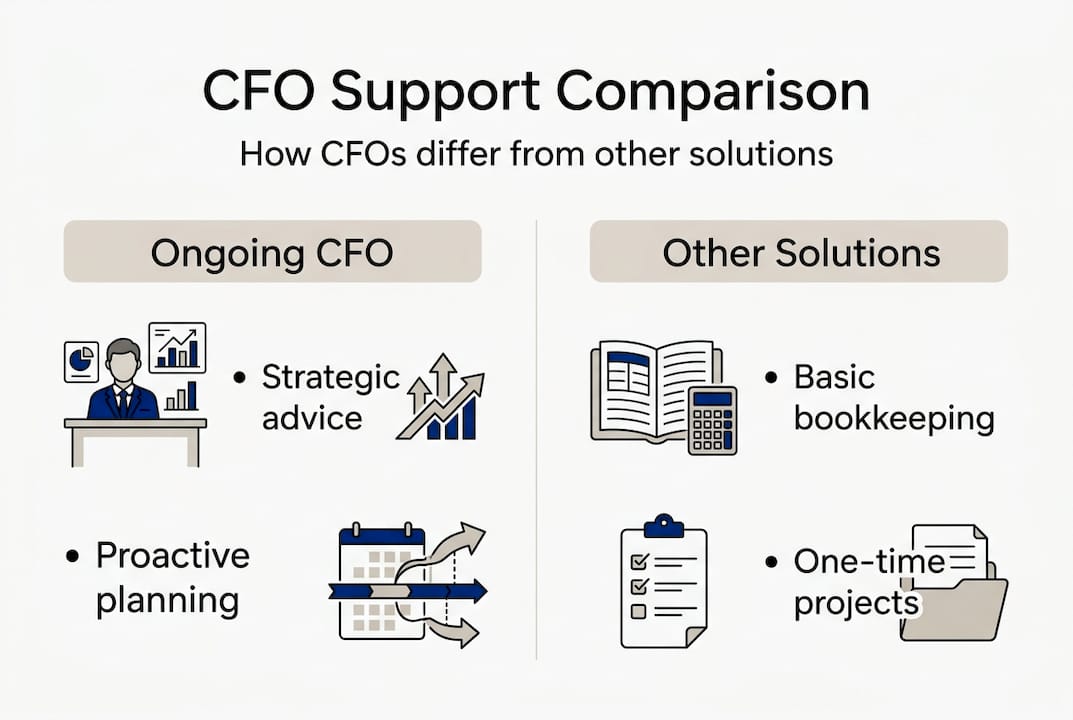
The contrast becomes especially clear when you look at what finance director vs chief accountant roles cover compared to ongoing CFO involvement. A chief accountant keeps the books correct. A finance director, like an ongoing CFO, builds the financial foundation your business grows on.
Knowing when to choose ongoing CFO support over other models is important:
- You are generating consistent revenue but have no clear view of where profit actually comes from.
- Your business is growing fast enough to make financial decisions regularly and frequently.
- You are preparing for a funding round, acquisition, or major capital expenditure.
- You feel like you are making decisions based on gut rather than financial data.
- You have a bookkeeper or accountant already, but nobody is connecting the numbers to strategy.
The pitfall of limited-scope solutions is that they solve the immediate problem but leave the underlying gap open. A one-off CFO engagement can fix a cash flow crisis. It cannot build the ongoing financial intelligence that prevents the next one. Similarly, understanding bookkeeper vs CFO differences helps clarify that compliance and strategy are two entirely different needs, and businesses past a certain stage need both covered at once.
Ongoing CFO support is best understood as a business partnership. It is not a service you buy and park on a shelf. It grows with your business, adjusts as your priorities shift, and compounds in value the longer the relationship continues.
How to make ongoing CFO support work for your business
Knowing the unique value of ongoing CFO support, apply these steps to maximize results for your own business.
Getting value from ongoing CFO support does not happen automatically. It requires some preparation and intentional habits on your end. Here is how to set yourself up for real results:
- Clarify your financial goals before the first meeting. Are you trying to raise capital, stop the cash flow bleed, or improve margins? A clear goal gives your CFO immediate direction.
- Organize your existing financial data. Make sure your profit and loss statements, balance sheet, and bank records are up to date and accessible before engagement begins.
- Define your KPIs together. Work with your CFO to identify the three to five metrics that best reflect the health and progress of your specific business.
- Establish a regular meeting cadence. Monthly at minimum, bi-weekly if you are in a growth phase. Consistency drives accountability.
- Track action items between meetings. Every CFO meeting should produce specific next steps. Follow through on them.
- Review ROI quarterly. Ask your CFO to show you how financial decisions have moved the needle since you started working together.
Monitoring essential business KPIs consistently is one of the clearest ways to measure whether your CFO engagement is delivering. If the numbers are moving in the right direction and you understand why, the model is working.
Connecting those KPIs to a daily financial dashboard gives you real-time visibility between formal CFO meetings, so you are not waiting a month to spot a trend.
Pro Tip: When selecting a remote or virtual CFO, prioritize someone with direct experience in your industry. A CFO who has worked with manufacturers understands inventory dynamics. One who has worked in professional services understands utilization rates. Generic financial advice gets diluted. Industry familiarity makes every insight sharper and every recommendation more practical.
Red flags to avoid in virtual CFO arrangements include vague deliverables with no measurable outcomes, infrequent communication or slow response times, over-reliance on templated reports that do not reflect your specific business model, and any provider who focuses only on the past without building forward-looking forecasts.
The overlooked advantage: Why ongoing CFO support is worth it
Wrapping up the actionable steps, it is worth sharing a different take based on what most owners overlook.
Most businesses wait until something breaks before they bring in financial expertise. A cash crisis hits, a loan gets denied, a major client walks. Then they scramble to get a CFO involved. The problem is that by then, the options are narrower and the cost of recovery is higher.
Here is what we have seen repeatedly: the businesses that benefit most from ongoing CFO support are not the ones in crisis. They are the ones that started the engagement earlier than they thought they needed to, and built compounding financial momentum over time. Each month of CFO involvement adds another layer of insight, another refined process, another decision made with real data. That compound effect over 12 to 18 months creates a business that is dramatically more resilient and more valuable than one getting sporadic advice.
Consider a hypothetical scenario. Two businesses start the year at similar revenue levels. One brings in a CFO only when they need to apply for a loan. The other has had ongoing CFO support for eight months. When both businesses hit a slow quarter, the second one already has a forecast in place, a contingency plan, and a lender relationship that was built before the pressure started. The outcome is rarely close.
Recognizing signs your business needs a CFO for growth earlier rather than later is the mindset shift that separates businesses that scale strategically from those that manage by firefighting. Ongoing support is not an expense. It is the mechanism that turns financial information into better business outcomes, month after month.
See how ongoing CFO support can elevate your business
If you are ready to see the difference ongoing CFO support can make, here is where to take the next step.
At John Galt Finance, we work directly with small and medium-sized businesses to provide the kind of financial leadership that moves the needle. Whether you need a clearer path through business financial planning, a dedicated approach to financial management for profitability, or access to CFO-led financial analysis built around your industry and goals, we have a model that fits your stage of growth.
We start with a diagnostic review of your current financial position, then build an ongoing engagement that delivers real, measurable results. No generic templates. No one-size-fits-all advice. Just strategic financial partnership built around what your business actually needs to grow.
Frequently asked questions
How is ongoing CFO support different from a part-time accountant?
Ongoing CFO support delivers high-level financial strategy and leadership, not just transaction processing or compliance work. A part-time accountant records and reports; an ongoing CFO interprets and directs your financial decisions.
Can ongoing CFO support be provided remotely?
Yes, most ongoing CFO support services for SMBs are delivered virtually, using cloud-based accounting tools, video calls, and shared dashboards for real-time reporting and communication.
What are the first signs a business needs ongoing CFO support?
Trouble forecasting cash flow, unclear or confusing financial reports, and missed growth opportunities are the most common signals. These are exactly the areas where ongoing CFO services drive the fastest improvement.
Which financial metrics should ongoing CFO support help track?
Ongoing CFO support should help you track revenue growth, gross and net profit margins, cash flow, burn rate, and other essential financial metrics that directly reflect your business’s financial health.
How soon should I expect to see results from ongoing CFO involvement?
Most business owners begin to notice meaningful improvements in cash flow visibility and decision-making confidence within three to six months of consistent CFO engagement.
Recommended
- Why SMEs Need CFO Services: Unlock Growth and Clarity
- CFO-Led Financial Analysis: Smarter SME Decisions
- 7 Signs Your Business Needs a CFO | John Galt Finance
- 8 Key Signs Your Business Needs a CFO for Growth
FAQ
Why pay for ongoing CFO support instead of project work?
Strategic finance compounds. Ad-hoc projects fix a moment; ongoing support institutionalizes weekly cash discipline, monthly variance review, and quarterly strategy refresh. The cost differential is usually 30-50% more, but the EBITDA impact is 5-10x over 18 months.
What does ongoing CFO support actually include?
Typically: weekly cash forecast updates, monthly P&L review with variance commentary, quarterly board package, ad-hoc strategic projects (pricing, capital raises, M&A diligence), and CEO advisory time. Scope should be documented in the engagement letter.
How is ongoing CFO support priced?
Three models: fixed monthly retainer (most common, $3k-$10k), tiered (basic/growth/scale packages), or hours-based ($200-$500/hr). Retainer is best for stable engagements; hours work for unpredictable scope. Avoid hours-only billing past month 3; it discourages efficient work.
What’s the off-ramp if the engagement isn’t working?
Standard contracts include 30-60 day termination clauses. Good firms support a knowledge transfer to a successor (in-house controller, new firm) at no extra cost. Watch for engagement letters that lock you in for 12+ months with no exit; that’s a red flag.
When do I outgrow ongoing fractional CFO support?
Around $25M-$50M revenue, or when you raise an institutional round of $10M+. At that point, you need a full-time CFO who can hire a team and own board-level investor relations. Most fractional CFOs will help you recruit your replacement. See our signs you need a CFO framework.