

Financial Position Analysis Benchmarks
| Metric | Benchmark |
|---|---|
| Current ratio (healthy SMB) | 1.5-3.0 |
| Quick ratio (healthy) | >1.0 |
| Debt-to-equity ratio (healthy) | <2.0 |
| Working capital target (% of revenue) | 15-25% |
| Return on assets (top quartile SMB) | >10% |
| Return on equity (top quartile) | >15% |
| Interest coverage ratio (healthy) | >3.0 |
| Equity multiplier (healthy) | <3.0 |
Cash flow management is the single biggest challenge for 60% of SMBs, and poor financial management remains the top reason small and medium-sized businesses fail. Yet most owners only look at their numbers when something goes wrong. That reactive approach is exactly what keeps good businesses stuck or, worse, sends them under. This guide breaks down what financial position actually means, why analyzing it regularly is one of the highest-leverage habits you can build, and how to put practical tools to work so your business can grow from a place of clarity, not guesswork.
Table of Contents
- What is your financial position, really?
- Why analyzing financial position matters for your business
- Risks of neglecting financial position analysis
- How to analyze your financial position: Practical tools and steps
- The uncomfortable truth most business owners miss about financial analysis
- Next step: Unlock business clarity with expert financial guidance
- Frequently asked questions
Key Takeaways
| Point | Details |
|---|---|
| Early warning system | Analyzing financial position catches problems before they become crises. |
| Better strategic decisions | Clear financial insights enable smarter investments, hiring, and pricing. |
| Improved funding odds | Strong analysis and ratios build lender and investor confidence. |
| Practical tools available | SMBs can use Excel, QuickBooks, or fractional CFOs for effective financial reviews. |
What is your financial position, really?
Now that you know how high the stakes are, let’s clarify what “financial position” actually means for your business.
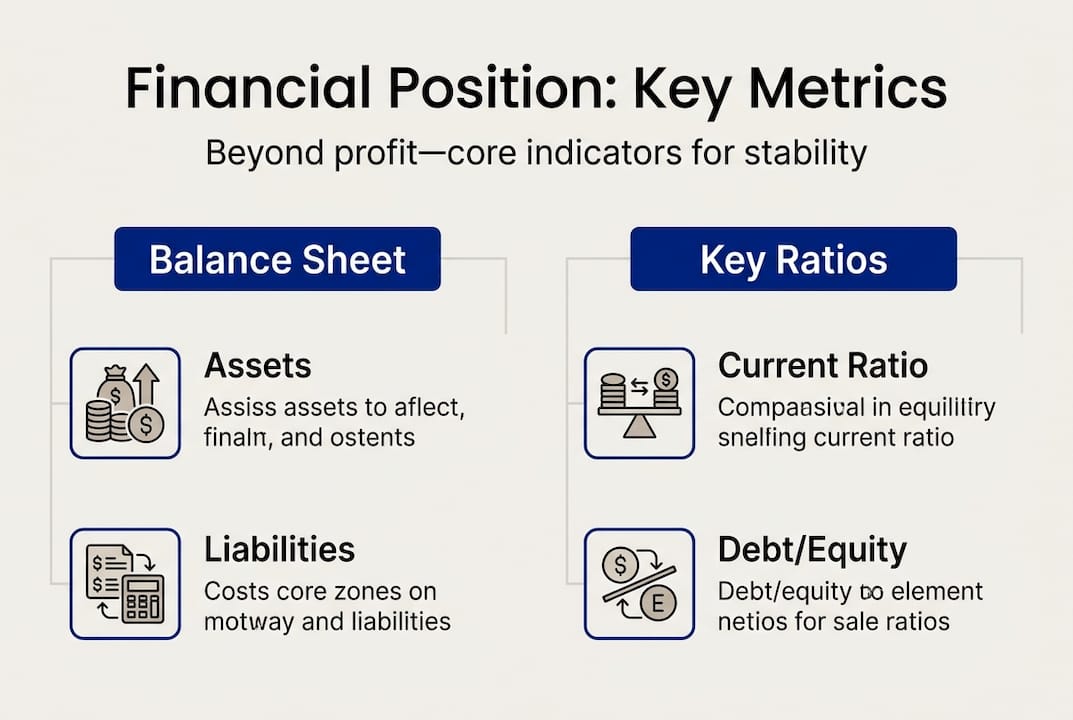
Most owners think of their finances in terms of profit. Did we make money this month? That’s a useful question, but it only tells part of the story. Your financial position is a full snapshot of everything your business owns, owes, and has built up over time. It’s captured in your balance sheet and reflects three core components:
- Assets: Everything your business owns or is owed. Cash, receivables, inventory, equipment, and property.
- Liabilities: Everything your business owes. Loans, accounts payable, tax obligations, and accrued expenses.
- Equity: The residual value left for owners after liabilities are subtracted from assets. Think of it as your financial stake in the business.
Here’s where a common misconception trips people up. A business can show strong profits while sitting on a dangerously weak financial position. How? Imagine you’re generating revenue but most of it is tied up in unpaid invoices or slow-moving inventory. Your income statement looks fine. Your balance sheet tells a different story.
The metrics that reveal your true financial position go beyond profit. Working capital (current assets minus current liabilities) shows whether you can cover short-term obligations. Your debt-to-equity ratio signals how much of the business is financed by creditors versus owners. And your asset base determines your capacity to weather downturns or fund growth.
Another myth worth busting: being cash-rich in the short term does not mean you’re financially healthy long-term. A business sitting on cash but carrying growing liabilities and stagnant assets is quietly moving toward a cliff. Regular financial analysis surfaces exactly these warning signs, like when liabilities are outpacing asset growth, before they become a crisis.
For owners focused on improving SME profitability, understanding your financial position is the foundation everything else builds on. Profit matters, but stability is what lets you actually use that profit to grow.
Why analyzing financial position matters for your business
Once you understand what financial position truly reflects, here’s why thoughtful analysis is a non-negotiable for any growth-minded owner.
Think of your financial position as the vital signs of your business. Doctors don’t wait for patients to collapse before taking readings. They track trends over time, spot anomalies early, and intervene before small problems become serious ones. The same logic applies here.
“Financial analysis enables informed decision-making across pricing, investment, and hiring, and helps build the kind of lender confidence that comes from transparent, strong financial ratios.” — SumUp Financial Analysis Guide
Here’s what regular analysis actually unlocks for your business:
- Early problem detection. You see liquidity gaps and debt buildups weeks or months before they threaten operations.
- Smarter pricing decisions. Knowing your real cost structure means you price to sustain margins, not just to win work.
- Confident hiring and investment. You know whether you can actually afford to expand, rather than finding out the hard way.
- Lender and investor trust. Clean records and strong ratios make funding conversations far easier and more favorable.
- Strategic planning traction. You can set realistic goals when you know where you’re starting from.
The OECD’s 2025 SME financing data confirms that poor financial management is the primary reason SMEs fail. That’s not just an academic observation. It’s a pattern repeated across industries and geographies, and it’s almost always preventable.
Pro Tip: Set a fixed date each month to review your balance sheet alongside your income statement. Treating it like a standing appointment, rather than a task you get to when things are slow, is what separates businesses that catch problems early from those that don’t.
For a deeper look at how expert support changes the game, explore the benefits of SME CFO services and what they make possible in practice.
Risks of neglecting financial position analysis
Knowing the upside of analysis is powerful, but understanding the risks of neglect can be a wake-up call.
Skipping regular financial position reviews isn’t a neutral decision. It’s a slow-building risk. Here’s what typically happens when owners fly blind:
- Solvency surprises: A business can appear operational for months while quietly becoming insolvent. By the time the warning signs are obvious, options are limited.
- Missed financing windows: Lenders look at your ratios. If your debt-to-equity is out of balance or your working capital is thin, you won’t qualify for the credit you need, precisely when you need it most.
- Reactive debt spirals: Without visibility, owners often resort to expensive short-term borrowing to patch cash flow gaps, compounding the problem.
- Legal exposure: Tax obligations, covenant breaches, and overdue payables can escalate quickly when there’s no one watching the numbers closely.
- Denied credit lines: A scenario we see often involves a business where asset growth quietly lags behind liability growth for 12 to 18 months. Nobody noticed. Then the bank review comes, ratios fail, and the credit line is pulled at exactly the wrong moment.
Consider this: OECD 2025 data shows that SME lending declined from 2023 to 2025 in many markets, with higher interest rates making financing more restrictive. In this environment, errors in financial management are harder and more expensive to fix. There’s less margin for oversight.

The cost of reactive financial management isn’t just stress. It’s real money, lost opportunities, and in some cases, the business itself. The key steps for financial management exist precisely to keep you ahead of these scenarios. And if you’ve ever wondered what unlocking financial clarity would do for your business, the answer is: it removes these risks from your table entirely.
How to analyze your financial position: Practical tools and steps
To shift from concern to action, here’s how you can start analyzing your financial position with tools and steps suitable for SMBs.
You don’t need a team of accountants to get this right. You need a clear process and the right tools for your stage of business. Here’s where to start:
Step 1: Pull your core financial statements. Your balance sheet, income statement, and cash flow statement. These three together give you the full picture.
Step 2: Calculate your key ratios. Focus on current ratio (current assets divided by current liabilities), debt-to-equity, and gross margin. These are your vital signs.
Step 3: Compare against benchmarks. Internal trend comparison is useful, but benchmarking against industry peers reveals whether your position is genuinely strong or just stable by your own low bar.
Step 4: Spot trends over time. A single snapshot is limited. Three to six months of data starts showing patterns. Twelve months reveals the real shape of your business.
| Tool | Best for | Cost | Expertise required |
|---|---|---|---|
| Excel / Google Sheets | Custom models, full control | Low | Medium |
| QuickBooks | Automated tracking, reporting | Medium | Low |
| Fractional CFO | Strategy, interpretation, benchmarking | Variable | None (they bring it) |
Monthly and quarterly reviews with consistent benchmarks are what enable genuinely proactive management. Tools like QuickBooks and Excel handle the mechanics well. But for SMBs without a full-time finance lead, a fractional CFO bridges the expertise gap by translating raw numbers into decisions.
Pro Tip: Don’t just track ratios in isolation. Pair each ratio with a simple question: “Is this trending better or worse than three months ago?” Trends matter more than point-in-time snapshots.
For owners ready to go deeper, explore financial metrics for SMBs, the different financial model types available to you, and strategic finance best practices that translate analysis into growth.
The uncomfortable truth most business owners miss about financial analysis
Conventional wisdom treats financial analysis as something you do when raising money, applying for a loan, or when the numbers look worrying. That framing is exactly backward.
The businesses we’ve seen navigate downturns, scale successfully, and secure favorable financing on short notice all share one trait: they analyze obsessively before anything urgent appears. They’re not reacting to their financials. They’re reading patterns early enough to actually respond.
Here’s what most checklists won’t tell you. The value of financial analysis isn’t in the individual review. It’s in the accumulated pattern recognition that builds over months. Each month you look at your position, you get marginally smarter about your business. After a year, you can see a problem forming three months before it becomes a problem. That is an enormous operational advantage.
Hiring experts or embedding clear processes doesn’t just save you in a crisis. It pays off exponentially in better decisions made continuously. Understanding what fractional CFOs do in practice makes this concrete: they don’t wait for red flags. They build the systems that prevent red flags from forming in the first place.
Next step: Unlock business clarity with expert financial guidance
If you’re ready to move from understanding to implementation, specialized support can help.
Analyzing your financial position is one thing. Knowing what to do with what you find is where most business owners get stuck. John Galt Finance helps SMBs turn raw financial data into clear, actionable strategy through fractional CFO support, tailored diagnostics, and precise financial modeling.
Whether you’re building your first real financial model through our custom financial modeling process, running a Financial Health Check to see exactly where you stand today, or getting serious about cash flow forecasting, the right guidance pays for itself fast. Don’t wait for warning signs to act. The best time to analyze your financial position is before anything looks wrong.
Frequently asked questions
What is the most important reason to analyze financial position?
The most important reason is to catch problems early, before they escalate. Regular financial analysis lets you see warning signs like liabilities outpacing assets long before a crisis hits.
How often should a business analyze its financial position?
Monthly or quarterly reviews are the recommended rhythm for most SMBs. Consistent review intervals are what build the pattern recognition that drives proactive management.
What tools are best for small businesses to analyze financial position?
Excel, QuickBooks, and a fractional CFO are the most practical options. QuickBooks and Excel handle ratio tracking well, while a fractional CFO adds the strategic interpretation layer most small businesses need.
What’s the difference between financial position and profit?
Profit measures earnings over a specific period, while financial position covers your total assets, liabilities, and equity. A business can be profitable and still have a weak or deteriorating financial position.
Recommended
- Unlock business growth by mastering financial KPIs
- Strategic finance best practices: SME owner’s guide to growth
- Unlock business growth with a custom financial modeling process
- Essential financial metrics to track for SMB growth: 2026
FAQ
What is financial position analysis?
It’s a structured review of your balance sheet, liquidity, solvency, and leverage to assess financial health. Unlike P&L analysis (which shows profitability), position analysis shows resilience: can you survive shocks?
How often should I review my financial position?
Quarterly at minimum, monthly if you have debt covenants or are in a high-risk industry. Annual is too infrequent; major position shifts (over-leverage, deteriorating liquidity) can compound in 90 days.
What’s the most important position ratio for SMBs?
Current ratio (current assets / current liabilities). Below 1.0, you can’t cover short-term obligations. Above 3.0, you’re carrying inefficient working capital. Target 1.5-3.0. See our working capital optimization guide for tactics.
How does financial position affect lending and valuation?
Banks set loan covenants on position ratios (current ratio, debt service coverage, debt-to-equity). Investors and acquirers discount valuation 10-30% for weak position metrics. A clean balance sheet is collateral for cheaper capital. See our business valuation guide.
What do I do if my financial position is weakening?
Three-step playbook: (1) freeze non-essential capex and discretionary spend, (2) accelerate AR collections and renegotiate AP terms, (3) raise emergency capital (LOC, owner injection) before position breaks debt covenants. Acting at 90 days early is the difference between rescue and restructuring.