

CFO Support Workflow Benchmarks
| Metric | Benchmark |
|---|---|
| Hours per week for embedded CFO support (SMB) | 10-20 hours |
| Cadence of CEO-CFO sync | Weekly (60-90 min) |
| Cadence of board financial review | Monthly or quarterly |
| Cadence of 13-week cash forecast update | Weekly |
| Number of finance team members for $5M-$20M SMB | 2-4 FTE (bookkeeper, controller, fractional CFO) |
| Average CFO retainer for SMB | $3,000-$10,000/month |
| Onboarding time for a new fractional CFO | 30-60 days |
| Documents needed for CFO onboarding | 3 years financials, current AR/AP aging, debt schedule, cap table, key contracts |
Running a business between $500K and $20M in revenue without a strategic financial partner is like navigating without a map. You’re making decisions daily, but without the right financial infrastructure, those decisions often cost you more than you realize. The good news is that ROI typically runs 2 to 10x through improved cash flow, margin gains, and fundraising success when SMBs implement a structured outsourced CFO workflow. This guide walks you through exactly how to build one, step by step.
Table of Contents
- Why SMBs need a CFO support workflow
- Key components of an effective CFO support workflow
- Step-by-step: Building your CFO support workflow
- Troubleshooting: Common mistakes and how to avoid them
- How to measure results: What success looks like
- Why most SMBs get CFO support wrong — and how to fix it
- Unlock expert CFO support for your business growth
- Frequently asked questions
Key Takeaways
| Point | Details |
|---|---|
| Structured support saves costs | Outsourced CFO workflows offer strategic finance expertise for a fraction of a full-time CFO’s cost. |
| Defined processes drive results | Setting up roles, KPIs, and regular reviews helps SMBs outperform DIY and ad hoc approaches. |
| Proper workflow maximizes ROI | Businesses see improved cash flow, revenue, and margins with a disciplined CFO support process. |
| Accountability prevents failure | Regular oversight and aligned expectations are crucial to avoid common outsourcing pitfalls. |
| Measure outcomes against benchmarks | Tracking EBITDA, revenue growth, and fundraising success clarifies your CFO workflow’s impact. |
Why SMBs need a CFO support workflow
Most small and mid-sized businesses fall into one of two traps. Either the owner handles all financial decisions personally, juggling spreadsheets between client calls, or they hire a bookkeeper and assume that’s enough. Neither approach gives you the strategic visibility you need to grow with confidence.
The cost of staying in those traps is real. Without structured financial oversight, businesses routinely miss margin erosion, underprice services, misread cash cycles, and enter fundraising conversations completely unprepared. These are not small problems. They compound quietly until a cash crunch or a bad quarter makes them impossible to ignore.
Here’s what DIY financial management actually costs you compared to outsourced CFO support:
| Approach | Typical annual cost | Strategic output | Fundraising readiness |
|---|---|---|---|
| Owner-managed finances | $0 direct, high time cost | Reactive only | Low |
| Bookkeeper only | $20K to $60K/year | Transactional only | Very low |
| Full-time CFO | $250K to $500K/year | High | High |
| Outsourced/fractional CFO | $12K to $180K/year | High | High |
The math is straightforward. Outsourced CFOs are ideal for SMBs generating $1M to $50M in revenue who need strategic finance without full-time overhead. You get the same caliber of thinking at 60 to 80% less cost, which is why demand for these services is surging globally.
Common financial headaches that structured CFO support solves:
- Unpredictable cash flow that forces short-term decision making
- No clear picture of which products, services, or clients are actually profitable
- Inability to build financial models for planning or fundraising
- Reporting that’s always backward-looking, never forward-looking
- No one accountable for tracking KPIs or financial milestones
If any of those sound familiar, you don’t have a bookkeeping problem. You have a strategy problem. Understanding the difference between a bookkeeper vs CFO function is the first step toward knowing what kind of support your business actually needs.
“Businesses that treat financial management as a back-office function instead of a strategic discipline are the ones that plateau early.”
Our fractional CFO guide breaks down exactly where these roles diverge and why it matters at your stage of growth.
Key components of an effective CFO support workflow
Understanding the “why” is only valuable if you act on it. A CFO support workflow isn’t just hiring someone and hoping for the best. It’s a structured system with defined roles, tools, and review cycles.
Who needs to be involved:
- Business owner or CEO: Sets strategic priorities, approves major decisions, and participates in monthly financial reviews
- Bookkeeper or controller: Maintains clean, up-to-date books that the CFO can actually work with
- Fractional or outsourced CFO: Interprets the numbers, builds models, monitors KPIs, and advises on decisions
This sounds simple, but the research is clear. Success depends on clean books, receptive leadership, and clearly defined KPIs. If any one of those three is missing, the workflow breaks down fast.
Essential financial tools your workflow should include:
- Accounting software (QuickBooks, Xero, or similar) with current, reconciled books
- A cash flow forecasting model updated at minimum monthly
- A KPI dashboard tracking gross margin, burn rate, customer acquisition cost, and revenue per employee
- A financial model for scenario planning and decision support
- A board-ready reporting package for stakeholder communication
Here’s how a systematic CFO workflow compares to the ad hoc approach most SMBs default to:
| Factor | Ad hoc approach | Systematic CFO workflow |
|---|---|---|
| Financial reviews | When problems arise | Monthly, scheduled in advance |
| KPI tracking | Informal or occasional | Documented, reviewed regularly |
| Cash flow forecasting | None or reactive | Rolling 13-week forecast |
| Strategic planning | Annual at best | Quarterly with monthly check-ins |
| Fundraising preparation | Last-minute scramble | Ongoing investor readiness |
Understanding the full scope of what a fractional CFO does day to day will help you set the right expectations before you engage one. The role goes well beyond reviewing monthly statements.
Pro Tip: Build your CFO workflow around scheduled, recurring financial reviews rather than crisis response. If your CFO only hears from you when something is wrong, you’re already behind. Proactive reviews give you time to course-correct before small problems become expensive ones.
Ongoing CFO support works best when it’s structured around a predictable cadence, not reactive firefighting.
Step-by-step: Building your CFO support workflow
With the components clear, here’s how to actually build the workflow from scratch. This process works whether you’re starting fresh or formalizing something that’s been informal for years.
Step 1: Clean up your financial foundation. Before your CFO can add value, your books need to be accurate and current. Reconcile all accounts, categorize transactions consistently, and ensure your chart of accounts reflects how your business actually operates.

Step 2: Define your KPIs. Work with your CFO to identify the five to eight metrics that matter most for your business model. Gross margin, monthly recurring revenue, accounts receivable days, and EBITDA (earnings before interest, taxes, depreciation, and amortization) are common starting points. Document what “good” looks like for each one.
Step 3: Choose and onboard your CFO partner. Select someone with experience in your industry or revenue stage. Clarify scope in writing: What will they own? What decisions require your sign-off? What’s outside their scope? Ambiguity here is where most engagements fail.
Step 4: Establish your financial review cadence. Set a monthly financial review meeting as a non-negotiable. Add a quarterly strategic planning session and a weekly or biweekly check-in for active projects. Put these on the calendar before the engagement begins.
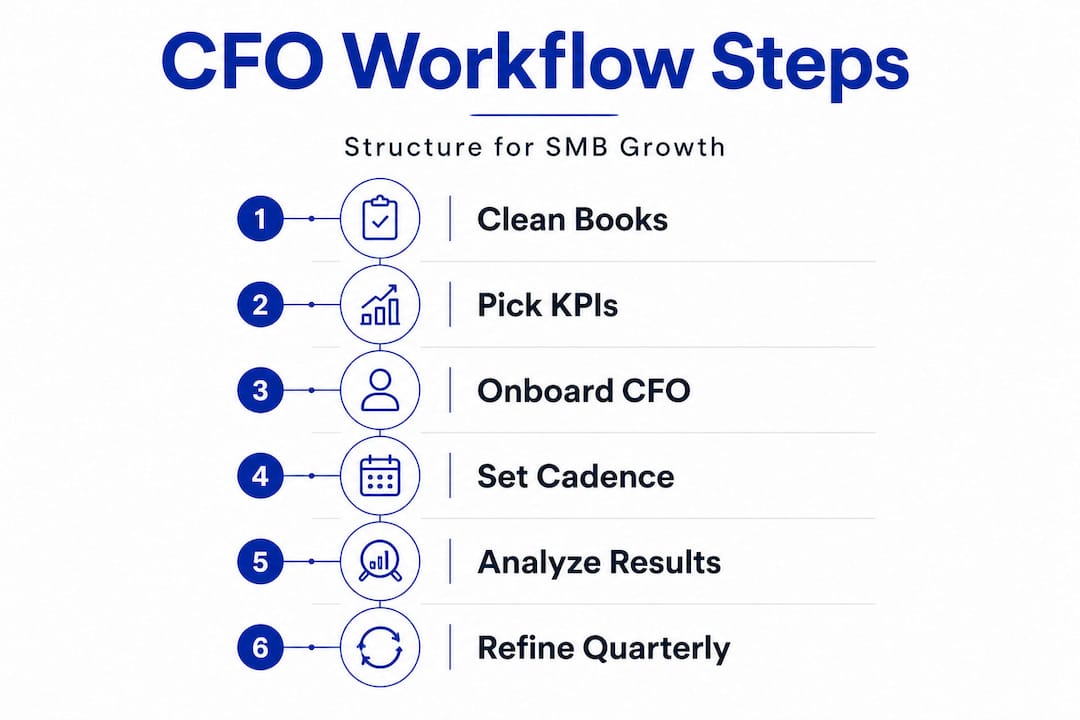
Step 5: Implement CFO-led financial analysis. This is where the real value shows up. Your CFO should be analyzing variances from budget, flagging margin compression, modeling growth scenarios, and connecting financial data to operational decisions.
Step 6: Build toward strategic goals. Whether your goal is profitability improvement, debt reduction, or investor readiness, your workflow should have explicit milestones tied to those objectives. Track them at every review.
Step 7: Review and refine quarterly. Every three months, assess what’s working and what isn’t. Adjust the scope, tools, or cadence based on your evolving needs. A good CFO workflow is not static.
The results businesses achieve with this kind of structure are well-documented. Businesses with structured CFO support show 78% better cash flow management, a 3.2x EBITDA improvement, and 28% faster year-over-year revenue growth acceleration. Those aren’t projections. Those are measured outcomes.
Pro Tip: Use a shared financial dashboard that both you and your CFO can access in real time. Visibility kills surprises. When both parties are looking at the same numbers on the same schedule, accountability is built into the system automatically.
Industry-specific financial analysis adds another layer of precision, because benchmarks differ dramatically across sectors.
Troubleshooting: Common mistakes and how to avoid them
Even well-designed workflows break down without proper maintenance. Here are the most common failure points and how to prevent them.
Mismatched expectations. This is the number one reason CFO engagements underdeliver. The business owner expects the CFO to manage operations, handle vendor relationships, or fix accounting errors. The CFO expects to focus on strategy and modeling. Neither expectation was written down. The solution is a clear scope document from day one.
Operational overload. As CFO pressures increase, including cost control amid growth investments, it’s easy to pile urgent tasks onto your CFO that crowd out strategic work. Guard their bandwidth. If your CFO is spending 80% of their time on bookkeeping cleanup or vendor calls, you’re paying CFO rates for bookkeeper work.
No accountability structure. A monthly review call only works if decisions from the previous call were actually tracked and executed. Keep a running action log. Review it at every meeting. Accountability isn’t automatic. You have to build it in.
KPI drift. Businesses evolve. The metrics you set in month one may not be the right ones by month six. Review your KPIs quarterly and update them as your business model changes.
Ad hoc firefighting. If every conversation with your CFO starts with a new crisis, your workflow has broken down. Reactive mode means you’re not getting strategic value, just damage control.
“Even strong CFO support can fail without accountability and clear KPIs. The tool is only as effective as the system around it.”
Common warning signs that your workflow needs attention:
- Financial reviews are postponed more than twice in a row
- You’re surprised by cash shortfalls that a forecast should have caught
- Your CFO is asking for the same data repeatedly because records are inconsistent
- No one can name the top three financial priorities for the current quarter
Recognizing the signs your business needs a CFO is important, but recognizing when your current approach isn’t working is equally critical.
Pro Tip: Schedule a 30-minute monthly accountability check-in separate from your financial review. Use it exclusively to track the status of decisions and action items from previous meetings. This one habit prevents more workflow failures than anything else.
How to measure results: What success looks like
A CFO support workflow is an investment. Like any investment, you need to know what return you’re targeting and how you’ll measure it.
EBITDA improvement, margin gains, revenue growth, and fundraising success are the four core categories where well-run CFO workflows deliver measurable results. Here’s what the data shows:
| Metric | Without CFO support | With structured CFO support |
|---|---|---|
| Cash flow management | Reactive, often short | 78% improvement in predictability |
| EBITDA | Baseline | Up to 3.2x improvement |
| Year-over-year revenue growth | Industry average | 28% acceleration above average |
| Fundraising success rate | Low, unprepared | 45% improvement |
| Gross margin visibility | Often unknown | Tracked monthly |
Here’s a practical framework for tracking your own results:
Month 1 to 3: Focus on establishing baseline metrics. What are your current margins, cash cycle, and EBITDA? Document these before interventions so you have a real starting point.
Month 3 to 6: Measure early wins. Are cash flow forecasts improving? Are you making faster, more confident decisions? Is your reporting more current and accurate?
Month 6 to 12: Evaluate strategic outcomes. Revenue growth, EBITDA change, new funding secured, cost reductions identified. These are your headline numbers.
Ongoing: Compare your results to the benchmarks above. If you’re not seeing movement in at least two of those four categories within six months, revisit your scope, KPIs, or CFO partner.
Remote CFO services have expanded access to this level of support dramatically. Businesses anywhere in the world can now access the same quality of financial strategy that was previously reserved for companies with large finance teams.
Why most SMBs get CFO support wrong — and how to fix it
Here’s the uncomfortable truth most articles won’t say directly: the majority of SMBs who hire outsourced CFO support don’t get full value from it. Not because the CFO isn’t capable, but because the business wasn’t ready to use them well.
The pattern is consistent. A business owner hits a pain point, usually a cash crunch or a failed funding conversation, and reaches out for CFO help. They engage someone, have a few good sessions, but never build the internal habits that make the workflow stick. Reviews get skipped. KPIs go untracked. The books fall behind again. Six months later, they conclude that “CFO support didn’t work.”
What actually didn’t work was treating strategic financial support like a one-time fix rather than an ongoing operating discipline.
The businesses that get the most out of CFO support share three characteristics. First, they come in with clean or quickly cleaned-up financials. Second, their leadership is genuinely open to changing how decisions get made based on data. Third, they treat the CFO relationship like a board relationship: prepared, accountable, and strategic.
The technical skill of your CFO matters far less than the internal readiness of your business. A world-class CFO working with chaotic books and a distracted owner will underperform a solid CFO working with a prepared, engaged business team every single time.
If you’re serious about scaling, start by reading up on the signs you need a CFO for growth. Then ask yourself honestly: is your business prepared to use that support effectively? The answer to that question will determine whether your CFO investment is transformative or disappointing.
Unlock expert CFO support for your business growth
If you’ve read this far, you already know that a structured CFO support workflow isn’t a luxury. It’s one of the highest-leverage investments a growing SMB can make. The question is whether you have the right partner and tools to make it work.
John Galt Finance offers ongoing CFO support solutions built specifically for businesses like yours, with revenues between $500K and $20M and teams of 5 to 50 people. From custom financial modeling to a detailed cash flow forecasting guide, every service is designed to give you CFO-level insight without the full-time cost. Book a demo today and see exactly what a structured financial workflow could do for your numbers.
Frequently asked questions
How much does outsourced CFO support typically cost?
Outsourced CFO support typically costs between $1,000 and $15,000 per month, which is 60 to 80% less than a full-time CFO’s annual salary of $250,000 to $500,000, making it highly accessible for growing SMBs.
What results can I expect from implementing a CFO support workflow?
Benchmarks show 78% better cash flow, a 3.2x EBITDA increase, and 28% faster annual revenue growth for businesses using structured CFO support compared to those without it.
What are the most common mistakes when outsourcing CFO support?
Failures most often come from unclear scope, lack of accountability structures, or trying to use a CFO for operational tasks rather than strategic financial work.
How do I know if my business is ready for outsourced CFO support?
If you’re experiencing rapid growth, financial complexity, or making major decisions without reliable data, your business is likely ready. Clean books and an engaged owner are the only real prerequisites.
Can a CFO support workflow help with fundraising?
Absolutely. Structured CFO support has been shown to deliver a 45% improvement in fundraising success rates, largely because it prepares your financials, models, and narrative well before you approach investors.
Recommended
- Unlock business growth with a custom financial modeling process
- Why SMEs Need CFO Services: Unlock Growth and Clarity
- Essential financial metrics to track for SMB growth: 2026
- Remote CFO services: Unlock strategic growth for SMBs
FAQ
How do I build a CFO workflow without hiring a full-time CFO?
Combine a fractional CFO (10-20 hrs/week) with an in-house controller or senior bookkeeper. The fractional CFO owns strategy, forecasting, and board reporting; the in-house resource handles month-end close and AR/AP. Total cost is typically 30-50% of one full-time CFO.
What does a typical week look like for a fractional CFO?
Monday: cash forecast update and review of prior week. Tuesday-Wednesday: deep work (analysis, model updates, board prep). Thursday: leadership sync, sales pipeline review. Friday: ad-hoc and planning the next week. Most CFOs reserve Friday afternoons for thinking time.
How do I keep my CFO accountable for results?
Define 3-5 outcomes for the first 90 days (monthly close under 10 days, weekly cash forecast live, board package built, etc.). Hold a quarterly review against scope. Avoid hourly billing without deliverables; it incentivizes the wrong behavior.
What’s the right reporting cadence for the CEO?
Weekly: cash position, AR aging, pipeline. Monthly: full P&L with variance commentary, KPI dashboard. Quarterly: strategic review, scenario refresh. If your CFO sends a 40-page monthly pack, you have a process problem, not a data problem.
When is it time to upgrade to a full-time CFO?
Typically at $25M+ revenue, fundraising of $10M+, or when you need a CFO who can hire and manage a 5+ person finance team. Below those thresholds, a fractional CFO is usually higher leverage. See our signs you need a CFO article for the full framework.