

Strategic Financial Planning Benchmarks
| Metric | Benchmark |
|---|---|
| SMBs with a 3-year strategic plan | ~35% (SCORE survey) |
| Planning horizon for SMBs ($1M-$10M) | 3 years (with annual refresh) |
| Recommended cash runway | 3-6 months of operating expenses |
| Debt-to-equity ratio target (healthy SMB) | <2.0 |
| Capex as % of revenue (asset-light SMB) | 2-5% |
| R&D as % of revenue (SaaS) | 15-25% (OpenView SaaS Benchmarks) |
| Time spent on strategic planning (CEO) | 10-15% of working hours |
| Companies with documented plan vs without (growth gap) | 30% higher revenue growth (Harvard study) |
Most business owners think financial planning means reviewing last quarter’s numbers, checking the bank balance, and putting together a budget for next year. That view is understandable, but it’s costing you real opportunities. Strategic financial planning is something fundamentally different. It’s about looking ahead, connecting your biggest business ambitions to concrete financial targets, and making decisions today based on where you want to be in three to five years. This guide explains exactly what it is, breaks down the core tools you need, and shows you how to put it into practice without a full-time CFO on your payroll.
Table of Contents
- What is strategic financial planning?
- Key components: The strategic financial planning toolkit
- Why SMBs need repeatable financial planning rhythms
- Scenario planning and risk: Making uncertainty manageable
- Applying strategic financial planning: Real SMB outcomes
- Why strategic planning is more accessible than you think
- Put strategic financial planning into action for your business
- Frequently asked questions
Key Takeaways
| Point | Details |
|---|---|
| Future-focused planning | Strategic financial planning guides decisions with forward-looking goals and forecasts, not just past results. |
| SMB toolkit essentials | Setting SMART goals, multi-period plans, and rolling cash-flow forecasts form the backbone of effective SMB financial strategies. |
| Repeatable rhythms matter | Regular reviews and planning intervals keep your business agile and prepared for cash-flow challenges. |
| Harness scenarios and risk | Incorporating scenario and risk thinking lets you anticipate uncertainty and make stronger choices. |
| Accessible without full-time CFO | Modern tools and part-time support now let SMBs run strategic financial planning without needing a full-time CFO. |
What is strategic financial planning?
Now that you know why routine financial analysis isn’t enough, let’s define what makes strategic financial planning distinct and valuable for your business.
At its core, strategic financial planning is “the process of translating a business’s long-term direction into financial goals, budgets, forecasts, cash-flow plans, and risk considerations so decisions can be made using forward-looking financial information.” That definition packs a lot in, so let’s unpack it.
The word “translating” matters. Your vision of doubling revenue in four years, opening a second location, or expanding into a new market doesn’t mean anything financially until you map it to numbers. Strategic financial planning creates that map. It answers questions like: How much cash will we need to hit that target? What will our margins look like at different growth rates? What happens to the plan if a key client walks?
Basic accounting and bookkeeping record what happened. Strategic financial planning determines what should happen and builds a financial framework to get you there. Think of accounting as a rearview mirror and strategic financial planning as your GPS navigation system.
“Most SMBs spend more time looking at last month’s numbers than planning for next year’s growth. The businesses that scale consistently are the ones that flip that ratio.”
Here’s what separates strategic financial planning from standard budget tracking:
- It’s forward-looking. Forecasts, projections, and multi-year models replace historical-only reports.
- It’s goal-driven. Every financial decision connects back to a specific, measurable business objective.
- It’s dynamic. Plans get updated as conditions change, not just once a year.
- It connects operations to finance. Hiring plans, marketing spend, and product investments all tie into financial targets.
For SMBs specifically, exploring strategic finance best practices can help you see how these concepts apply at your scale, without the complexity that large enterprises deal with.
Key components: The strategic financial planning toolkit
With the foundation in place, it’s time to break down what strategic financial planning looks like in action, step by step.
Core mechanics include setting SMART financial goals, building multi-period plans covering three to five years, managing cash flow and liquidity projections, using financial statements as the foundation, and incorporating scenario and risk thinking into every planning cycle.

Here’s a comparison of traditional budgeting versus strategic financial planning at the component level:
| Component | Traditional budgeting | Strategic financial planning |
|---|---|---|
| Time horizon | 12 months | 3 to 5 years, with annual layers |
| Focus | Cost control and variance | Growth, direction, and risk |
| Update frequency | Annually | Rolling updates (monthly/quarterly) |
| Cash flow view | Monthly totals | Timing, runway, and liquidity |
| Decision support | Reactive | Proactive and forward-looking |
| Risk analysis | Minimal | Built into every scenario |
Let’s walk through each core component in plain terms:
- SMART financial goals. Vague targets like “grow revenue” don’t work. A SMART goal sounds like “increase gross margin from 38% to 45% by Q4 2027 by reducing supplier costs and adjusting pricing on the top three product lines.” Every goal needs a number, a date, and an owner.
- Multi-period planning. Annual budgets are necessary but not sufficient. A three to five year plan gives you the runway to make big decisions, like taking on debt, raising capital, or investing in new equipment, with confidence. You’re not guessing; you’re planning with structure.
- Forecasting and budgeting together. Forecasting projects what you expect to happen based on current trends and assumptions. Budgeting sets what you want to happen based on targets. Running both together lets you spot the gap between aspiration and reality early enough to do something about it. Reviewing essential financial models will show you which model types apply to your specific situation.
- Cash flow and liquidity planning. Profitability on paper doesn’t pay your suppliers or your team. You need to know when cash comes in and when it goes out, not just whether you made money this quarter.
- Scenario and risk planning. What happens if your biggest client reduces orders by 30%? What if raw material costs spike 20%? Building these what-if scenarios into your regular review cycle means you have a plan before the crisis hits.
Pro Tip: Don’t build your financial plan in isolation. Your sales team knows what the pipeline really looks like, and your operations lead knows where the real cost pressures are. Pull those people into the planning process and you’ll get a far more accurate and useful model. Learn more through these financial management steps that connect planning to execution.
Why SMBs need repeatable financial planning rhythms
Understanding the toolkit is only part of the solution. What really counts is how consistently you use these tools. Here’s why rhythm is everything.
For SMBs, strategic financial planning works best when it’s built around repeatable planning intervals and a sharp focus on cash flow, specifically the timing difference between profit and actual cash availability, liquidity, and how long the business can operate before needing external funds.
Here’s a practical planning rhythm that works for most SMBs with revenues between $500k and $20 million:
| Planning interval | What to review | Who should be involved |
|---|---|---|
| Weekly | Cash position, receivables aging, payables due | Owner, bookkeeper |
| Monthly | P&L vs. budget, cash flow forecast, key metrics | Owner, finance lead |
| Quarterly | Rolling forecast update, scenario review, goal check-in | Leadership team |
| Annually | Full strategic plan refresh, 3 to 5 year model update | Owner, advisors, CFO/fractional CFO |
This layered approach gives you real-time visibility at the operational level while also keeping the long-term direction in focus. It prevents the common trap of only looking at finances when there’s already a problem.
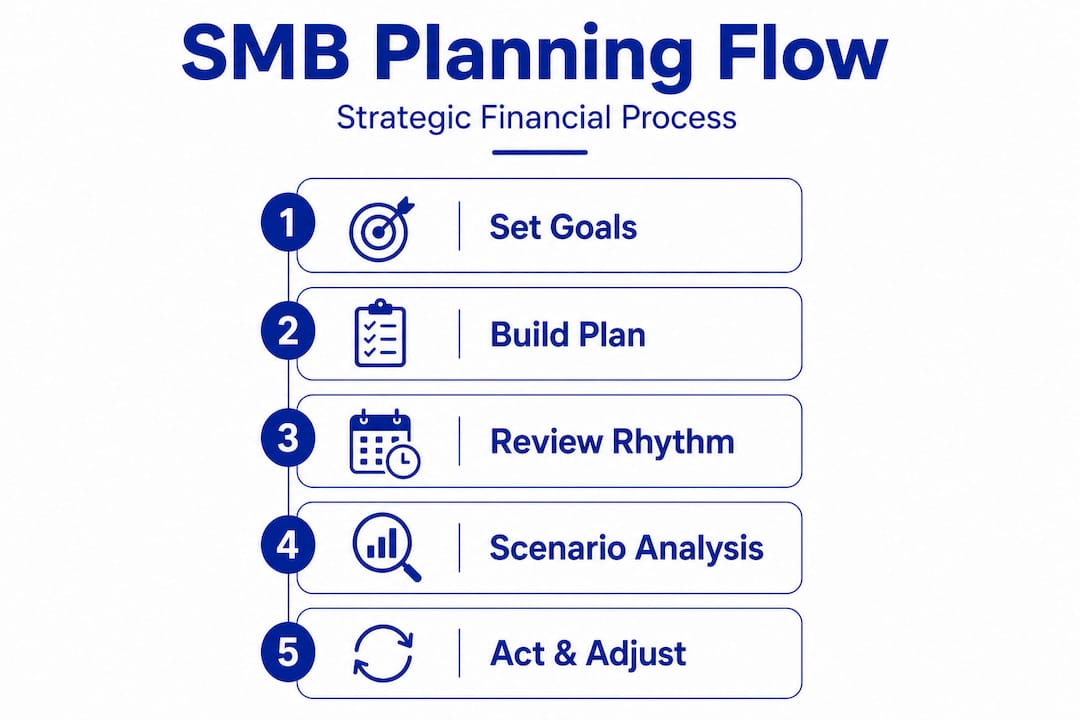
One of the most overlooked concepts for SMB owners is cash runway: how many months your business can operate at current burn rate before running out of cash. This number should be reviewed monthly, especially during growth phases when you’re spending ahead of revenue. Managing cash flow challenges proactively is far less painful than scrambling for a line of credit in a crisis.
Here’s a sobering reality: many businesses that show strong profits on their income statement run into serious cash problems because they aren’t tracking the timing of when cash actually arrives. A client pays net 60. You pay your suppliers net 15. That gap can quietly destroy an otherwise healthy business.
Key monitoring habits that separate financially resilient SMBs from fragile ones:
- Track essential financial metrics every month, not just at tax time.
- Build a rolling 13-week cash flow forecast that you update weekly.
- Know your breakeven point and review it any time your cost structure changes.
- Set a cash reserve target and treat it like a non-negotiable minimum.
Statistic callout: SMBs that use rolling forecasts updated at least monthly are significantly better positioned to catch problems early, adjust spending before cash gets tight, and approach lenders or investors from a position of strength rather than desperation.
Scenario planning and risk: Making uncertainty manageable
With forecasts and rhythms set, the next step is controlling the unknown, and that’s where scenario planning and risk management come in.
The finance function’s strategic role now includes forecasting, scenario thinking, and decision support. The good news is that SMBs can replicate these outputs with the right tools or fractional support, without needing a full-time finance team.
Scenario planning sounds technical, but the concept is simple. You build your base case financial model, then you stress test it against a range of realistic situations. Most SMBs should run at least three scenarios:
- Base case: Your most likely outcome given current trends and a reasonable set of assumptions.
- Downside case: What happens if revenue drops 20 to 30%? Which costs can you cut and how quickly?
- Upside case: What does your cash need look like if growth accelerates faster than expected? Can you actually fund it?
This exercise consistently surfaces hidden risks and opportunities that never appear in a standard budget. For example, many SMB owners discover in the upside scenario that rapid growth actually creates a cash crunch because they have to hire and invest ahead of the revenue that growth eventually generates.
Pro Tip: Build your scenarios using ranges, not single-point estimates. If your best estimate for revenue growth is 15%, model 10% and 20% as well. That range tells you far more about the risk in your plan than any single number. Use this scenario planning guide to structure this process from scratch.
Common risks SMBs should include in their scenario analysis:
- Key customer concentration (one client representing more than 20% of revenue)
- Supplier price increases and availability disruptions
- Interest rate changes affecting debt costs
- Regulatory or compliance changes in your industry
- Talent shortages driving up labor costs unexpectedly
None of these are exotic risks. They’re the situations that blindside businesses every year simply because they hadn’t modeled what would happen if things went sideways. Pairing scenario planning with a clear financial risk mitigation strategy means you’re not just identifying risks, you’re building a response before you need one.
Applying strategic financial planning: Real SMB outcomes
Theory is great, but SMBs need to see that these steps work in real life. Here’s how data and owner experiences bring the process to life.
Data on SMB financial health shows that businesses demonstrating consistent revenue growth and stronger earnings performance are typically the ones applying structured financial planning. They’re not operating on gut feel. They track, they forecast, and they adjust.
“The businesses that accessed growth capital, improved their margins, and scaled sustainably weren’t necessarily the ones with the best products. They were the ones with the clearest financial picture of where they were going.”
Here’s a practical, step-by-step approach that SMB owners can start applying today:
- Define your three to five year ambitions. Write down your revenue target, profitability target, and any major investments or milestones (new location, new product line, acquisition). Make each one specific and time-bound.
- Build or update a financial model. Even a well-structured spreadsheet that projects revenue, costs, and cash flow monthly for the next 24 months is a significant step forward. Use your actual historical data as the starting point.
- Set a regular review cadence. Block calendar time for monthly financial reviews. Treat them as non-negotiable. Review actuals against forecast, update your assumptions, and flag anything that’s drifting off track.
- Use simple templates or accessible software. You don’t need enterprise-grade tools to do this well. The discipline of doing it regularly matters far more than the sophistication of the tool.
- Don’t fear outside support. A fractional CFO or outsourced financial advisor can set up your planning framework, train your team, and provide ongoing review for a fraction of a full-time salary. For most SMBs with revenues under $10 million, this is the highest-leverage financial investment available.
Why strategic planning is more accessible than you think
Here’s a candid perspective based on working with SMBs across a wide range of industries and revenue levels: the biggest barrier to strategic financial planning is not complexity. It’s the belief that it’s only for larger companies with dedicated finance teams.
That belief is simply wrong, and it’s expensive to hold onto.
The tools available today mean that a business with $2 million in revenue can run the same quality of financial modeling and scenario analysis that a $50 million company runs. The difference is access to expertise, not access to technology. Modern cloud-based financial tools have made the technical side remarkably approachable. What’s actually hard is the discipline to use them consistently.
The second mistake we see repeatedly is waiting until there’s a financial problem before taking planning seriously. By then, your options are narrow and your leverage is low. The best time to build a strategic financial plan is when business feels stable enough that it doesn’t feel urgent. That stability gives you the space to think clearly and the time to build something solid.
Our strongest recommendation: start imperfect and iterate. A rough three-year model reviewed every month is worth infinitely more than a perfect model built once and forgotten. Businesses that adopt this “done beats perfect” approach consistently out-perform those who wait until they have all the information before acting. If you’re considering whether ongoing CFO support makes sense for your business, the answer for most growing SMBs is yes, even on a part-time or fractional basis.
Put strategic financial planning into action for your business
If you’re ready to move from understanding to action, here’s where to start.
Reading about strategic financial planning is the first step. Putting it into practice is where the real value shows up. Whether you’re starting from scratch or trying to bring more structure to a planning process that’s already partially in place, having the right resources and support dramatically shortens the learning curve.
At John Galt Finance, we specialize in helping SMBs with revenues between $500k and $20 million build the financial planning infrastructure that drives real growth. Start by exploring our financial planning guide for a structured overview of the full planning process. From there, our cash flow forecasting resources give you the practical tools to manage liquidity with confidence. For businesses ready to build a tailored financial model, our custom financial modeling process is built specifically for SMB growth. The next step is yours to take.
Frequently asked questions
How does strategic financial planning differ from regular budgeting?
Strategic financial planning sets long-term direction and uses forecasts for forward-looking decisions, while budgeting focuses only on tracking income and expenses for a specific period. Budgeting is one tool within strategic planning, not a replacement for it.
How often should SMBs update their strategic financial plans?
Most SMBs benefit from updating their financial plans at least quarterly, with rolling forecasts reviewed monthly or even weekly during times of uncertainty or rapid change.
Can I do strategic financial planning myself, or do I need a CFO?
With the right tools or fractional support, SMBs can achieve CFO-level planning results because fractional support replicates the outputs of a full-time finance function at a fraction of the cost.
What financial data should SMBs review most regularly?
Prioritize cash flow forecasts, profit and loss statements, balance sheets, and short-term liquidity projections, as financial statements form the foundation of any effective planning process.
What is the typical planning horizon for SMBs?
A three to five year plan horizon gives SMBs the structure to pursue ambitious growth targets while maintaining enough detail to make practical, near-term decisions.
Recommended
- Strategic finance best practices: SME owner’s guide to growth
- Essential financial metrics to track for SMB growth: 2026
- Financial scenario planning: grow smarter in 2026
- Unlock business growth with a custom financial modeling process
FAQ
What’s the difference between strategic planning and budgeting?
Strategic planning sets the 3-5 year direction (markets, products, capital structure). Budgeting allocates the next 12 months of dollars to execute it. Without strategy, your budget is just a spending plan. Without a budget, your strategy is just a wish list.
How long should a strategic financial plan take to build?
For an SMB, 6-10 weeks: 2 weeks of diagnostic, 2 weeks of scenario building, 2 weeks of stakeholder review, 2 weeks of finalization. Compressing it further usually produces a plan nobody executes.
What financial scenarios should I model?
At minimum, model base case, downside (-20% revenue), and upside (+20% revenue). Layer in stress tests for your biggest customer leaving and a 90-day AR slowdown. See our 13-week cash forecasting guide for the short-horizon view that complements strategic plans.
How do I know if my strategic plan is working?
Define 5-7 leading indicators (pipeline, headcount ramp, gross margin trend) and review them monthly against plan. Don’t wait for annual results to know whether you’re on track; by then it’s too late to course-correct.
Should I share my strategic plan with employees?
Share the direction and the top 3-5 priorities widely. Share detailed financial targets selectively (leadership team plus department heads). Transparency drives alignment but exposes the plan to competitive risk if it leaks; balance both.