

Cash Reserve Management Benchmarks
| Metric | Benchmark |
|---|---|
| Recommended operating reserve | 3-6 months of opex |
| Recommended reserve for seasonal/project businesses | 6-12 months |
| SMBs with less than 1 month cash reserve | ~50% (JPMorgan Chase Institute) |
| Median SMB cash buffer days | 27 days |
| High-yield business savings yield (2026) | 4.0-5.0% APY |
| Treasury bill yield (4-week, 2026) | 4.5-5.3% |
| FDIC insurance limit per bank, per ownership category | $250,000 |
| Recommended bank diversification at $1M+ reserves | 2-3 institutions |
Most small and medium-sized businesses are operating far closer to the financial edge than their owners realize. Only 28% of small businesses have three or more months of cash reserves, which means the overwhelming majority are one bad quarter, one large unexpected expense, or one slow season away from a genuine crisis. This guide gives you the same framework a CFO would use to build, position, and actively manage your cash reserves so your business stays stable, stays funded, and stays ready to grow.
Table of Contents
- Why managing cash reserves matters for SMBs
- Setting the right cash reserve target for your business
- Where to hold and optimize cash reserves
- Monitoring, managing, and mobilizing your reserve
- CFO-level tips: Advanced moves and common mistakes
- Where most SMBs go wrong—and how to outsmart the average
- Ready to optimize your cash reserves? Partner with pro-level finance solutions
- Frequently asked questions
Key Takeaways
| Point | Details |
|---|---|
| Set 90-day operating cash minimum | Maintaining at least 90 days of reserves is vital for weathering unexpected shortfalls. |
| Diversify reserve holdings | Keep cash in a mix of high-yield and liquid accounts to maximize earnings and access. |
| Monitor reserves with key metrics | Track Days Cash on Hand and related metrics every quarter for continuous financial health. |
| Adjust strategies as your business grows | Review and right-size your reserve policies as revenue streams stabilize or new risks emerge. |
| Leverage forecasting for growth | Use forecasting and scenario planning to manage reserves proactively and unlock new opportunities. |
Why managing cash reserves matters for SMBs
Cash reserves are not the same as profit. They are the readily available funds your business can access immediately to cover operating expenses without taking on debt, delaying payroll, or missing vendor payments. Think of them as the oxygen supply for your operations. You don’t think about them until they’re running low, and by then you’re already in trouble.
The numbers are sobering. Average SMB cash reserves sit at just 27 days, while best-in-class businesses maintain 90 or more days of runway. Financial experts recommend that micro and small businesses target three to six months of operating costs held in liquid form. That’s not a conservative suggestion. It’s the floor.
| Reserve level | Days cash on hand | Risk profile |
|---|---|---|
| Dangerous | Under 30 days | High likelihood of disruption |
| Marginal | 30 to 60 days | Vulnerable to seasonal shifts |
| Stable | 60 to 90 days | Adequate buffer for most events |
| Best-in-class | 90+ days | Positioned for stability and growth |
Why does this matter so much for SMBs specifically? Because larger businesses have easier access to credit lines, investor capital, and institutional relationships that smooth out cash gaps. You don’t always have those same options on short notice. Your reserves are your credit line. And building them properly requires a deliberate, CFO-level approach.
Key reasons cash reserves protect your business:
- They cover payroll, rent, and fixed costs during revenue dips
- They allow you to negotiate better payment terms with suppliers (paying on time or early earns discounts)
- They prevent panic-driven decisions like taking high-cost emergency loans
- They signal financial credibility to lenders and potential investors
That said, idle cash carries real opportunity costs. Money sitting in a non-interest-bearing account is silently losing value to inflation. The goal, as outlined in cash flow management tips for growing businesses, is not to hoard but to optimize. More on that in a moment.
“A liquidity buffer isn’t just a safety net. It’s a strategic asset that gives you freedom to act, not just survive.” That’s the mindset that separates reactive SMBs from proactive ones.
The key financial metrics for SMBs you need to track begin with Days Cash on Hand (DCOH). This is calculated by dividing your available cash by your average daily operating expenses. If that number is below 60, your first priority is to build it up before anything else.
Setting the right cash reserve target for your business
Not every business needs the same cushion. Your optimal reserve level depends on three factors: industry volatility, business size and stage, and seasonal revenue patterns. A construction firm with irregular contract revenue needs a different buffer than a SaaS company with predictable monthly subscriptions.
Here’s a practical three-bucket framework used at the CFO level:
- Operating minimum (90 days): Non-negotiable. This is your baseline survival fund. Every business should build toward this before tackling anything else.
- Stability buffer (up to 180 days): Appropriate for businesses in volatile industries, those with irregular receivables, or companies going through rapid change such as hiring surges or product launches.
- Growth pool (beyond 180 days): Excess cash beyond your stability buffer that should be actively reinvested rather than left idle. Options include equipment upgrades, market expansion, or paying down high-cost debt.
For seasonal businesses, this framework is especially critical. 82% of business failures trace back to cash flow problems, and seasonal SMBs are disproportionately at risk if they don’t budget peak-season surpluses to fund slow periods. A summer-focused retail business that spends all its August profits on inventory by October is gambling on a perfect Q4.
| Approach | Reserve target | Best suited for |
|---|---|---|
| Conservative | 150 to 180+ days | Volatile industry, irregular revenue |
| Balanced | 90 to 120 days | Stable sector, predictable cash flows |
| Dynamic | 60 to 90 days + active reinvestment | High-growth stage, strong credit access |
Conservative reserves of 180+ days make sense for industries where revenue is unpredictable, but they do signal idle capital if held too long without strategy. The dynamic approach reinvests excess for growth while protecting that essential 90-day core. Neither approach is wrong. The mistake is picking one and never revisiting it.
Pro Tip: Set a specific dollar amount as your reserve floor, not just a percentage. If your monthly operating costs are $80,000, your 90-day target is $240,000. Write that number down. Make it visible. It becomes your financial north star.
As part of your strategic finance for SMBs planning, revisit your reserve targets every time a significant change happens in your business: a new major client, a lost contract, a new hire, a market shift. Your cash needs in year three look nothing like they did in year one.
Where to hold and optimize cash reserves
Once you know how much to hold, the next question is where. Keeping everything in your operating checking account is like storing your emergency fund under the mattress. Safe? Maybe. Smart? No.

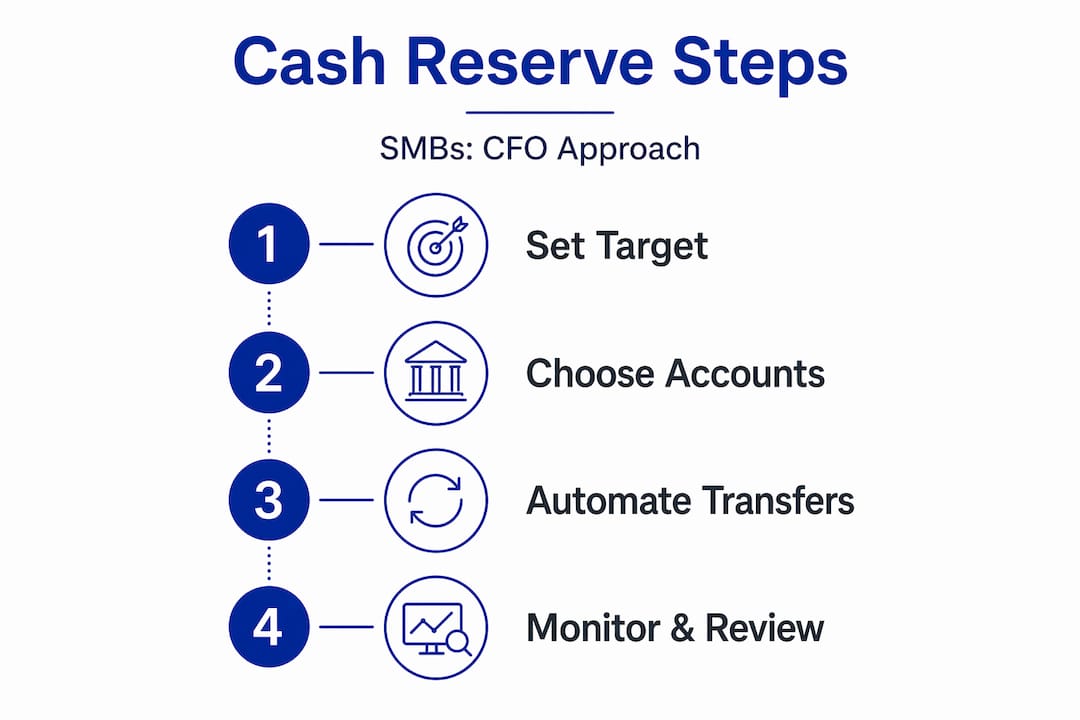
A tiered approach is the CFO standard. Operational reserves belong in high-yield savings accounts or short-term Treasury bills, with excess swept into money market accounts that offer both liquidity and yield. This structure means your cash is working harder without sacrificing access when you need it.
Best practices for holding your reserves:
- Tier 1 (immediate access, 30 days of expenses): Business checking or high-yield savings account at an FDIC-insured institution
- Tier 2 (short-term yield, 30 to 90 days): High-yield savings, Treasury bills with 90-day maturities, or government money market funds
- Tier 3 (medium-term, 90 to 180 days): Short-duration bond funds, CDs with early withdrawal options, or sweep accounts
Diversification across institutions also matters. FDIC coverage caps at $250,000 per depositor per institution. If your reserves exceed that, split them across multiple banks rather than leaving yourself partially unprotected.
As part of your working capital optimization strategy, review your holding structure quarterly. Interest rate environments change, and what earned you a solid yield last year may be underperforming today. Don’t set it and forget it.
Pro Tip: Automate a monthly sweep from your operating account to your Tier 2 reserve account. Even a small, consistent transfer builds the habit and the balance simultaneously.
Monitoring, managing, and mobilizing your reserve
Having a reserve is not enough. You need a system for monitoring it, clear rules for deploying it, and a process for replenishing it after you do.
Start by assigning ownership. Appointing a dedicated working capital leader inside your business, whether that’s your controller, your CFO, or an outsourced finance partner, ensures this doesn’t fall through the cracks. Whoever owns cash management should be tracking more than just the bank balance. They need to watch granular metrics like WADC (Weighted Average Days Cash) and WAT (Working Asset Turnover), not just the standard DSO, DPO, and DIO ratios.
The sobering reality: US SMBs with revenues under $300 million carry an average Cash Conversion Cycle of 120 days, and small firms hold 20 to 30% more cash than they need due to poor visibility into their own financials. That excess cash isn’t protecting you. It’s a sign your reporting isn’t sharp enough.
A simple reserve monitoring process:
- Calculate DCOH weekly during volatile periods, monthly during stable ones
- Set a trigger point (e.g., DCOH drops below 60) that automatically prompts a financial review
- Track your Cash Conversion Cycle monthly to spot collection or payment delays early
- Create a “reserve health dashboard” with three metrics: current DCOH, target DCOH, and variance
- Review your replenishment plan if reserves are deployed, with a clear timeline to rebuild
When should you deploy reserves? Three legitimate triggers exist: a planned seasonal slowdown you’ve modeled in advance, an unexpected but essential expense (equipment failure, legal costs), or a defined growth opportunity with measurable ROI. Emotional decisions (“things feel tight”) are not a deployment trigger. That’s what the system protects you against.
“The moment your cash reserve feels optional is the moment you’ve already lost control of your financial posture.”
Want a CFO to walk through your specific numbers? Book a free 30-min review - we look at your P&L, cash flow, and unit economics and tell you the top 3 things to fix.
The working capital management system you build now creates the habits that keep you solvent when others in your industry are scrambling.
CFO-level tips: Advanced moves and common mistakes
Once your foundation is solid, advanced strategies can meaningfully improve both the size of your reserves and the speed at which you build them.
Instant payments accelerate inflows and reduce SMB reliance on credit lines, with many high-urgency businesses now willing to pay small fees to access funds immediately rather than waiting standard settlement times. If your business regularly waits two to five days for payments to clear, instant payment rails can functionally add days to your cash on hand without changing your reserve balance at all.
Advanced CFO strategies for reserve optimization:
- Build rolling cash flow forecasting models covering three to twelve months across base, upside, and downside scenarios
- Incentivize early accounts receivable payments with 1 to 2% early payment discounts. These are far cheaper than the cost of borrowing if you run short
- Negotiate extended payment terms with key vendors, especially on non-time-sensitive orders
- Audit your AP and AR cycles quarterly to find hidden cash sitting in delays
- Use scenario planning to stress-test what happens if your top client delays payment by 60 days or if a key cost doubles
The most common mistakes we see, outlined in detailed steps to improve cash flow, are over-optimism on receivables, no formal cash review schedule, and treating reserves as a slush fund rather than a protected asset class.
Pro Tip: Create a “cash reserve policy” document, even a one-pager, that defines your target DCOH, your holding structure, your deployment triggers, and your replenishment timeline. Share it with anyone who touches your finances. Clarity prevents costly improvisation.
Where most SMBs go wrong—and how to outsmart the average
Here’s the uncomfortable truth: most advice about cash reserves treats the target as a fixed destination. “Build three to six months and you’re done.” That framing is wrong, and it leads smart business owners to make expensive mistakes in both directions.
Small firms actually hold proportionally higher cash in their early years but reduce reserves as they grow and their cash flows become more predictable. That’s not irrational. It reflects improving operational maturity and better visibility. The problem is when businesses don’t consciously manage that evolution. They either hold too much (missing reinvestment opportunities) or too little (walking into a liquidity crisis).
The best-run SMBs we’ve worked with treat their cash reserve target the way a pilot treats altitude. Not as a destination but as a constantly adjusted variable based on current conditions, upcoming turbulence, and where they’re trying to land. They review their models quarterly, they update their scenarios when conditions shift, and they never confuse “we haven’t needed our reserves yet” with “we don’t need reserves.”
Over-hoarding is just as dangerous as under-saving. Cash sitting idle at 2% in a savings account while your business could earn 20% ROI on a well-priced equipment investment isn’t safety. It’s avoidance. Meanwhile, businesses that chase every growth opportunity without protecting their operational minimum end up borrowing at 15 to 30% interest to cover gaps that $40,000 in reserves would have prevented entirely. Neither extreme reflects disciplined financial leadership.
The benchmark for great is not a number. It’s a system. Build the model, set the targets, review them regularly, and adjust based on real data from your finance best practices perspective. That’s what separates the 28% with strong reserves from the rest.
Ready to optimize your cash reserves? Partner with pro-level finance solutions
Managing cash reserves with precision isn’t something that happens by accident. It requires the right model, the right metrics, and the right guidance applied specifically to your business.
At John Galt Finance, we specialize in giving SMBs access to exactly this kind of expertise without the cost of a full-time CFO. Our team builds custom financial planning for business models that show you exactly where your reserves stand today and what they need to look like six to twelve months from now. We pair that with hands-on cash flow forecasting solutions and scenario planning so you’re never caught off guard. Whether you’re building your first formal reserve strategy or optimizing an existing one, our strategic finance growth guide resources and advisory team are ready to help you move from reactive to fully in control.
Frequently asked questions
How often should a small business review its cash reserves?
You should review cash reserves at least quarterly, or more frequently if your business is in a high-growth phase, navigating a downturn, or experiencing significant seasonal swings in revenue.
Is it better to keep all reserves in one account for simplicity?
No. Diversifying across tiered accounts, including high-yield savings and short-term instruments, balances yield, risk, and accessibility far better than a single account can.
What’s the biggest mistake SMBs make with cash reserves?
The most common mistake is holding too little cash as a buffer, with only 28% of small businesses maintaining three or more months of reserves, leaving most businesses dangerously exposed to even moderate disruptions.
How do instant payments affect reserve management?
Instant payments accelerate inflows and reduce dependence on credit lines, effectively improving liquidity without requiring you to hold a larger cash balance.
What metrics should I monitor for optimal reserve management?
Track Days Cash on Hand, Cash Conversion Cycle, and early warning indicators like rising DSO or falling collections rates. Dedicated working capital metrics such as WADC and WAT give you sharper visibility than basic ratios alone.
Recommended
- Cash flow management: 60% of SMBs struggle in 2026
- Essential financial metrics to track for SMB growth: 2026
- Strategic finance best practices: SME owner’s guide to growth
- Financial management for SME profitability: 5 key steps
FAQ
How much cash should my business actually keep on hand?
Calculate average monthly operating expenses, then multiply by 3-6 for a stable business or 6-12 for a seasonal, project-based, or customer-concentrated one. If you have debt service, add one quarter’s principal-and-interest payments on top of that baseline.
Where should I park business cash reserves?
Tiered approach: 1 month opex in operating checking, next 2-3 months in a high-yield business savings (currently 4-5% APY), beyond that in laddered Treasury bills (4-week to 13-week). Avoid CDs longer than 6 months; the liquidity penalty rarely justifies the marginal yield.
What’s the risk of keeping all cash in one bank?
FDIC insurance covers $250k per ownership category per bank. After Silicon Valley Bank in 2023, treasury teams routinely spread reserves across 2-3 banks once balances exceed $500k. ICS (Insured Cash Sweep) accounts can extend coverage to millions in one operational account.
How do I build cash reserves without slowing growth?
Three levers: (1) tighten DSO by 5-10 days through better collections, (2) negotiate longer DPO with key suppliers, (3) automatically sweep 5-10% of monthly revenue into a reserve account. See our working capital optimization guide for the mechanics.
When can I distribute excess cash to owners?
After meeting three tests: (1) cash reserve target hit, (2) debt covenants comfortably met, (3) next 12 months of planned capex funded. Distributions ahead of these tests are the #1 reason “profitable” SMBs hit liquidity crises in downturns.