

Strategic CFO Benchmarks
| Metric | Benchmark |
|---|---|
| Time CFO spends on strategy (best-in-class) | 40-50% (vs 15-20% historical) |
| Full-time CFO total compensation (US, $5M-$50M) | $220,000-$450,000/year |
| Fractional CFO retainer | $3,000-$10,000/month |
| ROI of strategic CFO (first 12 months) | 3-7x fees (CFO Selections survey) |
| Revenue threshold where strategic CFO pays back | $1M+ ARR |
| EBITDA improvement after CFO engagement (avg) | +2-4 percentage points within 18 months |
| Time from CFO hire to first board package | 30-60 days |
| Common strategic CFO deliverables | 3-year model, 13-week cash, KPI dashboard, capital plan |
Most business owners think of their CFO as the person who closes the books, files reports, and tells everyone what they can’t afford. That picture is outdated by about a decade. Today, 57% of finance leaders are responsible for shaping enterprise strategy, carrying 20% more responsibilities than peers who stay in the traditional finance lane. The modern CFO sits at the center of every major decision your company makes, and understanding that shift could be the single most important reframe for your business growth in 2026.
Table of Contents
- How the CFO’s role has evolved in strategic planning
- Key methodologies CFOs use for impactful strategic planning
- Balancing growth priorities and cost discipline under pressure
- Critical challenges for CFOs in strategic planning and how to overcome them
- Why the best CFOs are business strategists first and accountants second
- How to unlock strategic CFO thinking in your own business
- Frequently asked questions
Key Takeaways
| Point | Details |
|---|---|
| CFOs are strategic leaders | Today’s CFOs shape business direction and drive more than financial operations. |
| Key planning methodologies | Scenario planning, financial modeling, and KPI tracking empower CFOs to align resources with growth. |
| Growth and cost balance | CFOs must support expansion while ensuring cost discipline, even in volatile markets. |
| Agility is critical | Forward-thinking CFOs embrace agile planning to adapt to market changes and uncertainty. |
| Strategic CFO mindset | The most effective CFOs act as business architects, connecting data, insights, and execution. |
How the CFO’s role has evolved in strategic planning
The old version of a CFO was essentially a sophisticated bookkeeper. They tracked what happened, produced accurate reports, and made sure the company stayed compliant. That was valuable, no question. But it was fundamentally backward-looking. Every insight arrived after the fact, and “strategy” meant setting next year’s budget based on last year’s numbers.
The modern CFO operates in a completely different dimension. They are active participants in deciding where the company goes, not just how much it costs to get there. According to research from ICAEW on CFO strategic roles, today’s CFOs wear eight distinct strategic hats: leader, analyst, creator, critical thinker, adjudicator, orchestrator, implementor, and communicator. Each of those roles requires skills that go well beyond reading a balance sheet.
For small and medium-sized enterprises, this evolution matters even more. You rarely have a dedicated strategy team, a VP of corporate development, or a deep bench of senior analysts. Your CFO fills all of those gaps. When the role is done right, it creates leverage across every function in the business.
Here is a quick comparison that shows just how different the old and new models are:
| Dimension | Traditional CFO | Modern strategic CFO |
|---|---|---|
| Primary focus | Historical reporting | Forward-looking planning |
| Key deliverable | Financial statements | Strategic roadmaps |
| Business involvement | Finance department only | Cross-functional leadership |
| Decision role | Informer | Active decision-maker |
| Time horizon | Past quarter | Next 3 to 5 years |
| Risk posture | Risk avoidance | Calculated risk optimization |
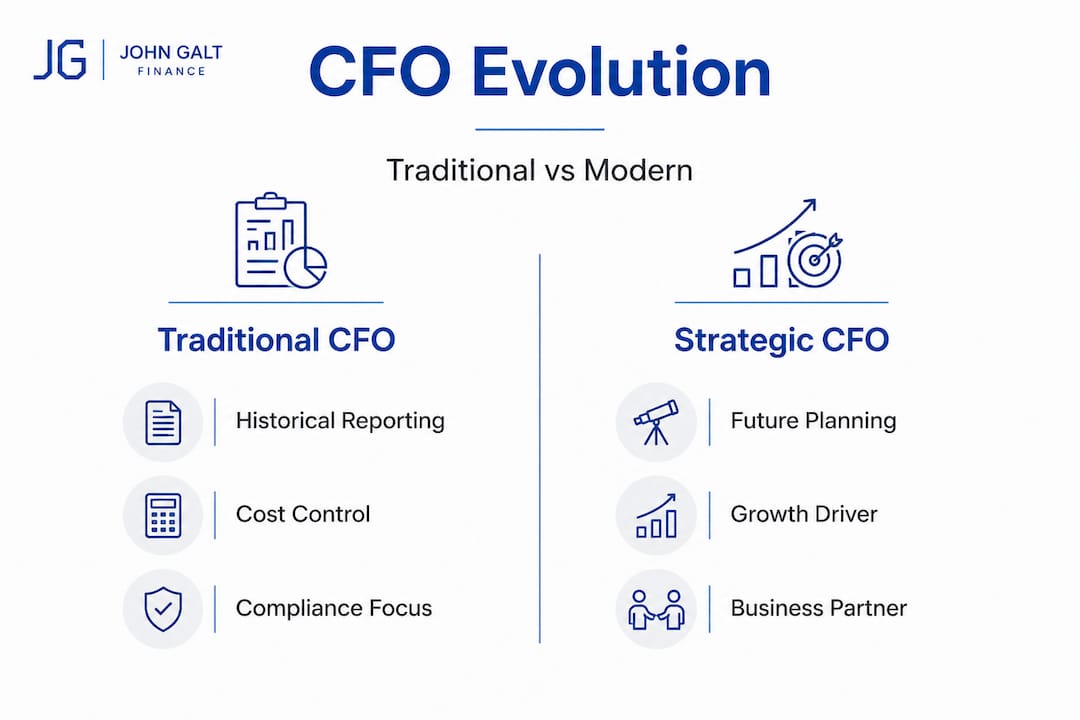
The gap between these two models is exactly why understanding the signs your business needs a CFO is so critical before you hire or outsource. You need the second model, not the first.
Strategic CFO activities typically include leading scenario analysis for major investments, partnering with operations leaders to improve unit economics, building financial models to test new market entry, communicating financial position to lenders and investors, and setting performance benchmarks across departments. These are not finance tasks. They are business tasks that happen to require deep financial fluency.

Key methodologies CFOs use for impactful strategic planning
With the CFO’s core responsibilities defined, here is how these strategic leaders actually drive business results through specific, repeatable methodologies.
The tools a modern CFO brings to strategic planning are both analytical and organizational. They create structure in environments where business owners often operate on instinct. Key CFO methodologies include scenario planning, driver-based financial modeling, KPI development, capital allocation prioritization, rolling forecasts, and business case development with ROI tracking. Each tool solves a specific problem.
| Methodology | Primary purpose | Best used when |
|---|---|---|
| Scenario planning | Model multiple futures | Facing uncertainty or major decisions |
| Driver-based modeling | Link operations to financials | Scaling headcount, pricing, or products |
| KPI development | Measure what matters | Building accountability across teams |
| Capital allocation | Prioritize investments | Multiple competing growth initiatives |
| Rolling forecasts | Update plans continuously | Markets or revenues shift frequently |
| ROI tracking | Evaluate outcomes | Post-investment performance reviews |
Building a data-driven strategic planning process using these tools does not have to be overwhelming. Here is how leading CFOs approach it in a structured sequence:
- Define the business objectives at the highest level, tied to specific outcomes like revenue growth, margin improvement, or market expansion.
- Identify the key value drivers that most influence those outcomes, which might be customer acquisition cost, average contract value, or production throughput.
- Build a driver-based financial model that connects those operational levers directly to your income statement and cash position. You can explore the essential financial models most relevant to your stage of growth.
- Develop KPIs tied to each driver, giving your management team a clear scorecard. A well-structured approach to mastering financial KPIs makes accountability visible at every level.
- Run scenario analyses to stress-test the plan under optimistic, base, and conservative assumptions. A solid scenario planning guide gives you a framework for doing this systematically.
- Switch from annual budgets to rolling forecasts so that you update your plan continuously rather than defending outdated assumptions all year long.
- Track ROI on every major initiative with the same rigor you apply to the original business case.
Pro Tip: Rolling forecasts are the most underused tool in small business finance. Most owners stick with an annual budget because it feels more controlled. In reality, a static budget locks you into assumptions you made six or twelve months ago. A rolling 12-month forecast updates as new data arrives, giving you a far more accurate picture of where you are actually headed.
The practical reality for SMEs is that you do not need to implement all seven of these steps at once. Start with a driver-based model and one rolling forecast cycle. The insight that generates will reveal exactly which other tools to add next.
Balancing growth priorities and cost discipline under pressure
While methodology is key, the true art of CFO leadership is balancing sometimes conflicting business goals. Growth costs money. Cost discipline constrains spending. Holding both priorities at the same time without compromising either one is where great CFOs separate themselves from average ones.
The data on this is clear. Nearly two-thirds of CFOs rank growth as their top priority for driving shareholder value, while 60% simultaneously rank cost management as equally critical. This is not a contradiction. It reflects the sophisticated thinking that defines strategic finance. You pursue growth, but you pursue it efficiently.
Here is how leading CFOs achieve both at once:
- Zero-based budgeting for discretionary spend: Rather than rolling forward last year’s costs with a small increase, they justify every discretionary line item from scratch each cycle.
- Growth investment tiers: They classify spending into three buckets: core operations, growth bets, and exploratory experiments. Each tier has its own financial standards and performance expectations.
- Unit economics monitoring: Before scaling any initiative, they verify that the economics at the unit level are sound. Growing a money-losing product faster just accelerates losses.
- Variance analysis with accountability: When costs run over or revenue falls short, they trace the variance to a specific decision and use it as a coaching tool rather than just a reporting exercise.
- Portfolio reallocation: They systematically move resources out of underperforming activities and into high-return ones, rather than protecting every budget line equally.
“The best CFOs do not treat growth and efficiency as opposing forces. They use financial discipline as the mechanism that makes growth sustainable, ensuring that every dollar invested in expansion has a clear path to return.” This perspective is what CFO services for growth brings to businesses that are scaling quickly but lack the financial infrastructure to scale responsibly.
Pro Tip: When a market disruption or internal emergency hits, many business owners respond by freezing all spending. That reflex can damage your competitive position. A better approach is the “protect, pause, pivot” framework. Protect your core revenue drivers, pause discretionary initiatives with unclear ROI, and pivot resources toward wherever the disruption creates opportunity. Your CFO should have this playbook ready before the crisis arrives, not during it.
The strategic finance best practices that consistently produce the best balance between growth and efficiency are built around discipline in the planning process itself, not just in the spending decisions.
Critical challenges for CFOs in strategic planning and how to overcome them
Understanding these tensions is crucial, but here are the chief obstacles and how forward-thinking CFOs solve them in practice.
Every CFO, regardless of company size, faces a version of the same core tension. The business needs immediate results. The market is unpredictable. The finance infrastructure is often not built for the strategic demands being placed on it. These are not excuses. They are real constraints that require specific solutions.
The most common obstacles CFOs report include balancing short-term performance pressure with long-term strategic initiatives, navigating market volatility that makes static budgets obsolete almost immediately, and working around infrastructure limitations such as manual processes, fragmented data systems, and outdated reporting tools that consume time that should go toward analysis.
Here is how high-performing CFOs address each challenge:
- Short-term vs. long-term tension: They create a clear financial separation between quarterly performance tracking and multi-year strategic investment tracking. Short-term metrics live in the operating scorecard. Long-term metrics live in the strategic roadmap. Neither bleeds into the other.
- Volatility and rigid budgets: They replace annual budget lock-ins with scenario-adjusted rolling forecasts that update monthly. This makes the plan a living document rather than a political artifact.
- Manual processes and data gaps: They prioritize automating the highest-volume, lowest-value finance tasks first, which frees analytical capacity for strategic work. Even basic automation in accounts receivable or expense reporting can reclaim five to ten hours of CFO time per week.
- Decision paralysis from too much data: They build a single-page executive dashboard tied directly to the key value drivers identified in the strategic model. Every decision gets tested against that dashboard.
“The CFO/Controller Financial Performance Index hit a record 149% in 2026, with strong expectations for revenue and profit growth. That optimism reflects what happens when businesses fix their finance infrastructure and give their CFO the tools to lead strategically.”
For SMEs, the infrastructure challenge is often the most acute because resources are limited. That is exactly why finance team outsourcing has become such a practical option. You get the strategic capacity without the full-time salary burden. And with access to industry financial analysis for CFOs, you can benchmark your performance against businesses with the same cost structures and revenue models, which makes planning far more precise.
Why the best CFOs are business strategists first and accountants second
Here is the uncomfortable truth most CFO hiring guides will not tell you: a highly technical accountant with deep compliance expertise can actually be the wrong hire for a growth-stage SME. Credentials and technical accuracy matter, but they are table stakes, not differentiators.
The CFOs who transform businesses are the ones who think like operators. They walk the production floor, ask sales leaders why deals fall through, and challenge marketing on what a lead actually costs to close. They do not just accept the numbers that land on their desk. They interrogate the assumptions behind those numbers.
The classic mistake at the SME level is hiring a finance leader who is brilliant at closing the month and terrible at challenging the CEO’s growth assumptions. That CFO produces beautiful reports about where the business has been. They offer almost no insight into where it should go.
What separates impactful CFOs is their willingness to operate at the intersection of financial strategy and operational reality. The most effective approach, which we see consistently in high-performing engagements, is CFO-led financial analysis that starts with the business question and works backward to the financial answer, not the other way around.
A practical test: ask your CFO what single operational change would have the biggest positive impact on your gross margin over the next 90 days. A finance manager will tell you about cost of goods. A strategic CFO will walk you through three specific levers, explain the tradeoffs of each, and recommend a sequenced action plan. That difference in response quality is the entire game.
How to unlock strategic CFO thinking in your own business
You do not have to wait until your company reaches a certain revenue threshold to access this level of financial leadership.
At John Galt Finance, we work with businesses between $500k and $20 million in revenue to build exactly the kind of strategic finance function described in this article. From a custom financial modeling process tailored to your specific drivers, to a structured financial scenario planning process that prepares you for multiple market futures, to a complete financial planning for business owners framework that ties your day-to-day decisions to long-term value creation. Our outsourced CFO model gives you senior-level strategic guidance without the overhead of a full-time hire, so your business gets the thinking it needs at a cost structure that makes sense right now.
Frequently asked questions
What is the CFO’s main contribution to strategic planning?
The CFO shapes business direction by connecting financial data to growth strategies, resource allocation, and risk management. Modern CFOs serve multiple roles including leader, analyst, creator, and orchestrator in the planning process.
Why are CFOs now so involved in overall business strategy?
57% of finance leaders now oversee enterprise strategy, reflecting their evolved role as business partners who drive growth, efficiency, and organizational adaptability rather than just financial compliance.
How do CFOs help balance growth and cost control?
Nearly two-thirds of CFOs prioritize both simultaneously, using tools like scenario planning, rolling forecasts, and unit economics monitoring to pursue growth without sacrificing financial discipline.
What challenges do CFOs face in strategic planning?
The top obstacles are balancing short-term pressures with long-term strategic value, managing volatility with agile planning processes, and overcoming infrastructure gaps that limit strategic thinking capacity.
Recommended
- Why SMEs Need CFO Services: Unlock Growth and Clarity
- CFO-Led Financial Analysis: Smarter SME Decisions
- Strategic finance best practices: SME owner’s guide to growth
- Remote CFO services: Unlock strategic growth for SMBs
FAQ
What makes a CFO “strategic” vs operational?
An operational CFO runs close, compliance, and controls. A strategic CFO does all that plus drives capital allocation, M&A, pricing strategy, and major capex decisions. The shift typically happens around $10M revenue, when operational tasks become a controller’s job and the CFO’s seat becomes about decisions that move EBITDA by 5%+.
Can a fractional CFO be strategic?
Yes, often more so than a full-time hire at that size. Fractional CFOs typically serve 3-8 clients and import patterns across industries. The risk is over-allocation; if a fractional CFO has more than 10 clients, depth suffers. Ask for client list size during diligence.
What’s the highest-leverage decision a CFO makes?
Capital allocation: where every incremental dollar of cash flow goes (debt paydown, growth investment, owner distributions, reserves). A poorly allocated $500k can cost an SMB 2-3 years of growth. Pricing is a close second; a 1% price increase often drops 5-10% to EBITDA.
How do I measure CFO impact?
Track three things: (1) EBITDA margin change vs baseline, (2) days to close month-end, (3) cash conversion cycle. A strategic CFO should improve all three within 12 months. If none have moved, you have a scope or person problem.
When should I promote my controller to CFO?
Rarely. Controllers are wired for accuracy and process; CFOs are wired for capital and strategy. Promoting a controller often leaves you with neither role done well. Better path: hire a fractional CFO above the controller, and grow the controller into VP Finance over 2-3 years.