

CFO Advisory Benchmarks
| Metric | Benchmark |
|---|---|
| CFO advisory hourly rate | $200-$500/hour |
| Project-based advisory (capital raise prep) | $10,000-$50,000 |
| Ongoing advisory retainer | $3,000-$10,000/month |
| Typical project length | 30 days (diagnostic) to 6 months (transformation) |
| Revenue range fit | $1M-$50M |
| Top use cases | Fundraising, M&A, turnaround, exit planning, system implementation |
| ROI achieved (top quartile engagements) | 5-10x fees |
| Time from engagement to first executive deliverable | 2-4 weeks |
Most business owners assume that a Chief Financial Officer is a luxury reserved for corporations with hundreds of employees and a finance department to match. That assumption is costing smaller businesses real money. CFO advisory services deliver strategic, data-driven financial leadership without the cost of a full-time CFO, making high-level financial guidance accessible to companies of any size. Whether you’re running a $1 million service business or scaling a $15 million manufacturing operation, the strategic clarity that CFO advisory provides can be the difference between reactive firefighting and confident, profitable growth.
Table of Contents
- What is CFO advisory? Core definitions and value
- CFO advisory vs bookkeeping and accounting: Key differences
- Situations when engaging CFO advisory drives the most value
- What a great CFO advisor delivers: Framework of results
- How to get started with CFO advisory (and what to expect)
- A CFO’s perspective: What most business owners miss about advisory
- Ready to transform your financial future with CFO advisory?
- Frequently asked questions
Key Takeaways
| Point | Details |
|---|---|
| Strategic impact | CFO advisory brings advanced financial decision-making to your business without hiring full-time. |
| More than bookkeeping | Advisory delivers forward-looking insights, not just historical reporting or compliance. |
| High-value situations | SMBs benefit most from CFO advice during growth, change, or financial stress. |
| Flexible engagement | Fractional or project-based models ensure any business can access CFO-level support. |
| Tangible business gains | Expect clearer strategy, better cash flow, and improved forecasting through advisory. |
What is CFO advisory? Core definitions and value
CFO advisory is the delivery of CFO-level financial expertise as a service, typically on a fractional, project-based, or retainer basis. Instead of hiring a senior finance executive at a full-time salary that can easily exceed $200,000 per year, you engage an experienced CFO advisor who brings the same depth of knowledge to your business on a flexible schedule. The value of CFO services lies in that strategic layer sitting above day-to-day bookkeeping and compliance work.
Here is what a CFO advisor actually does for your business:
- Financial strategy development: Setting long-term financial goals, identifying growth levers, and aligning your money with your business plan.
- Cash flow oversight: Monitoring inflows and outflows, forecasting future positions, and preventing the cash crunches that blindside so many growing companies.
- Risk management: Identifying financial vulnerabilities before they become crises, from customer concentration risk to debt covenant issues.
- Business modeling: Building scenario models that show what happens to your bottom line if revenue drops 20%, a key client leaves, or you hire five new staff members.
- Capital efficiency: Making sure every dollar in your business is working as hard as possible, whether that means renegotiating supplier terms or restructuring debt.
- Growth readiness: Preparing your financials, narratives, and projections for fundraising, acquisitions, or new market entry.
The contrast with a bookkeeper vs CFO is stark. A bookkeeper records what already happened. A CFO advisor shapes what happens next.
Pro Tip: Look for CFO advisors who specialize in your industry and business stage. A CFO who has guided SaaS companies through Series A rounds thinks very differently from one who has helped manufacturing businesses optimize working capital. Industry-specific insight accelerates results dramatically.
CFO advisory vs bookkeeping and accounting: Key differences
Understanding CFO advisory is easier when you see how it sits in relation to the financial professionals you already know. Most business owners have a bookkeeper, an accountant, or both. These are essential roles, but they serve a fundamentally different purpose than a CFO advisor.
The differences between bookkeepers and CFOs come down to one word: direction. Bookkeepers and accountants look backward. CFO advisors look forward.
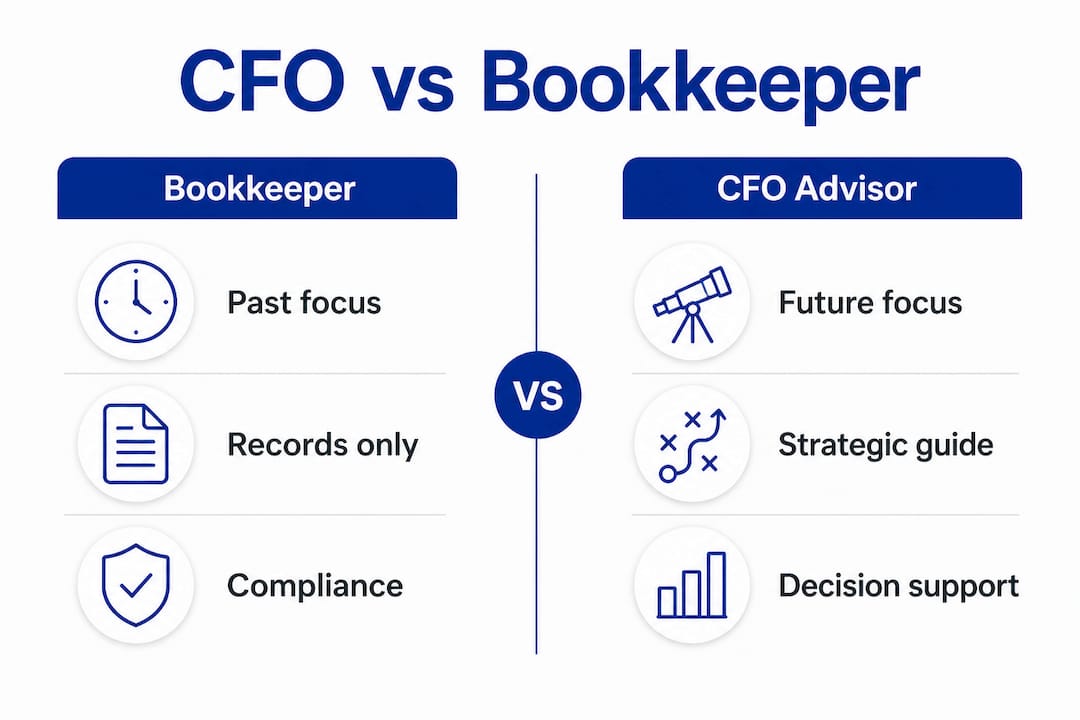
| Service | Primary focus | Key outputs | Business impact |
|---|---|---|---|
| Bookkeeping | Historical record-keeping | Transaction records, bank reconciliations | Compliance, accuracy |
| Accounting | Financial reporting and tax | P&L statements, tax returns, audits | Legal compliance, tax efficiency |
| CFO advisory | Strategy and growth | Forecasts, scenario models, KPI dashboards | Profitable growth, risk reduction |
As the CFO-led financial analysis approach demonstrates, CFO advisory is focused on strategic direction, forward-looking planning, and scenario analysis. Your accountant tells you what your profit was last quarter. Your CFO advisor tells you what your profit will be next quarter and what to do right now to improve it.
The distinction also matters when it comes to the finance director vs chief accountant conversation. Many SMBs assume a senior accountant covers strategic ground. In practice, most accountants are trained for compliance and reporting, not for business modeling, investor relations, or operational strategy.
Signs that you have outgrown standard accounting and need CFO-level input:
- Your revenue is growing but your cash position keeps shrinking.
- You are making major decisions based on gut feel rather than financial models.
- You are preparing to raise capital and your financials are not investor-ready.
- You are unsure which products, services, or clients are actually profitable.
- Your bank or investors are asking questions you cannot confidently answer.
Situations when engaging CFO advisory drives the most value
Once you see how advisory differs from basic financial services, it is vital to recognize exactly when bringing in a CFO advisor can make or break your next strategic move. Not every business needs ongoing CFO support, but there are specific moments when the absence of that expertise is genuinely dangerous.
60% of SMBs struggle with effective cash flow management, directly impacting their growth potential and survival. That statistic is not just a warning about cash. It reflects a broader pattern of financial decisions being made without the right expertise in the room.
Here are five business stages and events that call for CFO advisory:
- Rapid revenue growth: Scaling from $1 million to $5 million sounds exciting, but it creates cash flow timing problems, hiring pressure, and operational complexity that can quickly become unmanageable without financial oversight.
- Fundraising or investor conversations: Whether you are approaching a bank for a line of credit or pitching to a private equity firm, you need financial models, projections, and narratives that hold up under scrutiny.
- Mergers, acquisitions, or partnerships: These transactions involve financial due diligence, valuation, and deal structuring that require CFO-level expertise to protect your interests.
- Cash flow crisis or turnaround: When cash is tight and decisions need to be made fast, a CFO advisor can quickly identify the levers to pull and the risks to avoid.
- Strategic pivots or new market entry: Entering a new market, launching a new product line, or shifting your business model all carry financial risks that need to be modeled before you commit.
Recognizing the signs you need a CFO early gives you the advantage of proactive planning rather than reactive damage control. Similarly, understanding the signs your business needs a CFO for growth helps you time your engagement for maximum impact.
Pro Tip: Even a short-term CFO engagement during a critical transition, such as a 90-day project around a fundraise or an acquisition, can save you far more than it costs by catching blind spots before they become expensive mistakes.
What a great CFO advisor delivers: Framework of results
It is not enough to know you need a CFO advisor. With so much at stake, you need a clear picture of what results to expect so you can evaluate whether you are getting genuine value.
“A great CFO is your strategic partner, not just a finance cop.” The best advisors do not just report numbers. They challenge your assumptions, pressure-test your plans, and help you see around corners.
CFO advisory accelerates smart decision-making, improves cash flow, and makes business growth more predictable. Here is a practical breakdown of what that looks like in practice:

| CFO output | What it includes | Business impact |
|---|---|---|
| Rolling cash flow forecast | 13-week and 12-month cash projections | Prevents surprises, supports planning |
| Financial model | Revenue, cost, and profitability scenarios | Informs pricing, hiring, and investment decisions |
| KPI dashboard | Monthly metrics tailored to your business | Keeps leadership focused on what matters |
| Strategic roadmap | Financial milestones tied to business goals | Aligns team and resources with growth targets |
| Investor-ready financials | Clean statements, projections, and narrative | Increases funding success rate |
Beyond the tangible outputs, the intangible benefits are equally powerful. Business owners who work with skilled CFO advisors consistently report a shift in how they lead. Instead of feeling anxious about financial decisions, they feel informed and confident. That confidence frees up mental bandwidth to focus on sales, operations, and the parts of the business they actually enjoy.
The CFO-led analysis for SMEs approach also surfaces opportunities that owners routinely miss, such as underpriced services, underperforming product lines, or working capital tied up in slow-moving inventory. Solid financial planning for business is not just about avoiding risk. It is about finding the growth that was hiding in your numbers all along.
How to get started with CFO advisory (and what to expect)
With the benefits defined, here is how to make CFO advisory a practical step for your own business, no matter your starting point.
The first decision is choosing the right engagement model. There are three common structures:
- Hourly or project-based: Best for businesses with a specific, time-bound need, such as building a financial model for a fundraise or analyzing a potential acquisition. You pay for exactly what you need and nothing more.
- Fractional CFO retainer: A set number of hours per month, typically 10 to 40, where the advisor becomes an ongoing strategic partner. This model works well for businesses in active growth phases or those navigating complex financial environments.
- Embedded advisory: A higher-touch arrangement where the CFO advisor participates in leadership meetings, works closely with your team, and takes a more hands-on role in financial management.
Even lean SMBs can access expert CFO support through fractional or project-based advisory models, making this a realistic option for businesses well below the enterprise level.
Before your first engagement, gather the following:
- At least 12 months of financial statements (P&L, balance sheet, cash flow statement).
- A clear list of your top three to five business challenges or goals.
- Any existing forecasts, budgets, or financial models, even rough ones.
- Information about your current team, key customers, and revenue breakdown.
What do the first 90 days typically look like? Most CFO advisors begin with a diagnostic phase, reviewing your financials, identifying gaps, and building a baseline picture of your business. From there, they develop the tools and frameworks you need, whether that is a financial model, a cash flow forecast, or a KPI dashboard. By the end of the first 90 days, you should have clear visibility into your financial position and a roadmap for the next 12 months.
Pro Tip: Set clear outcomes and communication cadences at the very start of the engagement. Agree on what success looks like, how often you will meet, and what decisions the CFO advisor has authority to influence. This structure prevents the engagement from drifting into vague territory and ensures you get measurable value.
A CFO’s perspective: What most business owners miss about advisory
Here is something that rarely gets said plainly: most business owners wait far too long to engage a CFO advisor, and they pay for that delay in ways that are hard to quantify but very real.
The owners who benefit most from CFO services are not the ones in crisis. They are the ones who brought in expertise before the crisis arrived. They got a cash flow forecast before the slow season hit. They built a financial model before the investor meeting, not the night before. They identified a pricing problem before it eroded their margins for another 18 months.
The uncomfortable truth is that most financial problems in SMBs are not the result of bad luck. They are the result of decisions made without enough information. A CFO advisor’s primary job is to make sure you have the right information at the right time. That sounds simple, but it requires a specific kind of expertise that most business owners simply do not have and should not be expected to have.
There is also a confidence factor that gets underestimated. When you walk into a bank meeting, a negotiation, or a board conversation with a solid financial model and a clear narrative, the dynamic changes. You are not hoping the numbers work out. You know they do, and you can prove it. That confidence is not just psychological. It translates directly into better terms, better decisions, and better outcomes.
Think of great CFO advisory as a force multiplier. Every dollar you invest in strategic financial guidance has the potential to protect or generate many more dollars in return. The businesses that treat financial expertise as overhead are the ones that stay stuck. The ones that treat it as leverage are the ones that grow.
Ready to transform your financial future with CFO advisory?
If the concepts in this article resonate with where your business is right now, the next step is straightforward: get expert eyes on your numbers.
At John Galt Finance, we specialize in delivering CFO services for SMBs that are tailored to your industry, your stage, and your goals. From custom financial modeling that gives you real scenario clarity to CFO-led analysis that surfaces the opportunities hiding in your financials, our team brings the strategic depth your business deserves. Whether you need a one-time project or ongoing fractional support, we work with businesses generating $500K to $20 million in revenue and help them grow with confidence. Reach out today for a tailored assessment and see what expert financial leadership can do for your bottom line.
Frequently asked questions
Is CFO advisory only relevant to large businesses?
No, SMBs benefit from flexible CFO support and increasingly use advisory services to gain expert financial insight without the high cost of full-time staff.
How much does CFO advisory typically cost?
Costs vary widely based on scope and engagement model; most SMBs opt for fractional or project-based billing, which provides strategic guidance at a fraction of a full-time CFO’s salary, often ranging from $2,000 to $10,000 per month.
What is the difference between a CFO and a CPA or bookkeeper?
CPAs and bookkeepers handle compliance and record-keeping, while CFOs provide leadership and advanced strategy focused on growth, projections, and forward-looking financial decisions.
When should a business consider CFO advisory?
Consider CFO advisory when facing growth, cash flow challenges, strategic pivots, or when expert leadership is needed for complex decisions like fundraising or acquisitions.
Can CFO advisory be delivered remotely or virtually?
Yes, most modern CFO advisors operate fully remotely, making world-class financial expertise accessible to businesses anywhere in the world regardless of location or time zone.
Recommended
- CFO-Led Financial Analysis: Smarter SME Decisions
- What is ongoing CFO support and why you need it
- What does a fractional CFO actually do? A complete guide | John Galt
- Why SMEs Need CFO Services: Unlock Growth and Clarity
FAQ
What’s the difference between CFO advisory and a fractional CFO?
Advisory is project-based and time-bound (capital raise, M&A, system implementation). Fractional CFO is ongoing operational and strategic finance leadership. Many engagements start as advisory and convert to ongoing once trust is built.
When do I need CFO advisory vs ongoing CFO support?
Use advisory when you have a one-time strategic event and a competent internal finance team. Use ongoing fractional CFO when you need monthly strategy, board prep, and weekly cash discipline. Many SMBs need both at different stages.
How do I scope a CFO advisory engagement?
Three artifacts: (1) outcome (what specific decision or deliverable), (2) deliverables list (model, memo, board package), (3) timeline with milestones. Avoid open-ended “advisory hours”; that incentivizes scope creep without accountability.
What’s a fair price for capital raise advisory?
$15,000-$40,000 for an SMB Series A/B prep (model, deck, data room). Some advisors offer success fees (1-3% of capital raised) in addition to retainer. Avoid success-only models; they bias advisors toward closing any deal vs the right deal.
Can advisory work substitute for hiring a CFO?
For SMBs under $5M revenue, yes; project-based advisory plus a strong bookkeeper covers most needs. Above $5M, you need someone owning monthly close, cash forecasting, and KPI discipline; that’s a fractional or full-time CFO role.