3 - 2026 | John Galt

#ClientCase – Trentini: Cash chaos solved with a 13-Week “Cash cockpit”

Trentini is a premium interior and kitchen projects business with large ticket sizes, long lead times, multiple suppliers, and phased deliveries.

On paper, sales looked strong.

In reality, cash felt unpredictable.

Not because the business was unprofitable – but because cash lacked visibility.

The core issue looked like this:

  • Client payments in did not correlate with supplier payments out
  • Supplier payment terms were inconsistent
  • Large orders distorted cash forecasts
  • VAT impact was not being tracked
  • Reporting was solid, but cash remained a black hole

So we built a 13-week rolling cash flow control system.

Not just another finance report.

A weekly cash cockpit.

It included:

  • A forecast linked to deliveries and VAT
  • A supplier payment matrix with timing rules
  • A project cash tracker for outstanding balances
  • A liquidity curve for large orders
  • A weekly cash review routine so the founder stopped guessing

The result:

  • Predictable weekly cash
  • No cash surprises
  • Clear VAT visibility
  • Stronger negotiation power with suppliers

What the founder learned:

“If you think you are profitable but cash is stressful – you may not have a revenue problem. You have a visibility problem”

Want us to build your 13-week cash cockpit?

DM us – and we’ll map the cash gaps for you.

Share this:

Growth can still ruin you if your money comes in late.

In B2B, “net 45” is just fine. But what it really means is that you are lending your customer money to run their business with your balance sheet.


You pay salaries, vendors, equipment, taxes, and delivery today – while the invoice turns into cash weeks later. Profit looks great. The bank account looks crazy.

Here’s the easy test: Would you need more money to survive if you doubled sales next month? If so, your payment terms are your problem.


Three solutions that won’t sound threatening:

  • Start with money: 30-50% down or milestone payments.
  • Bill on the milestone date, not “end of month when we remember.”
  • Systematize collections: top 10 invoices, owner, next follow-up date.

And: Consider payment terms a price. Longer terms cost you money, so charge for it – or offer an early payment discount.


Most founders don’t have a “bad clients” problem. They have a “no process” problem.

Cash is oxygen. Revenue is a promise.


Share this:

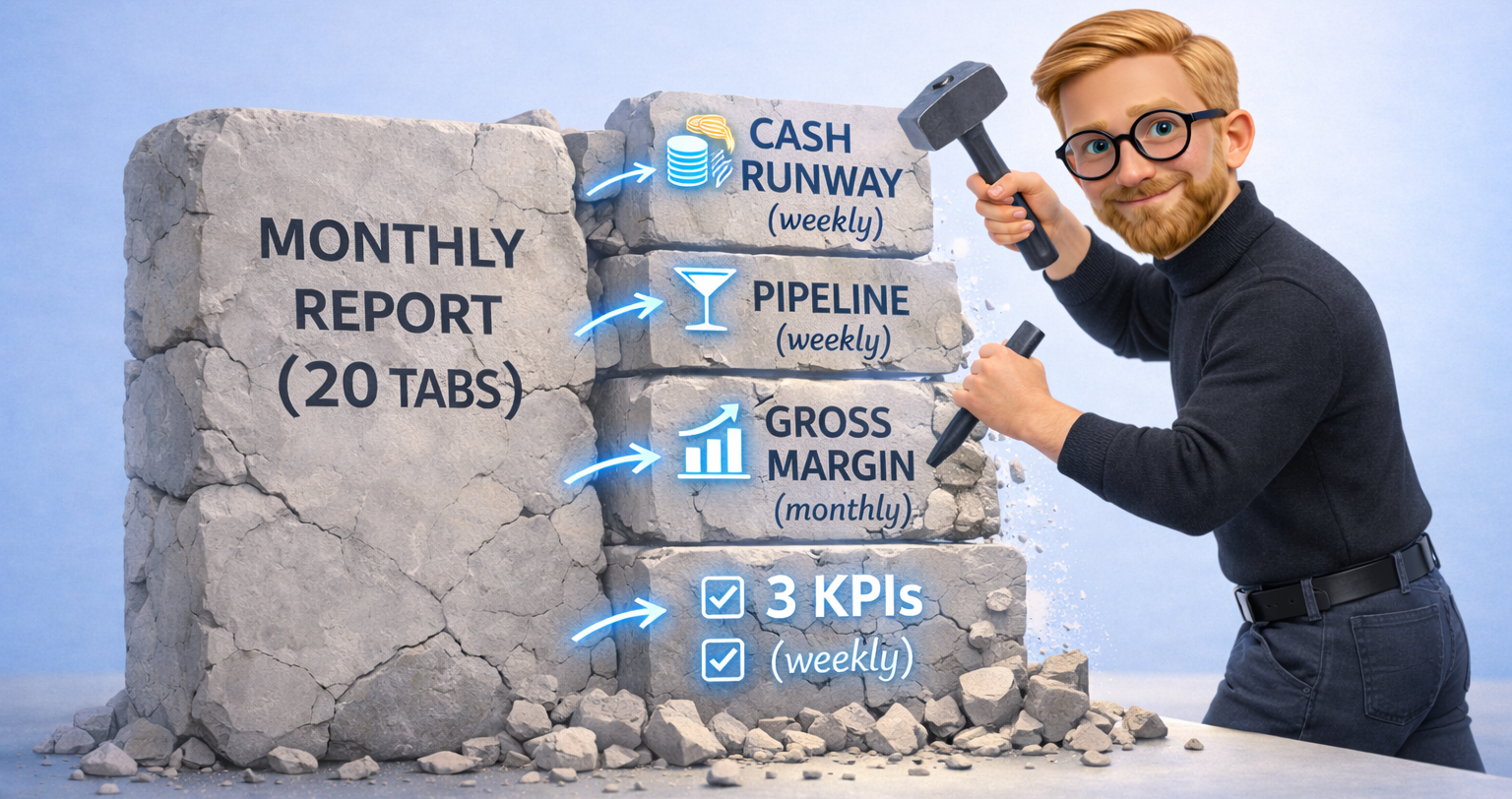
Most founders say they want “better reporting”

What they actually need is fewer numbers – and more decisions.

If your monthly close produces a 20-tab spreadsheet that nobody reads, you don’t have reporting.
You have accounting noise.

The goal of finance isn’t to describe the past.
It’s to reduce uncertainty about the next 30-90 days.

Here’s the simplest reporting stack that works for almost every service or SaaS business:

  1. Cash runway (weekly)
    How many weeks you can operate with current cash – based on your real burn, not hope.

  2. Revenue pipeline (weekly)
    Booked, likely, possible. With dates. Not “we’re talking to them”.

  3. Gross margin (monthly)
    By product/service line. If margin isn’t improving, growth won’t feel better.

  4. 3 KPIs (weekly)
    Pick the drivers that create cash. Examples: DSO, churn, CAC payback, utilization, leads-to-close rate.

Everything else is optional until these are clean.

One rule: every metric must answer a question.
If a number doesn’t change a decision, remove it.

Founders don’t need more data.
They need a dashboard that forces action.

If you want, send me your current monthly report (screenshot is fine) – I’ll tell you what to delete, what to keep, and what 3 numbers will actually run your business.

Share this:

The fastest way to stress-test a business isn’t a new strategy

It’s one spreadsheet.

Most founders don’t know their real unit economics. They know revenue, they guess margin, and they “feel” busy.

But cash doesn’t run on vibes.

Here’s the simple framework we use with clients:

  1. Revenue per delivery unit
    Per project, per customer, per shipment, per account – whatever your “unit” is.
  2. Direct costs per unit
    Labor, contractors, COGS, platform fees, fulfillment, commissions.
  3. Contribution margin
    What’s left after direct costs to pay overhead and generate profit.

If you can’t calculate contribution margin in 2 minutes, you’re flying blind.

Why it matters: growth amplifies whatever you’re selling.

If your contribution margin is thin (or negative), more sales don’t fix the business. They accelerate the problem.

Two quick fixes most teams can apply this week:

  • Stop pricing from competitors. Price from your cost structure + desired margin.
  • Separate “nice-to-have” scope from “must-have.” Scope creep is margin theft.

Strong businesses don’t just sell more.

They sell profitably, predictably, and with control.

If you want, I’ll share a one-page unit economics template you can fill in 20 minutes – and you’ll know exactly what to scale and what to stop.

Share this: