Uncategorized | John Galt

Remote CFO services: Unlock strategic growth for SMBs

Remote CFO Service Benchmarks

MetricBenchmark
Cost savings vs on-site full-time CFO60-75%
Remote CFO retainer (SMB)$3,000-$10,000/month
Time zone overlap with US client (best practice)4+ hours daily
Cadence of video sync with CEOWeekly (60-90 min)
Standard toolingQuickBooks/Xero, G-Suite, Slack, Loom, Excel/Google Sheets
Onboarding time (remote)30-45 days
Adoption of remote CFO since 2020+300% (CFO.com industry survey)
Net Promoter Score (top remote CFO firms)>60

Most small and medium business owners assume that a CFO is a luxury reserved for large corporations with deep pockets and sprawling finance departments. That assumption is costing businesses real money. Remote CFO services shatter that barrier by delivering high-level financial strategy, forecasting, and performance insight on a flexible, scalable basis. Whether you’re running a $1 million service business or a $15 million manufacturing operation, strategic financial guidance is not out of reach. This article breaks down exactly what remote CFO services include, how they compare to traditional options, and how to get started in a way that makes sense for your business.

Table of Contents

Key Takeaways

PointDetails
Strategic expertiseRemote CFOs provide unbiased strategic financial guidance for SMB growth.
Flexible solutionsOutsourced CFO services help optimize operations without fixed costs.
Industry benchmarkingRemote CFOs use industry benchmarks to drive performance improvement.
Easy onboardingSelecting the right remote CFO can be streamlined with clear criteria.

Understanding remote CFO services

Remote CFO services give your business access to a senior financial strategist without the cost or commitment of a full-time hire. Instead of sitting in your office, a remote CFO works virtually, often on a fractional or contract basis, meaning you pay for the expertise you need without funding a six-figure salary, benefits package, and office overhead.

The scope of work goes well beyond bookkeeping or tax preparation. A remote CFO focuses on the strategic layer of your finances. That includes building financial models, running scenario analysis (testing what happens to your cash if revenue drops 20%, for example), managing cash flow cycles, setting performance benchmarks, and advising on growth decisions like new product launches, acquisitions, or fundraising rounds.

Here’s what a typical remote CFO engagement covers:

  • Financial planning and budgeting: Building annual plans and rolling forecasts tied to your business goals
  • Cash flow management: Identifying cash gaps before they become crises and structuring payment cycles to improve liquidity
  • Scenario and sensitivity analysis: Modeling best-case, base-case, and worst-case outcomes so you can make confident decisions
  • Performance benchmarking: Comparing your margins, costs, and revenue metrics against industry standards
  • Strategic guidance: Advising on pricing, growth investments, cost structure, and capital allocation
  • Fundraising support: Preparing investor-ready financial models and narratives for lenders or equity investors

According to an outsourced CFO services guide, remote CFOs focus on strategic finance, keep industry benchmarks, and deliver unbiased guidance, which is something an internal hire embedded in daily operations often struggles to do objectively.
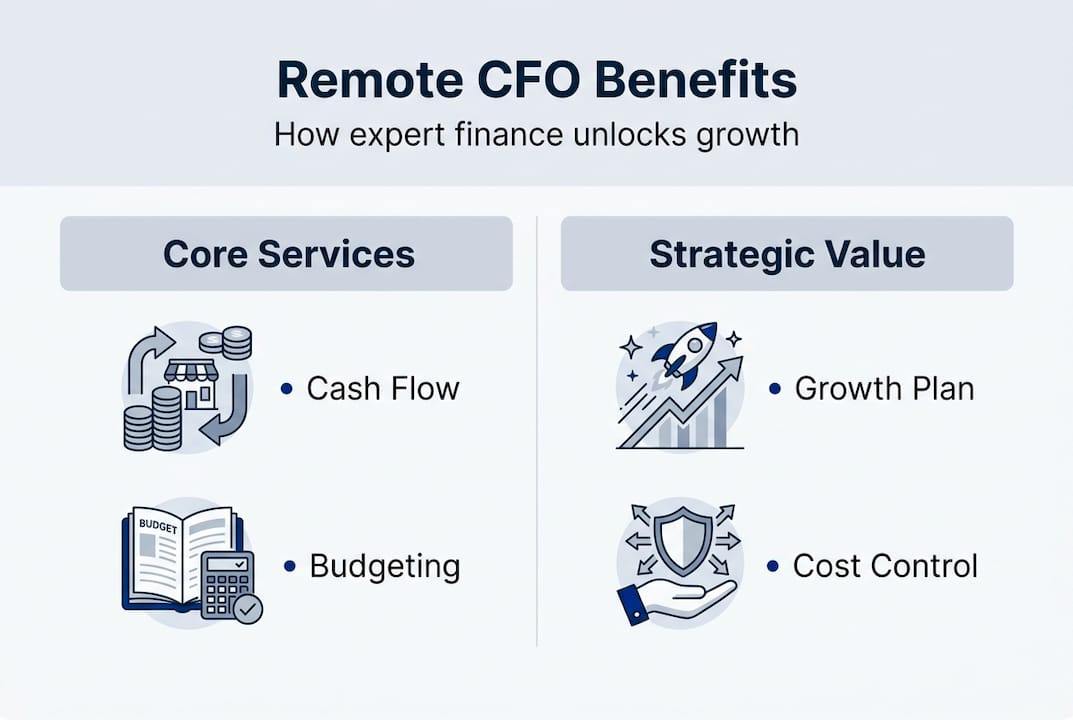
Infographic showing remote CFO key benefits

The delivery model matters too. Most remote CFO engagements use cloud-based tools such as QuickBooks, Xero, or specialized financial modeling platforms. You share access to your financial data, and the CFO builds, updates, and presents reports on a regular cadence, monthly, quarterly, or whatever your business needs.

Pro Tip: Before shortlisting any remote CFO, ask which accounting software and financial modeling tools they use. Compatibility with your existing systems will save hours of setup time and reduce the risk of data errors from the very start.

For SMB owners who want a deeper breakdown of how this model works in practice, a fractional CFO guide covers the engagement structure from first contact to ongoing support.

Remote vs. traditional CFO: Key differences for business owners

Understanding the structure of remote CFO services is step one. The more useful question for most business owners is: how does this actually compare to hiring someone full-time?

Here’s a direct comparison across the factors that matter most:

FactorRemote CFOTraditional in-house CFO
Cost$2,000 to $10,000/month$180,000 to $300,000+/year
AvailabilityScheduled, project-basedFull-time, on-site
Industry perspectiveBroad, cross-industry insightNarrow, company-specific
Strategic focusHighMixed with operational tasks
Integration depthModerateDeep
FlexibilityHigh, scalable up or downLow, fixed commitment
Onboarding timeDays to weeksMonths

The strategic focus column deserves particular attention. A traditional CFO often gets pulled into operational fire-fighting: signing checks, managing the accounting team, handling compliance deadlines. A remote CFO, by contrast, stays at the strategic level by design.

“Fractional CFOs bring unbiased views and industry benchmarks but are less embedded in the day-to-day.” That distance is actually an asset. It means the advice you get is grounded in what works across multiple businesses, not just what feels comfortable inside yours.

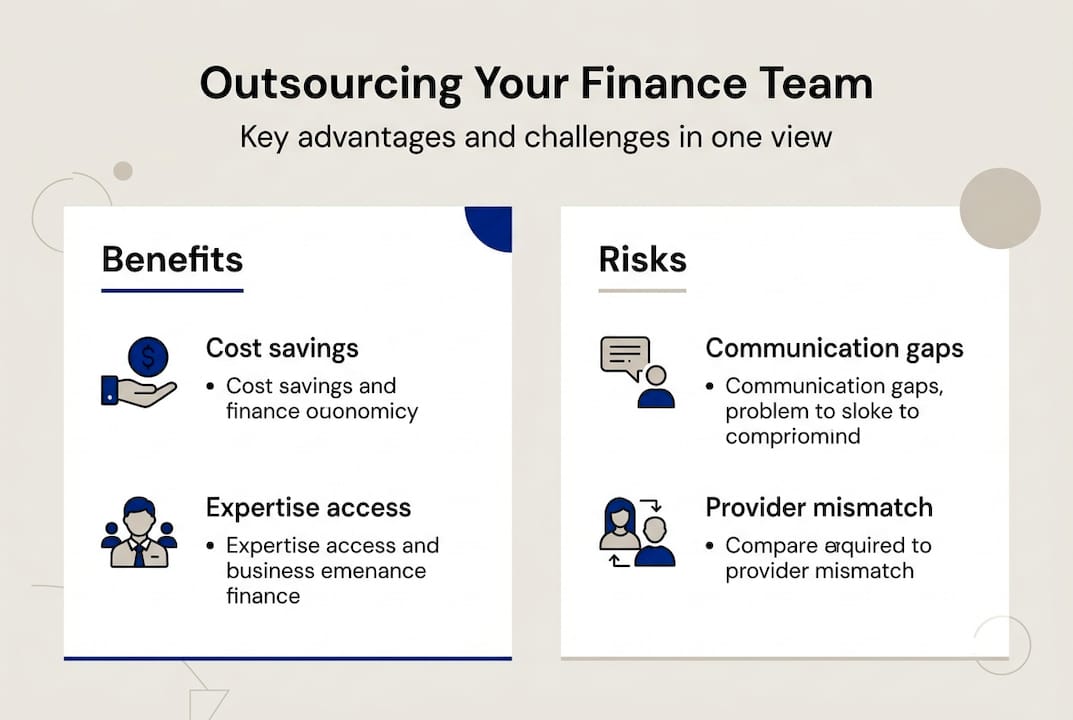
Advantages of a remote CFO:

  • Lower cost with immediate access to senior expertise
  • Fresh perspective unclouded by internal politics
  • Broad benchmarking from working across multiple industries
  • Scales as your business grows or contracts
  • Faster to engage than a full recruitment process

Disadvantages of a remote CFO:

  • Less day-to-day operational involvement
  • May require stronger internal bookkeeping support
  • Relationship building takes intentional effort in a virtual setup

Advantages of a traditional in-house CFO:

  • Deep integration with your team and operations
  • Available for real-time decisions and daily financial oversight
  • Stronger relationship with lenders, auditors, and internal staff

Disadvantages of a traditional in-house CFO:

  • High fixed cost regardless of business performance
  • Can develop blind spots from being too close to the business
  • Slower to hire and expensive to replace

Understanding these finance leadership differences helps you match the right model to your business stage. Most SMBs earning between $500K and $10 million will get far more strategic value per dollar from a remote CFO than from a full-time hire. And knowing specifically what fractional CFO duties look like in practice makes it easier to set clear expectations before signing anything.

Strategic benefits of remote CFO services for SMBs

Comparing options is useful, but what really matters is what a remote CFO actually does for your bottom line. The benefits are concrete, measurable, and often underestimated by business owners who have never worked with a CFO-level advisor before.

Remote CFOs focus on strategic improvement rather than day-to-day operations, and that focus translates into real business outcomes. Here are the most common strategic deliverables and what they deliver:

Team discussing strategic finance with laptops

DeliverableWhat it solvesBusiness impact
13-week cash flow forecastCash shortfalls and surprise gapsAvoids emergency borrowing
Financial model with scenariosUncertainty in growth planningConfident investment decisions
Profitability analysis by product/serviceHidden loss-making revenue streamsMargin improvement
Industry benchmarking reportUnknown performance gapsCompetitive cost structure
Fundraising-ready financial packageInvestor skepticismFaster, better-term capital

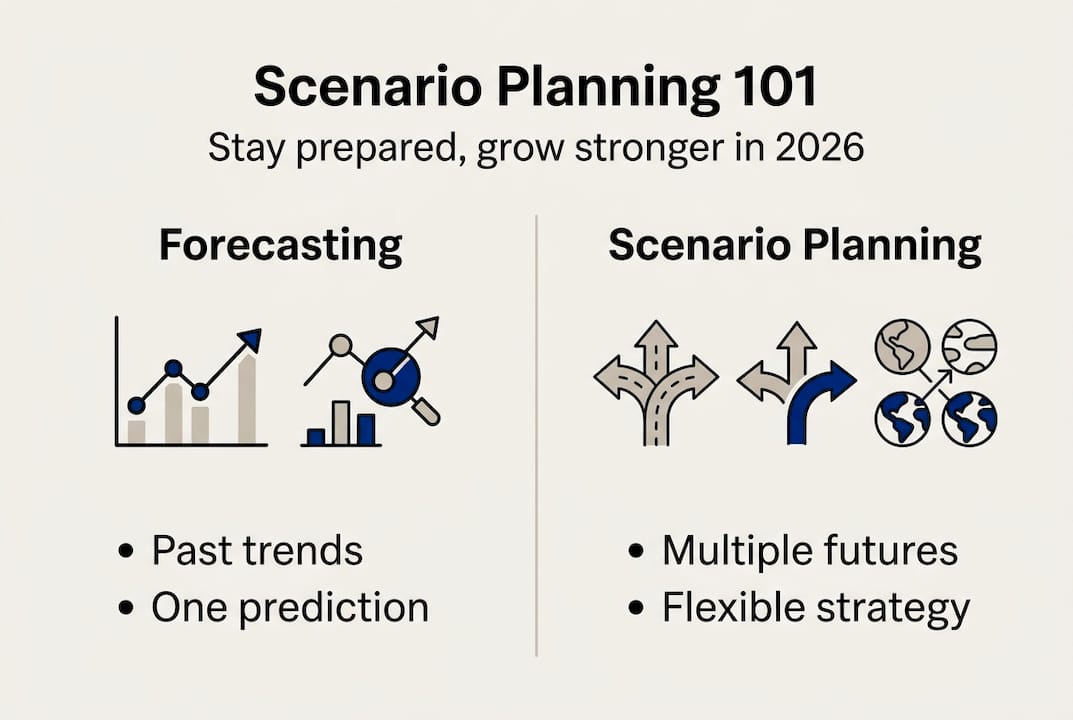
Scenario planning is one of the most powerful tools in a remote CFO’s kit. When you’re deciding whether to hire two more sales reps, open a second location, or take on a large contract, the risk feels intuitive but the numbers are fuzzy. A remote CFO builds the model that shows you what your cash looks like under each decision, so you stop guessing and start choosing with evidence.

Here’s how to integrate a remote CFO into your business effectively:

  1. Audit your current financial data quality. Clean, accurate books are the foundation. Before your CFO can forecast, they need reliable historical data.
  2. Define your top three financial priorities. Growth funding? Cash flow stability? Margin improvement? A focused mandate drives faster results.
  3. Establish a reporting cadence. Agree on when and how you’ll meet, what reports will be delivered, and who owns the numbers internally.
  4. Assign an internal point of contact. This is usually your bookkeeper or office manager. They’ll handle data requests and keep the workflow moving.
  5. Review progress monthly. Set a monthly check-in to review actuals versus forecast, discuss variances, and adjust strategy accordingly.

This process sounds simple, but most SMBs skip step one and two, which leads to wasted time and frustration on both sides. A remote CFO is not a miracle worker. They need accurate inputs and a clear mandate to deliver results.

For business owners wondering whether the timing is right, a guide on when to hire a CFO outlines the specific financial signals that suggest you’re ready. And if you want broader context on how CFO services fit into SMB growth strategy, the SME CFO services guide covers the full picture.

Pro Tip: Before signing any remote CFO contract, document your top three deliverables in writing. This gives both sides clear accountability and makes it easy to measure whether the engagement is delivering value after 90 days.

How to choose and get started with a remote CFO

With the benefits clear, the next step is finding the right partner. The market for remote CFO services has grown significantly, and not every provider offers the same depth of expertise. Selection should be based on industry experience, tech stack, and deliverables, not just price or availability.

Here’s a step-by-step process for evaluating and engaging a remote CFO:

  1. Define your scope before you start searching. Do you need ongoing monthly support, a one-time financial model, or help preparing for a fundraise? Knowing this narrows your search considerably.
  2. Build a shortlist based on industry experience. A CFO who has worked with SaaS companies will understand your metrics. One who specializes in manufacturing understands your cost structure. Match their background to your business model.
  3. Evaluate their technology. Ask specifically which tools they use for modeling, reporting, and communication. They should be fluent in at least one major accounting platform and a modeling tool like Excel, Google Sheets, or dedicated FP&A (financial planning and analysis) software.
  4. Request a sample deliverable. Ask to see an anonymized financial model or report they’ve produced for a similar client. This tells you more than any sales conversation.
  5. Run a paid pilot project. Before committing to a long-term contract, engage the CFO for a defined project such as a cash flow forecast or a profitability review. You’ll learn quickly whether the working relationship fits.
  6. Negotiate a clear contract. Define deliverables, response times, reporting formats, and exit terms upfront. Ambiguity in the contract leads to frustration later.

Before you hire, ask these essential questions:

  • What industries have you served, and do you have clients similar to mine?
  • What does your typical monthly engagement look like in terms of hours and deliverables?
  • How do you handle urgent financial questions outside of scheduled calls?
  • Can you provide references from clients at a similar revenue stage?
  • How do you stay current on industry benchmarks and regulatory changes relevant to my business?

Good strategic finance practices start with choosing the right partner, not just the cheapest one. Many SMBs make the mistake of comparing remote CFO fees to bookkeeping rates. That’s the wrong benchmark. The right comparison is the value of the decisions a CFO enables versus the cost of making those decisions without good data.

It’s also worth understanding where a remote CFO fits in relation to your existing financial support. If you’re unsure about the division of responsibilities, reading about the difference between a bookkeeper and CFO can clarify who does what and ensure your team structure actually supports strategic growth rather than just compliance.

Why most SMBs underestimate remote CFO impact

Here’s an uncomfortable truth: most SMB owners who hesitate on remote CFO services aren’t actually worried about cost. They’re worried it won’t work for a business their size. That belief is wrong, and it’s one of the most expensive assumptions a growing business can make.

The businesses that benefit most from remote CFO services are not the ones with complex org charts or investor boards. They’re the ones making major decisions, like taking on debt, hiring aggressively, or launching a new product line, without a single financial model to guide them. That’s where the risk lives. And that’s exactly where a remote CFO adds the most value.

Remote CFOs bring perspective that internal teams simply cannot generate on their own. They’ve seen how similar businesses handled similar crossroads. They carry benchmarks from across industries. They read the warning signs in your cash flow that you’re too close to the business to notice. These CFO need signals often appear long before a crisis hits, but only someone trained to read them can act in time.

The real missed opportunity isn’t paying for a remote CFO. It’s the cost of every strategic decision made without one: the pricing model that quietly erodes your margins, the growth investment that misses its targets, or the cash crunch that forces a rushed loan at unfavorable terms. Strategic finance is not a luxury. For any SMB serious about growth, it’s the foundation everything else is built on.

Get started: Unlock SMB growth with remote CFO solutions

If this article has clarified what remote CFO services can do for your business, the next move is simple: explore what a tailored engagement looks like for your specific situation.
https://johngalt-finance.com

At John Galt Finance, we work with SMBs across diverse industries to deliver outsourced CFO-level expertise without the full-time price tag. Our services include financial modeling for growth tailored to your business model, a cash flow forecasting guide to help you anticipate and manage liquidity, and strategic financial planning that positions your company for sustainable expansion. Whether you’re preparing for a fundraise, optimizing margins, or simply trying to understand where your money goes, our fractional CFO solutions are built to move fast and deliver results that actually show up in your financials.

Frequently asked questions

What does a remote CFO service include?

Remote CFO services typically cover financial planning, budgeting, cash flow management, and strategic guidance delivered virtually, including services like strategic finance and benchmarking tailored to your business stage and industry.

Is a remote CFO as effective as an in-house CFO?

Remote CFOs offer strong strategic expertise and unbiased perspectives, though as fractional CFOs focus on strategic work rather than daily operations, they are less involved in routine financial management than a full-time internal hire.

How do I choose the right remote CFO?

Look for industry-specific experience, technology compatibility, and clearly defined deliverables, since selection based on industry experience and deliverables is the most reliable predictor of a successful engagement.

Can remote CFOs help with cash flow and growth planning?

Yes. Remote CFOs specialize in scenario analysis and forecasting models that help SMBs plan for growth, manage risk, and maintain healthy liquidity across different business conditions.

FAQ

Can a remote CFO be as effective as on-site?

Yes for 95% of CFO work, which is analytical (modeling, forecasting, board prep). On-site adds value for team management, deal negotiation, and culture work. Most SMBs are better served by a senior remote CFO than a junior on-site one at the same cost.

What tools make remote CFO work effective?

Standard stack: cloud accounting (QuickBooks Online or Xero), shared docs (Google Workspace), messaging (Slack), async video (Loom), forecasting (Excel or a tool like Jirav/Fathom). The bottleneck is rarely tools; it’s data hygiene in the accounting system.

How do I evaluate a remote CFO?

Three checks: (1) sample deliverables (board pack, cash forecast), (2) reference calls with 2-3 current clients your size, (3) trial 30-day diagnostic engagement before signing 12 months. Avoid anyone who can’t show specific work product from comparable companies.

What time zones work for US SMBs?

4+ hours of overlap with your business day is the practical minimum. Eastern Europe and Latin America are the most common offshore CFO talent pools. Asia-based providers require either night work or strict async discipline; this usually trades cost for slower iteration.

How does a remote CFO integrate with my existing bookkeeper?

The bookkeeper owns transactional accuracy (close, reconciliations, AR/AP). The remote CFO owns forecasting, reporting, and strategy. Define handoffs in writing: bookkeeper closes by business day 7, CFO delivers variance and forecast by business day 10. See our outsourced finance team guide for org design.


Share this:

Outsource your finance team for strategic growth

Outsourced Finance Team Benchmarks

MetricBenchmark
Cost savings vs in-house finance team40-60%
Typical outsourced finance team cost (SMB)$2,500-$15,000/month
Standard team structureBookkeeper + controller + fractional CFO
In-house equivalent cost (US)$200,000-$400,000/year fully loaded
Typical onboarding time30-60 days
Revenue range fit$500k-$25M
Standard close cadence deliveredMonthly close in 7-10 days
Tools commonly includedQuickBooks/Xero, bill.com, Gusto, expense management

Most small business owners assume outsourced finance is a luxury reserved for large enterprises with complex needs. That assumption is costing them. Businesses with 5 to 50 employees that bring in outsourced financial expertise report measurable improvements in cash flow visibility, faster decision-making, and stronger internal controls. Outsourced finance teams reduce fraud, introduce cross-industry best practices, and give you CFO-level guidance without the full-time salary. This article breaks down what outsourced finance actually means for SMEs, what genuine benefits you can expect, and how to choose and implement the right team for your business.

Table of Contents

Key Takeaways

PointDetails
Expertise on demandOutsourced finance teams bring specialized knowledge that can guide business growth strategies.
Risk and fraud reductionUsing an external team strengthens internal controls, reducing risk and preventing fraud.
Process improvementsCross-industry best practices help streamline operations and enhance financial decision making.
Choose with careSelecting teams with industry experience and clear agreements is crucial for success.

Understanding outsourced finance teams

An outsourced finance team is an external group of professionals who handle some or all of your company’s financial operations. Unlike hiring a single bookkeeper or part-time accountant, an outsourced team typically includes specialists across multiple disciplines: bookkeeping, management reporting, cash flow management, budgeting, forecasting, and strategic financial planning. Think of it as a finance department you access on a flexible, scalable basis.

Businesses usually reach out for this kind of support at a specific inflection point. Maybe revenue has grown past $500k and internal tracking no longer cuts it. Maybe a lender is asking for financial statements you cannot produce confidently. Or maybe a turnaround situation demands a level of financial analysis your team simply does not have. Knowing the signs you need a CFO early can save you months of costly guesswork.

Here is what a typical outsourced finance team covers:

  • Bookkeeping and reconciliations: Keeping your records clean and current
  • Monthly management reporting: Profit and loss statements, balance sheets, dashboards
  • Cash flow forecasting: Projecting inflows and outflows weeks or months ahead
  • Financial planning and analysis: Budgeting, scenario modeling, KPI tracking
  • Strategic CFO support: Fundraising preparation, pricing strategy, operational decisions

One of the most underappreciated advantages is the cross-industry perspective these teams bring. When a firm works with dozens of businesses across retail, services, manufacturing, and technology, they carry pattern recognition that an in-house hire simply cannot develop. They have seen what works and what fails across many different business models.

“Outsourced teams reduce fraud via segregation of duties and bring cross-industry best practices; select providers with industry experience and clear SLAs to avoid common pitfalls.” — U.S. Chamber of Commerce

For SMEs, the combination of cost efficiency and depth of expertise is the real draw. You get access to CFO services for SMEs that would otherwise require a senior hire costing $150,000 or more per year. That comparison alone is often enough to make the decision straightforward.

Key benefits of outsourcing your finance function

Let’s go beyond the obvious cost argument. Cost savings matter, but they are just the starting point. Here is what outsourcing your finance function actually delivers when done right.

Expertise on demand. You get access to professionals who have solved complex financial problems across multiple industries. This means your cash flow model is not being built by someone who learned on the job at one company. It is built by someone who has modeled cash flow for dozens of businesses and knows exactly where the traps are.

Finance consultant reviewing spreadsheet in home office

Stronger internal controls. Small teams are vulnerable to fraud, especially when one person handles both recordkeeping and payments. Segregation of duties is a core fraud prevention principle, and outsourced teams naturally enforce it because multiple professionals handle different parts of the financial process.

Best-in-class processes. Outsourced providers invest in tools, technology, and systems that most SMEs cannot justify on their own. Cloud accounting platforms, automated reconciliation, real-time dashboards. These tools support solid SME financial management without the overhead of building those systems internally.

Cost comparison: outsourced vs. in-house finance

FunctionIn-house annual costOutsourced annual cost
Bookkeeper$45,000–$60,000$12,000–$24,000
Controller$90,000–$130,000$24,000–$48,000
CFO$150,000–$250,000$36,000–$84,000
Total (all three)$285,000–$440,000$72,000–$156,000

The numbers tell the story. For most SMEs generating $500k to $10 million in revenue, a full in-house finance team is out of reach. An outsourced team delivers equivalent or better output at a fraction of the cost.

Pro Tip: Ask your outsourced provider which specific processes they have brought from other industries that could apply to your business. The best ones will have concrete examples. If they cannot answer that question clearly, that tells you something important about the value they deliver.

You also gain access to strategic finance best practices built from real-world experience across business types. This is not generic advice. It is pattern-based insight applied directly to your numbers.

Challenges and what to watch for in outsourcing finance

Not every outsourcing arrangement works out. Owners who have had bad experiences usually point to the same issues: vague agreements, poor communication, or a provider who lacked relevant industry knowledge. These are real risks, and knowing them upfront is what separates a smart hire from a costly mistake.

Here are the most common challenges you need to watch for:

  1. Misaligned expectations. If you expect a monthly strategy call and they deliver a quarterly report, neither side wins. Define deliverables in writing before you sign anything.
  2. Weak communication rhythms. Finance is not a set-it-and-forget-it function. You need regular touchpoints, clear escalation paths, and someone who responds when a problem surfaces.
  3. Lack of industry experience. A generalist team may not understand the unit economics of your specific business model. A SaaS company has very different financial dynamics than a construction firm.
  4. Vague service agreements. Without clear SLAs, you have no way to hold your provider accountable for quality, turnaround times, or scope of work.

“Select providers with industry experience and clear SLAs to avoid common pitfalls.” — U.S. Chamber of Commerce

Pro Tip: Before signing a contract, ask your provider to describe three situations where they delivered value beyond basic reporting to a business similar to yours. Listen for specific examples, not general claims. Vague answers are a red flag.

Part of mitigating financial risks is knowing what red flags look like before you are inside a problematic contract. Watch out for providers who cannot name tools they use, who resist regular review meetings, or who do not have a clear onboarding process. These are CFO warning signs that a team is not operationally ready for your needs.

The solution is always the same: vet thoroughly, demand specifics, and treat the early weeks of the engagement as a probationary period where both sides are still building trust and rhythm.

How to successfully choose and implement an outsourced finance team

With a clear picture of the risks, the next step is building a process for selecting and rolling out the right team. This is where many owners stumble because they treat the search like a vendor procurement rather than a strategic hire. It is closer to the latter.

Step-by-step selection and implementation:

  1. Assess your needs. What does your business actually require? Start with a list of financial functions you need covered, then rank them by urgency.
  2. Evaluate providers. Interview at least three firms. Ask specifically about industry experience, team structure, and the technology they use.
  3. Review the service agreement carefully. Look for scope, deliverables, escalation procedures, and exit terms. Ambiguity here causes conflict later.
  4. Run a structured onboarding. Share historical financials, explain your business model, and walk the team through your current processes before they take anything over.
  5. Set a 90-day review. Build in a formal check-in within the first three months to assess fit, quality, and communication before the relationship becomes entrenched.

Provider evaluation criteria

CriteriaWhat to look for
Industry experienceSpecific examples from your sector
Technology stackCloud tools, automation, real-time reporting
Team structureWho handles your account day to day
Communication cadenceWeekly, monthly, ad-hoc availability
SLA clarityDefined turnaround times and deliverables
ReferencesVerifiable client outcomes

A well-matched provider will also support custom financial modeling tailored to your specific business model, not just generic spreadsheets. That modeling becomes the foundation for better decisions and eventually supports your ability to pursue attracting business financing when growth demands it.

Infographic showing finance outsourcing benefits and risks

Periodic reviews are not optional. Treat them as a standing agenda item, not a task you return to when something goes wrong.

Why the best outsourced finance teams drive more than just savings

Here is an uncomfortable truth most business owners do not hear: cost savings are the least interesting thing an outsourced finance team can do for you. The SMEs that extract the most value are not focused on cutting the salary line. They are focused on what the team sees that they cannot.

A skilled outsourced team reviews your numbers every month with fresh eyes and cross-industry pattern recognition. They notice when your gross margin is compressing before you feel it in cash. They flag when a pricing assumption has quietly stopped working. They bring the finance best practices of businesses two or three steps ahead of yours and apply them now.

Outsourcing your finance function is not about giving up control. It is about getting access to a more powerful playbook than you could build with an internal team at this stage of growth. The businesses that treat their outsourced finance team as a strategic partner, not a back-office vendor, consistently make better decisions, catch risks earlier, and grow faster. That is the real return on investment.

Ready to elevate your business with expert finance support?

Applying these insights starts with having the right financial infrastructure around your business. If you are scaling, navigating a turnaround, or simply trying to get clear visibility into your numbers, the right support makes the difference between reacting to problems and staying ahead of them.

https://johngalt-finance.com

At John Galt Finance, we work with SMEs to build that infrastructure from the ground up. Whether you need a structured financial planning for business owners approach, a solid cash flow forecasting guide to manage liquidity, or ongoing fractional CFO services to guide strategic decisions, we bring the expertise your business needs without the overhead of a full-time hire. Explore how we can support your next stage of growth.

Frequently asked questions

What is an outsourced finance team and how is it different from an in-house team?

An outsourced finance team is an external group of experts who provide finance and accounting services for your business, typically delivering broader expertise at lower cost than building an in-house team. Unlike a single in-house hire, they bring best practices from multiple industries and naturally enforce internal controls through team structure.

How can an outsourced finance team help prevent fraud?

They apply segregation of duties across team members, so no single person controls both recording and approving transactions. This structure, highlighted by the U.S. Chamber of Commerce, is significantly harder to maintain with small in-house teams or solo bookkeepers.

What are the risks of outsourcing finance?

The main risks are unclear expectations, poor communication, and providers without relevant industry experience, but choosing teams with clear SLAs and specific sector knowledge eliminates most of these issues before they start.

When is the right time for my business to consider outsourcing finance?

Consider outsourcing when your financial complexity has outgrown your current setup, when you need reporting quality for lenders or investors, or when a scaling or turnaround situation requires professional financial guidance you do not have internally.

How do I choose the best outsourced finance provider?

Assess their industry-specific experience, review the service agreement for clear deliverables and SLA accountability, verify references from similar businesses, and ensure the team structure gives you a consistent point of contact.

FAQ

What does an outsourced finance team actually do?

Three layers: (1) bookkeeper handles transactions, reconciliations, payroll, AR/AP, (2) controller owns monthly close, reporting, and compliance, (3) fractional CFO provides forecasting, strategy, and board support. You can outsource one layer or all three.

How does outsourced finance compare to hiring in-house?

In-house: deeper context, faster ad-hoc response, harder to scale up or down. Outsourced: 40-60% cheaper, scalable, more senior expertise per dollar, but requires clear scope. Most SMBs under $25M revenue save money and improve quality by outsourcing.

What’s the right team structure for my size?

$500k-$2M: bookkeeper + quarterly CFO. $2M-$10M: bookkeeper + monthly fractional CFO. $10M-$25M: bookkeeper + controller + fractional CFO. $25M+: hire in-house controller, keep fractional CFO until full-time CFO hire is justified.

How do I transition from in-house to outsourced?

60-day overlap is standard: weeks 1-4 the outsourced team shadows, weeks 5-8 they take over with in-house oversight, week 9 onward they run solo. Avoid hard cutovers; institutional knowledge always gets lost without an overlap.

What are the risks of outsourcing finance?

Three real risks: (1) data security (require SOC 2 or equivalent), (2) loss of institutional knowledge if turnover happens, (3) misaligned incentives if pricing is hours-based. Mitigate with documented processes, named lead person in contract, and outcome-based scope.

Share this:

Unlock profitability with industry-specific financial analysis

Industry-Specific Margin Benchmarks

IndustryGross Margin / Key Metric
SaaS / Software70-85% gross margin (Bessemer)
Professional services40-60% gross margin, 60-75% utilization target
Restaurants60-70% gross margin, 3-9% net margin
Retail (specialty)30-50% gross margin, 2-6% net margin
Manufacturing25-45% gross margin, 5-10% net margin
Construction15-30% gross margin, 3-8% net margin
Distribution / Wholesale15-30% gross margin, 2-5% net margin
Healthcare services40-60% gross margin, 8-15% net margin

Most business owners run their finances using generic rules of thumb, comparing their margins to national averages or whatever benchmark shows up first in a Google search. That approach is not just imprecise; it can actively mislead you. A 20% gross margin looks like a red flag in SaaS but signals decent health in grocery retail. Industry-specific benchmarks are the only reliable foundation for meaningful financial decisions. This guide walks you through the frameworks, key ratios, and practical applications that SMB owners need to stop guessing and start improving profitability with real precision.

Table of Contents

Key Takeaways

PointDetails
Industry context is crucialComparing your business only to peer benchmarks unlocks real financial insight and avoids costly mistakes.
Use sector-specific KPIsGross margin, current ratio, DSO, and other key metrics should always be measured against industry benchmarks.
Outsourced CFOs add valueThey deliver holistic analysis, dashboards, and strategy tailored to your industry for a fraction of the full-time cost.
Dashboards enable actionKPI dashboards provide real-time clarity, helping you spot trends and improve profitability before issues escalate.
Turn analysis into resultsApply industry-specific insights to pricing, cost controls, and receivables to drive meaningful profit growth.

Why industry context matters in financial analysis

When you apply a ratio without sector context, you are essentially using a thermometer to measure wind speed. The tool is real, but the reading is meaningless. Key ratios like gross margin or current ratio mean fundamentally different things depending on your industry’s cost structure, payment cycles, and capital intensity.

Take gross margin as a straightforward example. A SaaS company delivering software to thousands of customers with minimal incremental cost can realistically achieve 70 to 80% gross margins. A retail clothing store managing physical inventory, returns, and storage costs might celebrate a 45% gross margin. If the clothing store owner benchmarks against SaaS peers, they will feel perpetually behind on a race they were never running.

The current ratio, which measures short-term assets against short-term liabilities, also tells a different story by sector. For most manufacturers, a current ratio above 1.5 signals solid liquidity. For grocery chains that collect cash before paying suppliers, ratios below 1.0 are perfectly normal and healthy. Context is everything.

“A 30% net margin is extraordinary in professional services but a warning signal in distribution, where margins of 3 to 6% are the standard operating range.”

Here is why peer benchmarks matter more than static targets:

  • Realistic goal-setting: Peer data shows what is actually achievable in your market conditions, not what a textbook considers ideal.
  • Investor and lender expectations: Banks and private equity firms evaluate you against sector norms. Exceeding or falling below those norms triggers scrutiny.
  • Trend spotting: A ratio moving away from your sector’s average over several quarters is an early warning system, even if the absolute number still looks acceptable.
  • Negotiating power: Understanding where you sit in your competitive landscape strengthens your position in pricing, supplier negotiations, and financing discussions.

To get the most out of financial metrics for SMBs, you need to pair every ratio with its industry-specific green zone and track movement over time, not just a single snapshot.

Pro Tip: Never benchmark yourself against a company in a different business model, even within the same broad industry. A franchise restaurant and a fine-dining independent operate on completely different economic structures.

Core financial metrics and how to benchmark them

Understanding which ratios to prioritize saves you from drowning in spreadsheet noise. Below are the six metrics that drive the most strategic decisions for SMBs, along with what healthy looks like by sector.

“SME net profit ranges 5 to 15%, SaaS gross margin hits 75%, retail sits at 28%, and cafes land between 60 and 70%, proving that context is everything.”

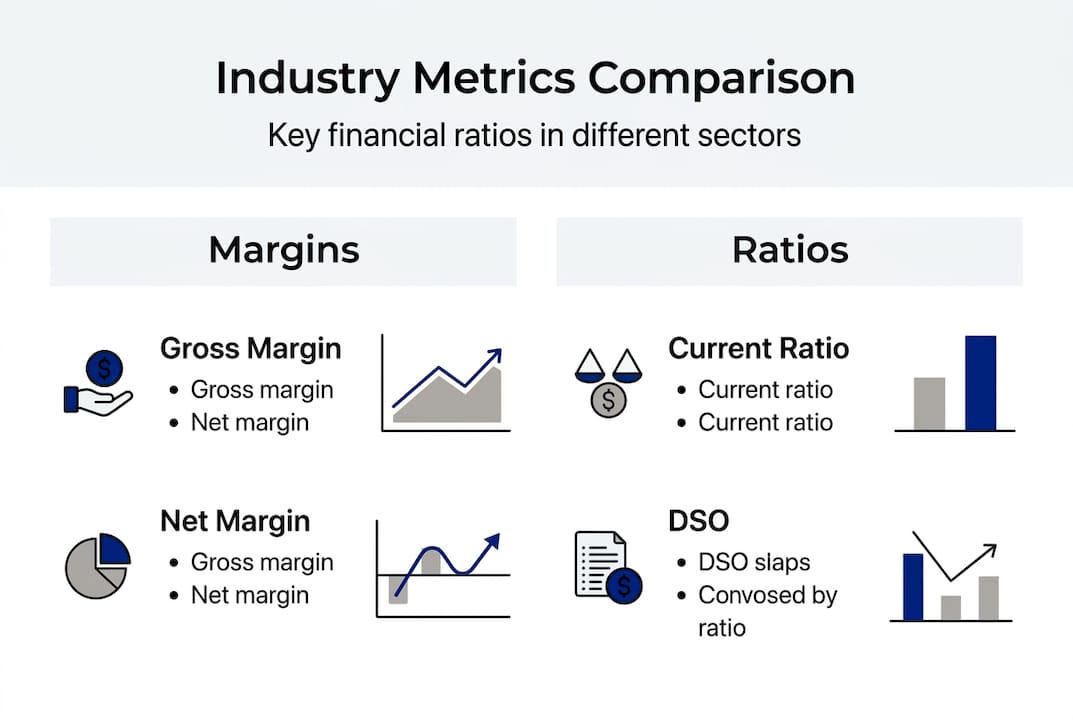
IndustryGross MarginNet MarginCurrent RatioDSO (days)Debt-to-Equity
SaaS / Tech70 to 80%10 to 25%1.5 to 3.030 to 45Low (0.3 to 0.8)
Retail25 to 50%2 to 6%1.2 to 2.05 to 15Moderate
Cafes / Food60 to 70%3 to 9%0.8 to 1.5N/A (cash)Moderate to High
Manufacturing20 to 40%4 to 10%1.5 to 2.540 to 60Higher accepted
Professional Services40 to 70%10 to 20%1.5 to 2.530 to 50Low

Infographic comparing core financial metrics

According to the 2026 small business revenue report, industry benchmarks continue to shift year over year, making it critical to refresh your reference points annually rather than relying on data from three years ago.

Here is a quick reference for when each metric takes priority:

  • Gross Profit Margin: Always top priority when evaluating pricing strategy or product mix decisions.
  • Net Profit Margin: Critical for owner distributions, investor reporting, and assessing overall business sustainability.
  • Current Ratio: Front and center when managing cash flow or approaching a line of credit renewal.
  • Debt-to-Equity: Key when planning capital investments or seeking growth financing.
  • DSO (Days Sales Outstanding): Essential for any business extending credit terms, measured as DSO under 40 to 60 days for most sectors.
  • DIO (Days Inventory Outstanding): A top lever for manufacturers and retailers managing working capital.

For businesses serious about tracking key KPIs consistently, building a monthly dashboard that flags deviations from sector norms is far more effective than reviewing static reports quarterly.

How outsourced CFOs tailor analysis to your industry

Knowing what to measure is one thing. Knowing how to interpret it, model it, and act on it is where most SMB owners hit a wall. That is exactly the gap an outsourced CFO fills without the $200,000-plus annual salary of a full-time hire.

Outsourced CFO creating scenario plan

Outsourced CFO methodologies include financial modeling, scenario planning, 13-week cash flow forecasting, and KPI dashboard visualization, all customized to your industry’s specific drivers. A SaaS CFO focuses on monthly recurring revenue, churn rate, and customer acquisition cost payback. A manufacturing CFO prioritizes throughput, overhead absorption, and inventory turns. The tools are similar; the calibration is completely different.

FeatureOutsourced CFOFull-time CFO
Monthly cost$3,000 to $25,000$200,000+ per year
Engagement flexibilityProject or ongoingFixed employment
Industry specializationSelector-based expertiseGeneral background
ScalabilityScales with business needsFixed capacity
Onboarding speedWeeksMonths

The cost comparison alone makes outsourced CFO services attractive, but the real value is in the methodology. Here is how a skilled outsourced CFO typically approaches industry-specific analysis:

  1. Audit current reporting: Identify gaps between what you are tracking and what your sector actually requires for meaningful decisions.
  2. Build an industry-calibrated model: Develop financial models using your sector’s cost structure, revenue drivers, and working capital patterns.
  3. Set sector-appropriate KPI targets: Define what ‘good’ looks like for your specific business, not the industry average alone.
  4. Implement real-time dashboards: Replace monthly static reports with live data tools that surface issues as they emerge.
  5. Run scenario and sensitivity analysis: Test how changes in pricing, volume, or costs affect profitability under your industry’s actual constraints.

If you want to see how this process works in practice, the custom financial modeling processes that drive real SMB growth are worth reviewing. For businesses focused on the bottom line, management for SME profitability covers how ongoing financial oversight compounds gains over time.

Pro Tip: Customizing your analysis framework to your industry reduces the risk of acting on a metric that looks alarming but is actually normal for your sector, saving both time and costly decisions.

Turning industry analysis into profits: Real-world applications

Frameworks and ratios only matter if they change how you operate. Here is what applying industry-specific analysis actually looks like at the business level.

Consider a retail SMB struggling with cash flow despite decent sales. By benchmarking their Days Inventory Outstanding against sector norms, they discovered they were holding 90 days of stock when the industry average was 45 days. Cutting excess inventory freed up working capital equivalent to three months of operating expenses. That cash went directly into marketing, generating a measurable revenue lift.

A B2B SaaS firm saw their DSO creeping toward 75 days, well above the sector target of 30 to 45. By analyzing which customer segments paid slowest, they restructured billing terms and added automated payment reminders. Collections improved by 40% within two quarters, reducing reliance on their credit line and cutting interest costs.

Here are the core profit levers by industry that analytics can expose:

  • SaaS / Tech: Reduce churn, optimize pricing tiers, and shorten collections cycles.
  • Retail: Align inventory to DIO benchmarks, improve supplier payment terms, and analyze product-level margins.
  • Food and beverage: Control food cost percentages, manage labor scheduling, and monitor table turn rates.
  • Manufacturing: Improve throughput, reduce scrap rates, and optimize overhead absorption.
  • Professional services: Bill more hours, reduce unbilled work in progress, and manage project profitability by client.

Tracking the right metrics consistently is what makes these levers accessible. SMB average revenue sits around $672,000 annually, but IT-sector businesses average $185,000 per month, a gap explained almost entirely by industry-specific economics and how effectively owners leverage financial data.

For businesses ready to move from awareness to execution, mastering financial KPIs is where that translation happens. You can also reference small business earnings data for current sector-level context to validate your own targets.

Pro Tip: Use a KPI dashboard updated at least weekly to catch trends early. A DSO that climbs 10 days over two months is far easier to reverse than one that has drifted for an entire year.

The uncomfortable truth about financial benchmarks

Here is what most articles about benchmarks will not tell you: the average benchmark is the least useful number in the dataset. Aiming for the industry average means aiming to be mediocre by definition. The businesses we see actually improving profitability are not chasing averages. They are identifying which specific metrics their sector’s top performers prioritize and closing the gap on those alone.

The second mistake is treating benchmarks as static. Markets shift. A gross margin that was competitive in 2022 might be genuinely weak today. Cross-industry margin comparisons are unreliable, but so are outdated same-industry benchmarks. You need current data paired with current trend analysis, not a number from a report three years old.

Spreadsheets also create a false sense of precision. A number is not an insight. Context, direction, and causation are insights. Business intelligence tools and expert guidance surface what raw data cannot: why a ratio is moving and what to do next. Exploring the benefits of SME CFO services shows how structured oversight turns numbers into decisions that actually shift outcomes.

Next steps: Get actionable industry-specific insights

Understanding your financial position relative to your sector is the starting point, but sustaining improvement requires ongoing analysis, not a one-time checkup. If the frameworks in this guide clarified what you should be measuring, the next step is building the systems to measure it consistently.

https://johngalt-finance.com

John Galt Finance helps SMBs implement exactly this kind of structured, industry-calibrated financial oversight. From business financial planning to a detailed cash flow forecasting guide and custom financial modeling solutions, the platform is built for business owners who want CFO-level insight without the full-time overhead. Book a diagnostic session to see exactly where your numbers stand against your sector’s benchmarks.

Frequently asked questions

What are the most important financial ratios for my industry?

Gross profit margin, net profit margin, and current ratio are essential starting points, but the target values vary significantly by sector. Industry-specific ratios like a 75% gross margin for SaaS versus 28% for retail illustrate why sector benchmarks must anchor your interpretation.

How can I tell if my margins are healthy?

Compare your margins directly to recent data from businesses in your same sector, not generic business rules. Empirical benchmarks confirm that SaaS gross margins average 75% and cafes land between 60 and 70%, so your reference point must match your business model.

What does an outsourced CFO do differently from my accountant?

Your accountant records and reports what happened. An outsourced CFO uses modeling, scenario planning, forecasting, and KPI dashboards to guide what should happen next, with strategies built around your specific industry’s economics.

How much do outsourced CFO services cost for SMEs?

Outsourced CFO fees typically run from $3,000 to $25,000 per month depending on scope and complexity. That is a significant difference from the $200,000-plus annual cost of a full-time hire, making it accessible for most growth-stage SMBs.

Why isn’t comparing my business to other industries reliable?

Every industry operates on different cost structures, payment cycles, and capital requirements, so a ratio that signals health in one sector can indicate serious risk in another. Avoid cross-industry comparisons and always anchor your analysis in peer-level, sector-matched benchmarks.

FAQ

Why do industry benchmarks matter for SMBs?

Generic financial advice fails because cost structures vary dramatically. A 25% gross margin is excellent in distribution and a disaster in SaaS. Without industry context, you can’t tell whether you’re winning or losing.

Where can I find reliable industry benchmarks?

RMA Annual Statement Studies (gold standard, paid), BizMiner (paid), IBISWorld (paid), and your trade association’s annual benchmarking report. Avoid free benchmarks aggregating data across all revenue tiers; they’re skewed by large companies and useless for SMBs.

What if my margins are below industry benchmark?

Run a three-step diagnostic: (1) pricing audit (are you under-pricing vs competitors?), (2) cost analysis (which COGS lines are above benchmark?), (3) customer mix (are low-margin customers dragging average down?). See our profit margin analysis framework.

How often should I rebenchmark?

Annually for industry medians, quarterly for your own trend. Industries shift; the 2020-2023 cost inflation reset benchmarks across most sectors. Anchoring to a 2019 benchmark in 2026 is a real risk.

What financial metrics matter most by industry?

SaaS: ARR, NRR, CAC payback. Services: utilization, billing rate, project margin. Retail: same-store sales, inventory turns, gross margin %. Manufacturing: OEE, gross margin, working capital days. Pick 5-7 KPIs specific to your model; generic KPIs miss what matters. See our SaaS financial metrics guide for SaaS depth.

Share this:

CFO-Led Financial Analysis: Smarter SME Decisions

CFO-Level Analysis Cadence & Outputs

Analysis TypeCadenceOutputDecision Driven
Cash flow forecast (13-week)WeeklyRolling liquidity viewHire freeze, debt draw, AR push
P&L variance vs. budgetMonthlyVariance commentaryOpEx cuts, re-forecast
Unit economics reviewMonthlyCAC, LTV, payback by segmentChannel mix, pricing
Pricing & margin analysisQuarterlyMargin by SKU/customerPrice changes, SKU rationalization
Scenario planningQuarterlyBest/base/downside modelHeadcount, capex commitments
Working capital reviewMonthlyDSO/DPO/DIO trendsCollections push, supplier terms
Cohort & retention analysisQuarterlyRevenue retention by cohortProduct investment, churn fixes

Most business owners treat their monthly profit-and-loss statement like a rearview mirror. It shows where you’ve been, but tells you almost nothing about where you’re headed. CFO-led financial analysis flips that model entirely. Instead of waiting for quarterly reports to reveal problems that already cost you money, it puts forward-looking, strategy-driven insights at the center of every major decision. For SMEs competing in fast-moving markets, this shift from reactive to proactive financial management isn’t a luxury. It’s the difference between growing deliberately and guessing your way forward.

Table of Contents

Key Takeaways

PointDetails
CFO-led analysis essentialsIt focuses on real-time, actionable insights so you can make better business decisions at speed.
Unique SME valueSmall and medium businesses benefit from proactive, scenario-driven financial analysis, not just periodic reports.
Balance speed and rigorQuality insights require efficient but disciplined analysis—avoid shortcuts that could hide financial risks.
Tools and frameworks matterUsing CFO-level frameworks and modern tools enables agility and more accurate forecasting.

What is CFO-led analysis?

CFO-led analysis is the practice of applying senior financial leadership to interpret business data in ways that directly inform strategy. It goes well beyond preparing financial statements or checking compliance boxes. A CFO frames financial data around the questions that actually matter to your business: Where is margin eroding? Which clients or products drain cash? What does the next 90 days look like if revenue slows by 20%?

Here’s what makes CFO-led analysis distinct from standard financial review:

  • Forward-looking by design. Instead of explaining what happened last quarter, it models what’s likely to happen next.
  • Customized to your strategy. Analysis is built around your specific growth goals, cost structure, and risk tolerance, not a generic template.
  • Grounded in scenario modeling. CFOs run multiple “what if” scenarios so you can make decisions with full visibility into the range of outcomes.
  • Tied to real-time metrics. Rather than waiting for month-end close, CFO-led analysis tracks live KPIs that signal problems early.

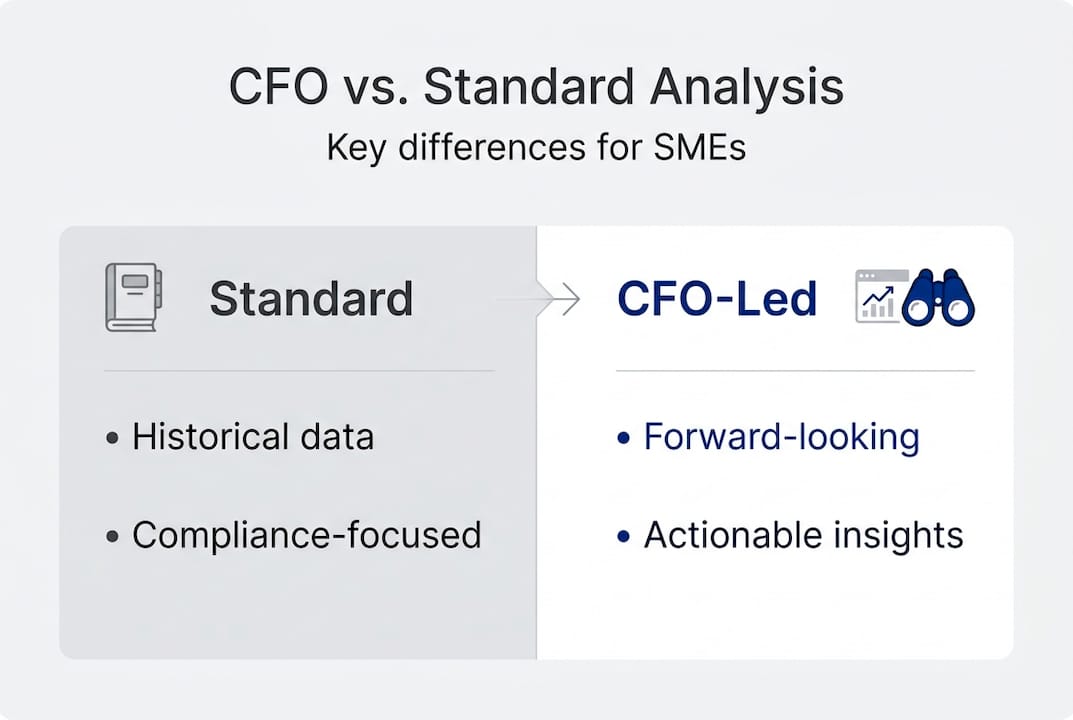
Standard financial analysis typically focuses on historical data, compliance reporting, and accurate bookkeeping. It answers, “What happened?” CFO-led analysis answers, “What should we do next and why?”

For SMEs, this distinction is critical. Research shows that CFOs influence accounting conservatism, shaping how quickly bad news surfaces in financial reports. That means the quality of your financial insight is directly tied to how your CFO structures and interprets the analysis, not just the numbers themselves.

Infographic comparing standard and CFO-led analysis

If you’ve noticed that your current financials feel disconnected from the real pressures in your business, it may be time to review the signs your business needs a CFO. And if you’re weighing whether a full-time hire is necessary, the value of CFO services for SMEs makes a strong case for flexible, outsourced options.

Pro Tip: Define your analysis scope around specific decision points, not just financial periods. Instead of asking “How did Q2 go?”, ask “What’s driving the margin gap in our top product line, and what are our options?”

The CFO skill set: What expertise drives analysis?

Not all financial professionals deliver the same level of insight. The gap between a bookkeeper, a controller, and a CFO isn’t just seniority. It’s a fundamentally different way of engaging with financial data.

Bookkeeper and CFO working in shared office

CFOs combine technical accounting knowledge with strategic forecasting, stakeholder communication, and scenario-building skills. They’re trained to balance speed against depth. Move too fast, and analysis quality suffers. Move too slow, and decisions get made without the right information. Research confirms that powerful CFOs influence the efficiency and quality trade-off in financial analysis, which is why who leads your analysis matters as much as the process itself.

AreaAccountant/ControllerCFO
Primary focusAccuracy and complianceStrategy and growth
Reporting styleBackward-lookingForward-looking
Key deliverableFinancial statementsForecasts, scenarios, KPIs
Decision supportHistorical summariesAction-ready recommendations
Risk managementFlags past issuesModels future risks

Strategic decisions a CFO-led analysis directly supports include:

  • Pricing strategy based on real margin analysis across products or services
  • Investment timing tied to cash flow cycles and projected returns
  • Cost management by identifying underperforming cost centers
  • Hiring decisions grounded in revenue-per-employee and capacity modeling
  • Fundraising readiness based on clean financial models and clear growth story

Understanding these bookkeeper vs CFO differences helps clarify why upgrading your financial leadership changes the quality of every business decision downstream. Pairing that leadership with consistent tracking of key financial metrics for SMEs creates a feedback loop that keeps strategy grounded in reality.

Pro Tip: When you meet with your financial team, don’t just ask for numbers. Ask, “What action should we take based on this data?” If they can’t answer that, your analysis process needs upgrading.

How CFO-led analysis improves business decision-making

The real value of CFO-level insight shows up when your business faces a fork in the road. Should you expand to a new market? Cut a product line? Take on debt to fund growth? Here are five concrete ways CFO-led analysis makes those calls sharper.

  1. Cash flow optimization. A CFO maps the timing of inflows and outflows to prevent cash gaps before they happen, not after payroll is at risk.
  2. Risk identification. By stress-testing your financials against adverse scenarios, CFO-led analysis spots vulnerabilities that look fine on a standard P&L.
  3. Scenario planning. You get three versions of the future (base, upside, downside) so decisions are never made on a single assumption.
  4. Investment timing. CFOs align capital spending with projected cash availability and revenue cycles, preventing overextension.
  5. Rapid response to market shifts. When conditions change fast, real-time tracking means you can adjust pricing, spending, or staffing before damage compounds.

“Balancing efficiency and analysis quality is crucial to avoid impaired decision-making in rapidly shifting business environments.”

This balance matters especially when liquidity tightens. Monthly reviews are fine during stable periods, but they’re dangerously slow during a cash crunch. Connecting your financial data to a financial dashboard lets you track these signals continuously rather than waiting for month-end surprises. For SMEs working to protect margins while scaling, pairing CFO insight with disciplined SME profitability management creates a compounding advantage.

Pro Tip: During any period of cash flow stress, review your cash flow statement daily. A single large receivable delay can cascade into payroll risk within days if you’re not tracking it.

CFO-led analysis in action: Frameworks, tools, and SME use cases

CFO analysis isn’t abstract. It runs on specific frameworks and tools that translate raw financial data into clear guidance.

The two cash flow methods compared:

MethodApproachBest use case
Indirect methodStarts from net income, adjusts for non-cash itemsAnnual planning, investor reporting
Direct methodTracks actual cash inflows and outflowsTight liquidity, daily or weekly monitoring

Research on CFO power and conditional conservatism shows that flexible, real-world analysis often requires shifting between these methods depending on business conditions. When cash is tight, the direct method gives you the granular, transaction-level visibility you need.

Core frameworks CFOs apply include:

  • Scenario modeling: Build three financial futures (optimistic, base, pessimistic) and map your decisions to each.
  • Variance analysis: Compare actual results to budget and forecast, then explain the gaps with specific business causes.
  • Rolling forecasts: Replace static annual budgets with forecasts that update monthly, keeping your plan current.
  • Key metric tracking: Focus on 5 to 8 metrics that directly predict business health: gross margin, burn rate, days sales outstanding, and similar.

Tech tools that support CFO-level analysis in SME environments include ERP integrations like NetSuite or QuickBooks Online, cash flow platforms like Float or Pulse, and business intelligence dashboards such as Fathom or Spotlight Reporting.

A practical example: an SME with 60-day receivables and 30-day payables will experience a chronic cash gap. A CFO using the direct method and a rolling forecast can model that gap precisely, then recommend invoice financing, adjusted payment terms, or a credit facility before the business hits a wall. A complete cash flow forecasting guide walks through exactly this kind of scenario. For project-based businesses in particular, cash flow for project-based businesses offers industry-specific strategies that map directly to CFO-level planning.

The overlooked power and risk of CFO-led analysis

Here’s what most articles on CFO analysis won’t tell you: more financial sophistication can actually introduce new blind spots if you’re not careful.

When CFOs are empowered and well-aligned with business goals, they drive agile, forward-looking analysis that genuinely accelerates growth. They cut through noise, prioritize the right metrics, and give leadership the confidence to act. That’s the upside most people talk about.

But there’s a tension worth naming. Research suggests that powerful CFOs may reduce accounting conservatism to present results more favorably, which can delay recognition of financial trouble. In practice, this shows up as over-optimistic forecasts, slow acknowledgment of a declining product line, or deferred write-downs that make the balance sheet look healthier than it is.

The lesson isn’t to distrust your CFO. It’s to build a structure where financial rigor and strategic agility coexist. Establish regular three-way reviews between the CEO, CFO, and board or advisory group. Require that bad news surfaces as fast as good news. Reward early warnings, not just polished forecasts. The SMEs that get the most out of CFO-led analysis are those that treat it as a discipline, not just a service.

Supercharge your SME with CFO-level expertise

CFO-led analysis gives you something rare: the ability to see your business clearly and act before problems become crises. It replaces gut-feel decisions with structured, data-backed strategy.

https://johngalt-finance.com

At John Galt Finance, we bring that level of insight directly to SMEs that aren’t ready for a full-time CFO but can’t afford to operate without one. Our custom financial modeling process is built around your specific business, not a template. We offer ongoing KPI tracking, cash flow forecasting solutions, and hands-on CFO support tailored for businesses in your revenue range. Explore our essential financial models or reach out to start with a business health check today.

Frequently asked questions

How is CFO-led analysis different from regular financial analysis?

CFO-led analysis is proactive and forward-looking by design, using forecasting and scenario planning tied to your business goals, whereas standard financial analysis focuses on historical reporting and compliance.

When should an SME consider shifting to high-frequency financial tracking?

If your business is experiencing cash flow stress or rapid change, shift to weekly or even daily cash tracking for the real-time visibility needed to respond before problems escalate.

Does CFO-led analysis apply only to large companies?

No. SMEs gain strategic and operational value from CFO-level insight just as much as large firms, particularly when it comes to cash flow control, smarter planning, and identifying growth opportunities.

What are the risks of relying solely on CFO-led analysis?

Excessive CFO influence can delay recognizing bad news, so pairing CFO analysis with independent reviews and board-level checks keeps financial reporting honest and timely.

FAQ

What’s the difference between bookkeeping reports and CFO-led analysis?

Bookkeeping reports show you what already happened (P&L, balance sheet, AR aging). CFO-led analysis explains why it happened, what it predicts, and what to do about it. A P&L says “gross margin dropped 3 points.” A CFO analysis says “gross margin dropped because customer mix shifted toward Segment C, which has 12-point lower margin. Recommend price adjustment by July 1 or de-emphasize the channel.”

Which financial analysis matters most for SMBs?

In order of impact for $1M-$20M businesses: (1) 13-week cash flow forecast, (2) unit economics by customer/channel, (3) pricing and margin analysis, (4) working capital cycle, (5) cohort retention (for recurring revenue businesses). These five drive 80% of executable decisions. Everything else is supporting context.

How do I make sure financial analysis actually drives decisions?

Tie every analysis to a specific decision and owner. Don’t produce a margin report unless someone is empowered to change pricing or kill SKUs. Don’t run a cash flow forecast unless someone can pull levers (collect AR, delay AP, draw credit). Reports without owners become wallpaper. Best practice: every monthly finance pack ends with a “Decisions Needed” page listing 3-5 items.

What KPIs should I see on my dashboard daily?

For most SMBs: (1) cash balance and 30-day forward forecast, (2) MTD revenue vs. monthly target, (3) gross margin run rate, (4) AR over 60 days, (5) one or two operating KPIs specific to your model (e.g., MRR for SaaS, ad ROAS for e-commerce, billable utilization for agencies). Five numbers, one screen, updated by 8am.

How long does it take to build CFO-level analysis from scratch?

With a fractional CFO and a competent bookkeeper, you can have a clean monthly close, 13-week cash flow, and basic KPI dashboard within 30-45 days. Unit economics, cohort analysis, and pricing models typically add another 30-60 days. Full strategic finance stack (close + forecast + scenarios + cohort + pricing + board pack) is usually a 90-120 day build for a business at $2-10M revenue.

Share this:

Cash flow management: 60% of SMBs struggle in 2026

SMB Cash Flow Management Benchmarks (2026)

MetricBenchmark
SMBs struggling with cash flow (2026)~60% (US Bank, NFIB surveys)
SMBs that fail from cash flow issues82% (US Bank study)
Median SMB cash buffer days27 days (JPMorgan Chase Institute)
Recommended cash reserve3-6 months opex
Median B2B DSO (US, 2026)40-50 days
13-week forecast accuracy target+/- 10% by week 4
High-yield business savings yield (2026)4.0-5.0% APY
SMBs using AR automation (2026)~45% (up from 25% in 2021)

Six out of ten small businesses experienced cash flow issues in the last 12 months alone. That number should stop you cold. Most owners blame slow sales or rising costs, but the real culprit is often invisible: a broken cash flow cycle that quietly erodes your ability to pay people, grow, and survive. This guide cuts through the noise and gives you practical, CFO-level strategies to take control of your cash flow, spot problems before they become emergencies, and build the financial resilience that separates stable businesses from those constantly scrambling.

Table of Contents

Key Takeaways

PointDetails
Cash flow determines survivalEffective cash flow management keeps your business afloat during tough times and fuels growth during good times.
Forecasting is essentialUsing proven tools and real-time data is the foundation for avoiding costly surprises and making smart decisions.
Proactive planning winsSetting aside reserves and using the right tactics beats scrambling for funding during a crisis.
Adopt a CFO mindsetViewing cash flow as a strategic asset separates thriving companies from those constantly putting out fires.

Why cash flow management matters: The unseen risks revealed

Cash flow is not the same as profit. You can post a strong revenue month and still find yourself unable to make payroll. That disconnect trips up business owners constantly, and the consequences are severe. Poor cash flow management is the leading reason businesses fail, not lack of customers, not bad products. Money coming in at the wrong time relative to money going out is enough to sink a healthy company.

The scary part? Most owners do not recognize the warning signs until the crisis has already started. You might be tracking key business financial metrics like revenue and gross margin while completely ignoring your operating cash cycle. By the time you notice the shortfall, your options are limited and expensive.

“Cash flow problems are not a sign of failure. They are a sign that your systems are not keeping pace with your growth.”

Here is what typically causes the breakdown:

  • Late customer payments that push receivables past 45 or even 60 days
  • Poor forecasting that leaves you surprised by large, predictable expenses
  • Failure to segment funds, mixing operational cash with reserves or tax obligations
  • Reactive borrowing, taking on high-cost debt only when things get desperate
  • Rapid growth that increases costs faster than collections catch up

Understanding when to consider a CFO is one of the smartest moves you can make when these patterns show up. The risk of inaction is not just a bad quarter. It is missed growth opportunities, damaged supplier relationships, and the stress of last-minute crisis financing at the worst possible rates.

Key strategies for effective cash flow management

Once you understand the risks, the next step is building a system that gives you visibility and control. Three proven methodologies stand out: rolling forecasts, cash flow method selection, and cycle optimization.

13-week rolling cash flow forecasts are the gold standard for small businesses. This approach tracks every expected inflow and outflow across the next 13 weeks, updated every week. It gives you an early warning system so you can act before a shortfall hits, not after. You can explore detailed forecasting techniques to build one that fits your business model.

Bookkeeper updating 13-week cash forecast

Here is a quick comparison of the two primary forecasting methods:

MethodBest forKey advantage
Direct methodShort-term, operational viewTracks actual cash movement week by week
Indirect methodLong-term, strategic planningStarts from net income and adjusts for non-cash items

Most SMBs benefit from using both. The direct method for weekly operations, the indirect method for strategic planning and investor discussions.

Beyond forecasting, two metrics deserve your close attention:

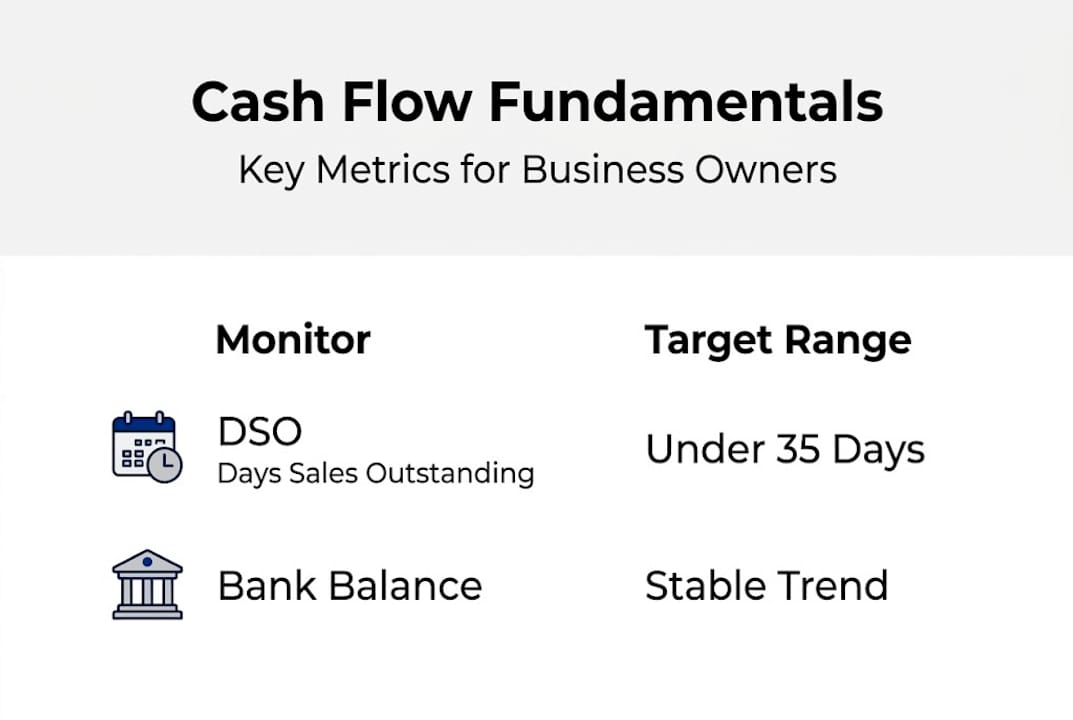
  1. Days Sales Outstanding (DSO): How long it takes to collect payment after a sale. Lower is better. If your DSO is creeping past 45 days, your improving accounts receivable process needs attention immediately.
  2. Cash Conversion Cycle (CCC): The total time from spending cash on inventory or services to collecting cash from customers. A shorter CCC means healthier cash flow.

Finally, segment your cash. Do not keep everything in one account. Separate your operational cash, your tax reserves, and your contingency funds. This single habit prevents the all-too-common mistake of spending money that was already spoken for.

Pro Tip: Key methodologies like 13-week rolling forecasts and DSO optimization are not just for large companies. SMBs that adopt these practices outperform peers on cash stability, often by a significant margin. Ask your accountant or custom financial modeling partner to help you set these up properly from the start.

Building resilience: Cash reserves, tech, and proactive tools

Strategies get you organized. Resilience keeps you standing when things go sideways. The difference between a business that weathers a downturn and one that folds is often one thing: preparation before the storm.

Start with reserves. Build 3 to 6 months of operating expenses in liquid reserves, segmented from your working capital. This is not a luxury for large corporations. It is a survival baseline for any SMB with seasonal revenue, major clients, or payment terms longer than 30 days.

Here is a benchmark table to help you assess your current position:

Reserve levelWhat it meansRisk exposure
Less than 1 monthDanger zoneVery high
1 to 2 monthsMinimal bufferHigh
3 to 6 monthsHealthy baselineModerate
6+ monthsStrong resilienceLow

Technology is your second line of defense. Modern accounting platforms and AI-based tools have made real-time cash visibility accessible to businesses of all sizes. Tools like QuickBooks and Float connect to your bank accounts, categorize transactions automatically, and flag anomalies before they become problems. AI-powered forecasting can even model multiple scenarios simultaneously, so you can see the cash impact of winning or losing a major contract.

Key technology practices to implement now:

  • Connect your accounting software to live bank feeds for daily updates
  • Use scenario planning features to stress-test your cash position
  • Set automated alerts for low balance thresholds
  • Benchmark your DSO and CCC against industry peers regularly

Building a credit line before you need it is equally important. Strategic finance for resilience means establishing lender relationships when your financials are strong, not when you are desperate. Crisis borrowing is expensive and puts you at a negotiating disadvantage.

Pro Tip: Review your profitability management tips alongside your cash flow data. A business can be profitable but cash-poor, and vice versa. Looking at both together gives you the clearest picture of financial health.

Turning insight into action: Practical CFO steps for small business owners

Knowing what to do and actually doing it are two different things. Here are the specific actions that move the needle.

  1. Hold a weekly cash review. Block 30 minutes every Monday to review your 13-week forecast. Update it with actual figures and flag any gaps in the next four weeks.
  2. Schedule a monthly working capital meeting. Review accounts receivable aging, accounts payable deadlines, and your reserve balance. Make this non-negotiable.
  3. Run scenario tests quarterly. Ask: what happens if our biggest client delays payment by 30 days? What if we lose a major contract? Model the cash impact before it happens.
  4. Build lender relationships now. Apply for a business line of credit when your cash position is healthy. Use it strategically, not as an emergency lifeline.
  5. Bring in expert oversight. Real-world cash flow transformation rarely happens without a skilled financial partner. An outsourced CFO provides ongoing oversight without the full-time cost.

Proactive measures like established reserves and pre-arranged credit lines consistently outperform reactive crisis financing in both cost and outcome. The businesses that stay calm during downturns are not lucky. They built the systems and relationships in advance.

Additional habits that compound over time:

  • Send invoices immediately upon delivery of goods or services
  • Offer small early payment discounts to accelerate collections
  • Negotiate longer payment terms with suppliers while keeping customer terms tight
  • Review your pricing annually to ensure margins cover cash cycle gaps

Pro Tip: Do not wait for a crisis to get serious about cash flow. The businesses that thrive long-term treat cash management as a weekly discipline, not a quarterly fire drill.

The hard truth most business owners miss about cash flow

Here is the uncomfortable reality we see again and again: most “fixes” businesses apply to cash flow problems are not actually fixes. Pushing customers to pay faster and delaying vendor payments buys you days, not stability. These are band-aids on a systems problem.

The businesses that maintain genuine cash stability share one trait: they invested in systems and relationships before the crisis hit. They built forecasting into their weekly rhythm. They established credit lines when they did not need them. They hired cash flow forecasting wisdom partners who knew what questions to ask.

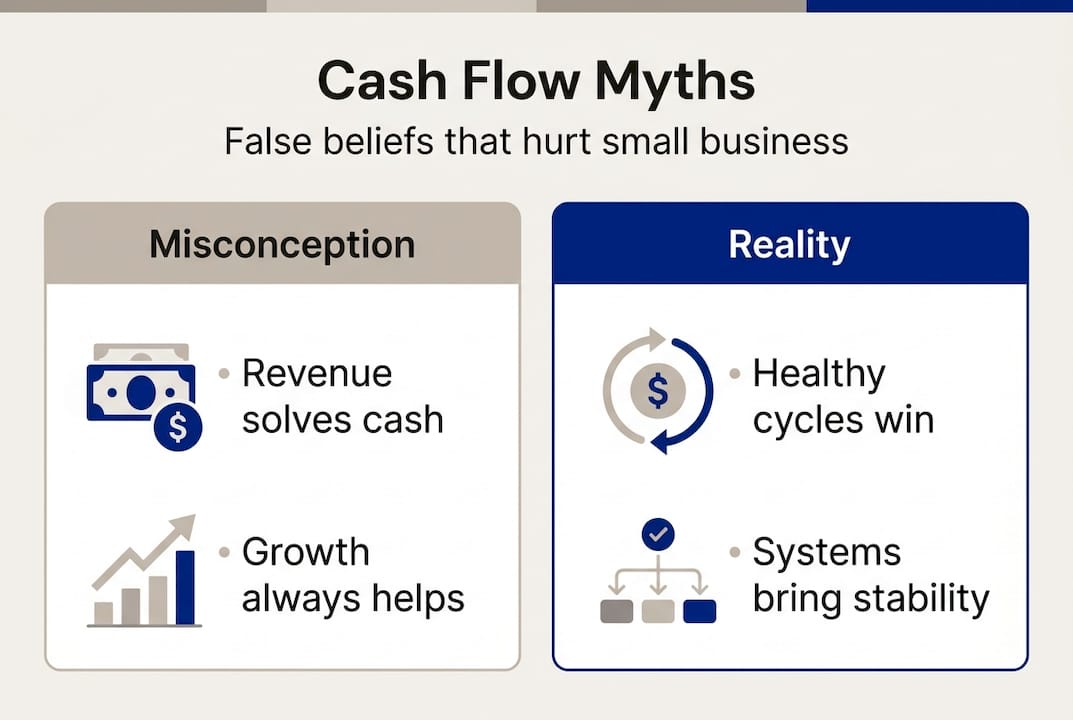
The most dangerous misconception in small business finance is that revenue growth solves cash problems. It often makes them worse. Scaling a broken cash cycle just scales the risk. True financial stability means your cash conversion cycle is tight, your reserves are funded, and your forecast is updated every single week, whether business is booming or slow.

Infographic refuting cash flow misconceptions

Prioritizing healthy cash cycles over vanity revenue metrics is not conservative thinking. It is what separates the businesses still operating in year five from those that closed in year two.

Unlock expert CFO solutions for smarter cash flow management

You now have the framework. But knowing what to do and having the capacity to execute it consistently are two different challenges for a busy business owner.

https://johngalt-finance.com

At John Galt Finance, we work with SMBs just like yours to build detailed cash flow forecasting systems, model the scenarios that keep you up at night, and provide ongoing CFO-level oversight without the overhead of a full-time hire. Whether you need custom financial modeling solutions or simply want a clear picture of where you stand, our team is ready to help. Start with a financial health check for your business and see exactly where your cash flow stands today.

Frequently asked questions

What are the biggest signs of poor cash flow management?

Warning signs include frequently scrambling to cover payroll, delaying vendor payments, and relying on a credit line to pay routine bills. These cash flow disruptions are common but entirely preventable with the right systems in place.

How much cash reserve should my business have?

Most financial experts recommend 3 to 6 months of operating expenses held in liquid reserves, segmented separately from your day-to-day working capital.

What tools and technology help with cash flow management?

AI-powered tools and accounting platforms like QuickBooks and Float provide real-time cash tracking, automated alerts, and scenario-based forecasting that dramatically improve accuracy and decision speed.

How often should I update my cash flow forecast?

Forecast weekly during uncertainty and at a minimum monthly when business conditions are stable. The 13-week rolling model works best when updated every Monday with actual data.

FAQ

Why are 60% of SMBs struggling with cash flow in 2026?

Three drivers: (1) higher interest rates have raised cost of working capital debt, (2) post-pandemic AR cycles remain stretched, (3) inflation has compressed margins faster than pricing has caught up. The solution isn’t to wait it out; it’s to tighten the cash conversion cycle.

What’s the first thing to do if cash is tight?

Build a 13-week direct cash forecast this week. You can’t fix what you can’t see. Then prioritize three actions: (1) call AR over 30 days personally, (2) negotiate net-45 terms with top 5 suppliers, (3) defer any non-essential capex. See our 13-week forecasting guide.

How much cash should an SMB hold in 2026?

3-6 months of operating expenses, parked in high-yield business savings earning 4-5% APY. If you’re seasonal or customer-concentrated, aim for 6-12 months. Below 1 month of cash is a crisis waiting to happen.

Should I take on debt to manage cash flow?

A working capital line of credit (LOC) is standard hygiene; arrange one before you need it. Avoid short-term high-cost products (merchant cash advances, factoring at >20% APR) unless it’s a true emergency. See our SMB funding options guide.

What tools help with cash flow management?

For forecasting: Excel template (free), Float, Pulse, or LiveFlow ($50-300/month). For AR automation: bill.com, Chaser, Upflow. For sweep-to-savings: most major banks now offer auto-sweep at 4-5% APY. Adopting any one of these typically pays back within 90 days.

Share this:

Why analyze financial position: unlock stability & growth

Financial Position Analysis Benchmarks

MetricBenchmark
Current ratio (healthy SMB)1.5-3.0
Quick ratio (healthy)>1.0
Debt-to-equity ratio (healthy)<2.0
Working capital target (% of revenue)15-25%
Return on assets (top quartile SMB)>10%
Return on equity (top quartile)>15%
Interest coverage ratio (healthy)>3.0
Equity multiplier (healthy)<3.0

Cash flow management is the single biggest challenge for 60% of SMBs, and poor financial management remains the top reason small and medium-sized businesses fail. Yet most owners only look at their numbers when something goes wrong. That reactive approach is exactly what keeps good businesses stuck or, worse, sends them under. This guide breaks down what financial position actually means, why analyzing it regularly is one of the highest-leverage habits you can build, and how to put practical tools to work so your business can grow from a place of clarity, not guesswork.

Table of Contents

Key Takeaways

PointDetails
Early warning systemAnalyzing financial position catches problems before they become crises.
Better strategic decisionsClear financial insights enable smarter investments, hiring, and pricing.
Improved funding oddsStrong analysis and ratios build lender and investor confidence.
Practical tools availableSMBs can use Excel, QuickBooks, or fractional CFOs for effective financial reviews.

What is your financial position, really?

Now that you know how high the stakes are, let’s clarify what “financial position” actually means for your business.

Most owners think of their finances in terms of profit. Did we make money this month? That’s a useful question, but it only tells part of the story. Your financial position is a full snapshot of everything your business owns, owes, and has built up over time. It’s captured in your balance sheet and reflects three core components:

  • Assets: Everything your business owns or is owed. Cash, receivables, inventory, equipment, and property.
  • Liabilities: Everything your business owes. Loans, accounts payable, tax obligations, and accrued expenses.
  • Equity: The residual value left for owners after liabilities are subtracted from assets. Think of it as your financial stake in the business.

Here’s where a common misconception trips people up. A business can show strong profits while sitting on a dangerously weak financial position. How? Imagine you’re generating revenue but most of it is tied up in unpaid invoices or slow-moving inventory. Your income statement looks fine. Your balance sheet tells a different story.

The metrics that reveal your true financial position go beyond profit. Working capital (current assets minus current liabilities) shows whether you can cover short-term obligations. Your debt-to-equity ratio signals how much of the business is financed by creditors versus owners. And your asset base determines your capacity to weather downturns or fund growth.

Infographic summarizing financial position key metrics

Another myth worth busting: being cash-rich in the short term does not mean you’re financially healthy long-term. A business sitting on cash but carrying growing liabilities and stagnant assets is quietly moving toward a cliff. Regular financial analysis surfaces exactly these warning signs, like when liabilities are outpacing asset growth, before they become a crisis.

For owners focused on improving SME profitability, understanding your financial position is the foundation everything else builds on. Profit matters, but stability is what lets you actually use that profit to grow.

Why analyzing financial position matters for your business

Once you understand what financial position truly reflects, here’s why thoughtful analysis is a non-negotiable for any growth-minded owner.

Think of your financial position as the vital signs of your business. Doctors don’t wait for patients to collapse before taking readings. They track trends over time, spot anomalies early, and intervene before small problems become serious ones. The same logic applies here.

“Financial analysis enables informed decision-making across pricing, investment, and hiring, and helps build the kind of lender confidence that comes from transparent, strong financial ratios.” — SumUp Financial Analysis Guide

Here’s what regular analysis actually unlocks for your business:

  1. Early problem detection. You see liquidity gaps and debt buildups weeks or months before they threaten operations.
  2. Smarter pricing decisions. Knowing your real cost structure means you price to sustain margins, not just to win work.
  3. Confident hiring and investment. You know whether you can actually afford to expand, rather than finding out the hard way.
  4. Lender and investor trust. Clean records and strong ratios make funding conversations far easier and more favorable.
  5. Strategic planning traction. You can set realistic goals when you know where you’re starting from.

The OECD’s 2025 SME financing data confirms that poor financial management is the primary reason SMEs fail. That’s not just an academic observation. It’s a pattern repeated across industries and geographies, and it’s almost always preventable.

Pro Tip: Set a fixed date each month to review your balance sheet alongside your income statement. Treating it like a standing appointment, rather than a task you get to when things are slow, is what separates businesses that catch problems early from those that don’t.

For a deeper look at how expert support changes the game, explore the benefits of SME CFO services and what they make possible in practice.

Risks of neglecting financial position analysis

Knowing the upside of analysis is powerful, but understanding the risks of neglect can be a wake-up call.

Skipping regular financial position reviews isn’t a neutral decision. It’s a slow-building risk. Here’s what typically happens when owners fly blind:

  • Solvency surprises: A business can appear operational for months while quietly becoming insolvent. By the time the warning signs are obvious, options are limited.
  • Missed financing windows: Lenders look at your ratios. If your debt-to-equity is out of balance or your working capital is thin, you won’t qualify for the credit you need, precisely when you need it most.
  • Reactive debt spirals: Without visibility, owners often resort to expensive short-term borrowing to patch cash flow gaps, compounding the problem.
  • Legal exposure: Tax obligations, covenant breaches, and overdue payables can escalate quickly when there’s no one watching the numbers closely.
  • Denied credit lines: A scenario we see often involves a business where asset growth quietly lags behind liability growth for 12 to 18 months. Nobody noticed. Then the bank review comes, ratios fail, and the credit line is pulled at exactly the wrong moment.

Consider this: OECD 2025 data shows that SME lending declined from 2023 to 2025 in many markets, with higher interest rates making financing more restrictive. In this environment, errors in financial management are harder and more expensive to fix. There’s less margin for oversight.

Small business owner at kitchen table with invoices

The cost of reactive financial management isn’t just stress. It’s real money, lost opportunities, and in some cases, the business itself. The key steps for financial management exist precisely to keep you ahead of these scenarios. And if you’ve ever wondered what unlocking financial clarity would do for your business, the answer is: it removes these risks from your table entirely.

How to analyze your financial position: Practical tools and steps

To shift from concern to action, here’s how you can start analyzing your financial position with tools and steps suitable for SMBs.

You don’t need a team of accountants to get this right. You need a clear process and the right tools for your stage of business. Here’s where to start:

Step 1: Pull your core financial statements. Your balance sheet, income statement, and cash flow statement. These three together give you the full picture.

Step 2: Calculate your key ratios. Focus on current ratio (current assets divided by current liabilities), debt-to-equity, and gross margin. These are your vital signs.

Step 3: Compare against benchmarks. Internal trend comparison is useful, but benchmarking against industry peers reveals whether your position is genuinely strong or just stable by your own low bar.

Step 4: Spot trends over time. A single snapshot is limited. Three to six months of data starts showing patterns. Twelve months reveals the real shape of your business.

ToolBest forCostExpertise required
Excel / Google SheetsCustom models, full controlLowMedium
QuickBooksAutomated tracking, reportingMediumLow
Fractional CFOStrategy, interpretation, benchmarkingVariableNone (they bring it)

Monthly and quarterly reviews with consistent benchmarks are what enable genuinely proactive management. Tools like QuickBooks and Excel handle the mechanics well. But for SMBs without a full-time finance lead, a fractional CFO bridges the expertise gap by translating raw numbers into decisions.

Pro Tip: Don’t just track ratios in isolation. Pair each ratio with a simple question: “Is this trending better or worse than three months ago?” Trends matter more than point-in-time snapshots.

For owners ready to go deeper, explore financial metrics for SMBs, the different financial model types available to you, and strategic finance best practices that translate analysis into growth.

The uncomfortable truth most business owners miss about financial analysis

Conventional wisdom treats financial analysis as something you do when raising money, applying for a loan, or when the numbers look worrying. That framing is exactly backward.

The businesses we’ve seen navigate downturns, scale successfully, and secure favorable financing on short notice all share one trait: they analyze obsessively before anything urgent appears. They’re not reacting to their financials. They’re reading patterns early enough to actually respond.

Here’s what most checklists won’t tell you. The value of financial analysis isn’t in the individual review. It’s in the accumulated pattern recognition that builds over months. Each month you look at your position, you get marginally smarter about your business. After a year, you can see a problem forming three months before it becomes a problem. That is an enormous operational advantage.

Hiring experts or embedding clear processes doesn’t just save you in a crisis. It pays off exponentially in better decisions made continuously. Understanding what fractional CFOs do in practice makes this concrete: they don’t wait for red flags. They build the systems that prevent red flags from forming in the first place.

Next step: Unlock business clarity with expert financial guidance

If you’re ready to move from understanding to implementation, specialized support can help.

Analyzing your financial position is one thing. Knowing what to do with what you find is where most business owners get stuck. John Galt Finance helps SMBs turn raw financial data into clear, actionable strategy through fractional CFO support, tailored diagnostics, and precise financial modeling.

https://johngalt-finance.com

Whether you’re building your first real financial model through our custom financial modeling process, running a Financial Health Check to see exactly where you stand today, or getting serious about cash flow forecasting, the right guidance pays for itself fast. Don’t wait for warning signs to act. The best time to analyze your financial position is before anything looks wrong.

Frequently asked questions

What is the most important reason to analyze financial position?

The most important reason is to catch problems early, before they escalate. Regular financial analysis lets you see warning signs like liabilities outpacing assets long before a crisis hits.

How often should a business analyze its financial position?

Monthly or quarterly reviews are the recommended rhythm for most SMBs. Consistent review intervals are what build the pattern recognition that drives proactive management.

What tools are best for small businesses to analyze financial position?

Excel, QuickBooks, and a fractional CFO are the most practical options. QuickBooks and Excel handle ratio tracking well, while a fractional CFO adds the strategic interpretation layer most small businesses need.

What’s the difference between financial position and profit?

Profit measures earnings over a specific period, while financial position covers your total assets, liabilities, and equity. A business can be profitable and still have a weak or deteriorating financial position.

FAQ

What is financial position analysis?

It’s a structured review of your balance sheet, liquidity, solvency, and leverage to assess financial health. Unlike P&L analysis (which shows profitability), position analysis shows resilience: can you survive shocks?

How often should I review my financial position?

Quarterly at minimum, monthly if you have debt covenants or are in a high-risk industry. Annual is too infrequent; major position shifts (over-leverage, deteriorating liquidity) can compound in 90 days.

What’s the most important position ratio for SMBs?

Current ratio (current assets / current liabilities). Below 1.0, you can’t cover short-term obligations. Above 3.0, you’re carrying inefficient working capital. Target 1.5-3.0. See our working capital optimization guide for tactics.

How does financial position affect lending and valuation?

Banks set loan covenants on position ratios (current ratio, debt service coverage, debt-to-equity). Investors and acquirers discount valuation 10-30% for weak position metrics. A clean balance sheet is collateral for cheaper capital. See our business valuation guide.

What do I do if my financial position is weakening?

Three-step playbook: (1) freeze non-essential capex and discretionary spend, (2) accelerate AR collections and renegotiate AP terms, (3) raise emergency capital (LOC, owner injection) before position breaks debt covenants. Acting at 90 days early is the difference between rescue and restructuring.

Share this:

Financial scenario planning: grow smarter in 2026

Financial Scenario Planning Benchmarks

MetricBenchmark
Standard scenario setBase, downside (-20%), upside (+20%)
Stress test for customer concentrationLoss of top 1-3 customers
Stress test for AR slowdownDSO +30 days for 90 days
Refresh frequency (scenarios)Quarterly minimum
Time to build first scenario model2-4 weeks
SMBs that model downside scenarios~30% (NFIB survey)
Cost of scenario planning (DIY in Excel)20-40 hours initial build
Cash reserve target (worst-case scenario)3+ months opex after stress test

Most business owners assume that a solid financial forecast is enough to navigate uncertainty. It isn’t. A single forecast tells you one story about the future, but the future rarely follows a script. SMEs using scenario planning show measurably higher resilience and growth rates compared to those relying on forecasts alone. This guide will show you exactly what financial scenario planning is, why it’s different from forecasting and budgeting, and how you can use it right now to make smarter, faster decisions for your business.

Table of Contents

Key Takeaways

PointDetails
More than forecastingFinancial scenario planning explores multiple futures, giving SMBs an edge over relying on single forecasts.
Boosts resilienceBusinesses with scenario planning adapt faster and perform better during market volatility.
Three focused scenariosStick to best, base, and worst case scenarios for clear, actionable decision-making.
Triggers drive decisionsLink plans to specific events (like a sales drop) so you know exactly when to act.
Ongoing updates requiredKeep your scenarios fresh by revisiting them every quarter or after major changes.

What is financial scenario planning?

Financial scenario planning means building financial models for at least three different versions of your future. Not one future. Three. You map out what happens if things go well, what happens if they go sideways, and what happens if they go badly. Then you decide in advance what you’d do in each case.

This is fundamentally different from financial planning basics, which typically involves setting goals and creating a single path to reach them. Scenario planning accepts uncertainty as a given and prepares you to respond to it, rather than being blindsided by it.

Here’s what makes scenario planning so powerful for small and medium businesses: it forces you to think through your assumptions before they’re tested by reality. When a supply chain disruption hits, or a key client walks away, you aren’t scrambling to figure out what to do. You already have a plan.

Scenario planning explores multiple hypothetical futures, unlike forecasting which predicts one likely outcome.” — ICAEW Financial Modelling Guidance

Forecasting says: “Based on current trends, we expect $500,000 in revenue next quarter.” Scenario planning says: “If revenue hits $500,000, here’s our plan. If it drops to $350,000, here’s what we cut. If it jumps to $700,000, here’s how we scale.”

Scenario planning is also distinct from custom modeling for business, which is the technical tool you use to build the models themselves. Think of scenario planning as the strategy and financial modeling as the execution.

Here’s what good scenario planning helps you do:

  • Answer ‘what if’ questions before they become real problems (e.g., What if our top client cancels?)
  • Stress-test your business model under different economic conditions
  • Align your leadership team on agreed responses before a crisis hits
  • Identify the early warning signs that tell you which scenario is actually unfolding
  • Plan for growth opportunities with confidence (e.g., What if we expand to a new market?)
  • Protect cash flow by mapping how different outcomes affect your bank balance

This isn’t a tool reserved for Fortune 500 strategy departments. It’s one of the highest-leverage things a small business owner can do.

Small business owner working on scenario plan

Scenario planning vs. forecasting and budgeting

Once you know what scenario planning is, the next step is understanding how it works alongside your other financial tools. Most business owners use forecasting and budgeting regularly. Scenario planning doesn’t replace them. It makes them far more useful.

ToolPrimary purposeTime horizonFlexibilityBusiness use case
Scenario planningExplore multiple futuresLong-term (1-5 years)HighStrategic decisions, risk planning
ForecastingPredict one likely outcomeShort to medium-termMediumOperational planning, investor reporting
BudgetingSet fixed financial targetsAnnualLowExpense control, performance tracking

Scenario planning is strategic. Forecasting is operational. Budgeting is about control. Each one answers a different question. Scenario planning asks “what could happen?” Forecasting asks “what will probably happen?” Budgeting asks “what are we allowed to spend?”

A real-world example makes this clear. Tetra Pak, the packaging giant, famously reduced its planning cycles and improved decision speed by integrating scenario planning alongside its standard forecasting processes. The key insight was that scenario planning complements forecasting and budgeting rather than replacing them. Businesses that use all three tools together respond faster to market shifts and make more confident investment calls.

For SMBs, the practical implication is simple. Your budget tells you where your money is going. Your forecast tells you where the business is headed. Your scenarios tell you what to do if the heading changes.

Pro Tip: Never rely on only one of these tools in isolation. A budget without scenarios is a fixed target in a moving market. Scenarios without a forecast give you no operational baseline. Use all three, and they will reinforce each other.

If you’re still unclear on how forecasting and budgeting interact, the breakdown in budgeting vs forecasting is a practical starting point before layering in scenario planning.

Why scenario planning matters for small and medium businesses

Here’s a number that should get your attention. SMB average monthly earnings were $83,600 in October 2025, down 21% month over month. A 21% revenue swing in a single month. For a business with tight margins and a lean team, that’s not a dip. That’s a crisis, unless you planned for it.

Planning approachResponse to 20% revenue dropTypical outcome
No formal planningReactive scrambling, delayed decisionsCash shortfall, missed payroll
Forecast onlyRecognized the gap, no pre-built responseSlow to act, partial recovery
Scenario planning adoptedActivated pre-planned cost controlsStabilized within 30-60 days

The table above reflects a pattern we see repeatedly. The businesses that survive sudden market shifts aren’t always the biggest or the most well-funded. They’re the ones that thought through the “what ifs” before those scenarios became real.

Following proven steps for SME profitability matters, but scenario planning gives those steps a safety net. It answers what you do when your profitability strategy encounters an unexpected roadblock.

Here are four real-world risks that scenario planning directly addresses for SMBs:

  1. Supply chain disruption: A key supplier raises prices by 30% or goes under entirely. Your scenario plan already maps out your backup suppliers and the margin impact.
  2. Market demand shift: Customer demand drops fast because of economic pressure or a competitor entering your market. Your downside scenario tells you exactly what costs to trim and when.
  3. Cash crunch: Revenue is fine but timing is off. Invoices come in late and bills come in early. SMB risk mitigation through scenario planning flags these timing risks before they become emergencies.
  4. Expansion risk: You’re considering hiring, opening a new location, or entering a new market. Scenario planning stress-tests the investment across multiple demand levels so you know your break-even point.

Scenario planning doesn’t eliminate risk. It ensures that risk never catches you completely off guard.

Infographic comparing forecasting and scenario planning

How to conduct effective financial scenario planning

Knowing why scenario planning matters is one thing. Doing it well is another. Here’s a practical process you can apply to your own business, regardless of your size or industry.

Step-by-step process:

  1. Define your planning goals. What decisions are you trying to support? Hiring? Expansion? Surviving a slow quarter? Your scenarios should connect directly to the decisions you’re actually facing.
  2. Select three scenarios. Build a base case (most likely outcome), a best case (things go well), and a worst case (things go badly). Expert guidance consistently recommends limiting to three. More than three and the exercise becomes unmanageable.
  3. Build your financial models. Map out revenue, costs, cash flow, and margins under each scenario. Use your actual business numbers as the foundation. This is where a cash flow forecasting tool becomes essential.
  4. Assign decision triggers. For each scenario, define the specific indicator that tells you it’s unfolding. Example: if monthly revenue falls 10% below baseline for two consecutive months, activate cost reduction plan B.
  5. Review and update regularly. Set a calendar reminder. At minimum, revisit your scenarios every quarter and after any major market event.

Common pitfalls to avoid:

  • Building too many scenarios and losing focus on any single one
  • Treating the base case as guaranteed and ignoring the other two
  • Forgetting to model cash flow timing, not just revenue and profit
  • Building scenarios once and never updating them as your business changes
  • Keeping scenarios confined to the finance team instead of sharing them with your leadership group

Pro Tip: Make each scenario a narrative, not just a spreadsheet. Write two or three sentences describing what’s happening in the market and in your business under each scenario. This makes the model far more actionable when you’re under pressure and need to act fast. A financial health checkup is a smart first step before you build your scenarios, so you’re starting with accurate baseline data.

A CFO’s perspective: What most scenario planning guides miss

Most guides treat scenario planning as a modeling exercise. Build three spreadsheets, label them best, base, and worst, and you’re done. That misses the point entirely.

The biggest reason scenario planning fails in small businesses isn’t a lack of data or a bad model. It’s that the scenarios get built once and never touched again. They become a document in a folder, not a living tool that shapes how you run your business week to week.

What actually works is treating scenario planning as an ongoing conversation with your numbers. The best business owners we work with revisit their scenarios whenever something shifts, a key contract, a market signal, a hiring decision. They involve their leadership teams so that everyone understands the triggers and the agreed responses. There are no surprises when the plan needs to activate.

Another thing most guides skip: the psychological component. When you’ve already decided what to do if revenue drops 15%, you can make that call fast and without panic. That speed is worth more than any spreadsheet sophistication.

If your scenarios feel disconnected from how you actually run the business, it may be time to look at the signs your business needs a CFO for outside perspective. A fractional CFO can help you build scenarios that are genuinely actionable, not just theoretically complete.

Get expert help with your scenario planning

Scenario planning delivers real results when it’s built on solid data and updated consistently. For many SMB owners, the challenge isn’t understanding the concept. It’s finding the time and expertise to do it well.

https://johngalt-finance.com

At John Galt Finance, we help small and medium businesses build custom scenario models grounded in their actual financials. Whether you need a one-time model or ongoing CFO support, we bring the strategic depth that makes planning actionable. Start with our business planning guide to build a strong foundation, use the cash flow toolkit to sharpen your cash projections, and explore our custom modeling process to see how we tailor models to your business. Reach out for a consultation and turn your scenario planning from a spreadsheet into a strategic advantage.

Frequently asked questions

What are the three main scenarios I should plan for?

Plan for a best case, base case, and worst case scenario. Sticking to three keeps the process manageable and ensures each scenario gets the attention it deserves.

How often should I update my financial scenarios?

Review your scenarios at least quarterly and after any significant business or market event. Not updating scenarios is one of the most common and costly mistakes SMB owners make.

Is financial scenario planning only for large companies?

Not at all. SMEs using scenario planning consistently show higher resilience and better growth outcomes, making it one of the highest-value practices for small and medium businesses.

How does scenario planning relate to cash flow?

Each scenario you model will show a different cash flow outcome, revealing potential shortfalls before they arrive. Ignoring cash flow in your scenarios is a critical mistake that leaves you vulnerable to timing crunches even when revenue looks healthy.

FAQ

What scenarios should I always model?

Five essentials: (1) base case (most likely), (2) downside (-20% revenue), (3) upside (+20% revenue), (4) loss of largest customer, (5) AR slowdown of 30 days for 90 days. Together they capture the main risks any SMB faces.

How is scenario planning different from forecasting?

Forecasting is your best estimate of the future. Scenario planning is multiple plausible futures with action plans for each. Forecasting answers “what will happen?”; scenarios answer “what will we do if X happens?”. Mature finance functions do both.

How often should I refresh scenarios?

Quarterly at minimum, plus any time you have a major external shock (recession warning, supply chain disruption, regulatory change). Outdated scenarios can be worse than no scenarios; they create false confidence.

What’s the right tool for scenario planning?

For SMBs under $10M revenue, Excel with scenario manager is sufficient. Between $10M-$50M, tools like Jirav, Vena, or Cube speed up iteration and reduce error. Avoid enterprise tools (Anaplan, Hyperion) until $50M+; the setup cost exceeds the value.

How do I get my team to actually act on scenarios?

Tie each scenario to specific triggers and actions. Example: “If two consecutive months are 10% below plan, freeze hiring and cut marketing 30%.” Pre-committed decisions get executed; abstract scenarios get filed and forgotten.

Share this:

How to Improve Cash Flow: Expert Steps for Business Owners

Cash Flow Improvement Benchmarks

MetricBenchmark
Median DSO (B2B SMB, US)40-50 days
Best-in-class DSO25-35 days
Median DPO30-45 days
Cash freed per 10-day CCC improvement (at $5M revenue)~$137,000
SMBs that fail due to cash flow problems82% (US Bank study)
Early payment discount (typical)2/10 net 30 (2% off if paid in 10 days)
Effective annual rate of declining 2/10 net 30~36%
SMBs with a written cash policy~25%

Your revenue is growing, your sales team is crushing targets, and your product is flying off the shelf. Then your bank account runs dry. This scenario is more common than most owners want to admit, and it happens because revenue and cash flow are not the same thing. A profitable business can still fail when cash is tied up in unpaid invoices, slow-moving inventory, or poorly timed expenses. This article walks you through CFO-level strategies, from understanding your core metrics to using modern forecasting tools, so you can diagnose what’s draining your cash and take deliberate steps to fix it.

Table of Contents

Key Takeaways

PointDetails
Monitor key metricsTracking DSO, CCC, and Current Ratio monthly helps you spot cash flow trouble early.
Address bottlenecksIdentify and resolve obstacles like slow receivables and customer concentration to improve cash flow.
Build cash reservesMaintain 3-6 months of operating expenses to ensure you can weather downturns and growth periods.
Leverage technologyUse forecasting tools and automation for regular monitoring and faster response.
Think proactivelyStrategic habits—planning, reserve building, and scenario analysis—are crucial for sustainable cash flow.

Understand your cash flow fundamentals

Before you can fix a cash flow problem, you need to know what you’re measuring. Cash flow is simply the movement of money in and out of your business over a given period. Positive cash flow means more is coming in than going out. Negative cash flow means the opposite, and it can cripple operations even when your income statement looks healthy.

Here are the key metrics every business owner should track:

  • Cash flow from operations (CFO): Cash generated by your core business activities, excluding financing and investments.
  • Accounts Receivable (AR): Money your customers owe you. High AR means cash is sitting outside your business.
  • Accounts Payable (AP): Money you owe suppliers. Strategically managing AP helps you hold cash longer.
  • Days Sales Outstanding (DSO): How many days, on average, it takes to collect payment after a sale.
  • Cash Conversion Cycle (CCC): The total time from spending cash on operations to collecting it back from customers.
  • Current Ratio: Current assets divided by current liabilities. Indicates short-term financial health.

The table below shows target ranges for each metric:

MetricTarget RangeWhat It Signals
DSOUnder payment terms (e.g., under 35 for Net 30)Speed of collections
CCC30 to 45 days for service businessesOperational efficiency
Current Ratio1.5 to 2.0Liquidity health
Cash Reserve3 to 6 months of operating expensesBusiness resilience

Infographic on cash flow fundamentals for business

According to cash flow benchmarks, DSO under 35 days for Net 30 terms, a CCC between 30 and 45 days for service companies, and a Current Ratio between 1.5 and 2.0 are the targets you should be hitting. If your numbers fall short, something in your operations is leaking cash.

Bookkeeper reviewing accounts receivable report

Common pitfalls that skew these numbers include offering loose payment terms without follow-up, letting invoices age past 60 days, keeping too little reserve, and mixing personal and business expenses. Start tracking business KPIs monthly to catch early warning signs before they become emergencies.

Pro Tip: Schedule a monthly 30-minute cash flow review. Look at your AR aging report, your bank balance trend, and your upcoming AP obligations. This one habit can prevent most cash emergencies.

If you want to see how a real company went from stress to stability, this predictable cash flow case study shows exactly how the process works in practice.

Identify and address cash flow obstacles

With metrics in place, the next step is spotting and solving obstacles that drain cash. Most small and mid-size businesses face the same recurring culprits, even if the symptoms look different across industries.

The most common obstacles include:

  • Slow receivables: Customers paying late stretches your DSO and creates gaps between your obligations and income.
  • High fixed overhead: Rent, payroll, and subscriptions that don’t flex with revenue can crush cash during slow periods.
  • Seasonality: Predictable slow seasons become crises when you haven’t built reserves ahead of time.
  • Customer concentration: Relying heavily on one or two clients creates dangerous exposure. If one delays payment or leaves, your cash flow collapses.

Service businesses and manufacturers face different versions of these problems. This comparison illustrates the difference:

FactorService businessesManufacturing businesses
Primary cash riskSlow AR collectionsInventory carrying costs
Overhead flexibilityHigher (less physical assets)Lower (equipment, materials)
Seasonality exposureModerateHigh
Cash cycleShorterLonger

Research into cash flow risk patterns confirms that seasonal industries must build peak reserves and credit lines well in advance, service firms generally manage cash cycles more efficiently than manufacturers, and over-leverage combined with customer concentration are leading causes of business failure.

Practical remedies for these obstacles:

  • Renegotiate payment terms with suppliers to delay outflows.
  • Require deposits or milestone payments on large service contracts.
  • Diversify your client base to reduce dependency on any single customer.
  • Automate invoice reminders to reduce late payments without awkward follow-up calls.
  • Explore bridge financing options to cover gaps during slow seasons rather than waiting until you’re out of options.

For a deeper look at balancing inflows and outflows, the working capital management strategies guide walks through the practical steps. You can also review how to approach mitigating financial risks before they escalate.

Pro Tip: Set a cash reserve target before your busy season ends. Aim to have at least two months of operating expenses tucked away before your slow season starts.

Strategic actions to boost cash flow

Once obstacles are managed, put strategic actions in place for sustainable cash flow improvement. This is where you move from reactive firefighting to deliberate financial management.

Here are the steps to take in order:

  1. Tighten your AR process. Send invoices immediately after delivery. Set automated reminders at 7, 14, and 30 days past due. Consider small early-payment discounts (like 2% for payment within 10 days) to accelerate collections.
  2. Extend AP strategically. Pay on the last acceptable day, not the first. This keeps cash working for you longer without damaging supplier relationships.
  3. Automate invoicing and payment collection. Tools that auto-charge stored payment methods eliminate delays caused by manual follow-up.
  4. Restructure expensive debt. High-interest short-term loans drain cash fast. Refinancing into longer-term, lower-rate facilities reduces monthly obligations and frees up operating cash.
  5. Adjust your sales approach. Not every sale improves cash flow. Chasing low-margin, slow-paying clients can actually hurt your position.
  6. Run monthly scenario plans. Model best-case, base-case, and worst-case cash flows using your cash flow forecasting essentials to prepare decisions in advance.

“Sell selectively, build 3 to 6 months of reserves, and use lines of credit before a crisis, not during one.”

That quote captures the growth paradox many owners miss: chasing top-line revenue without managing cash timing creates the illusion of success while quietly building fragility. Knowing the right time for withdrawals is equally important as growing revenue.

Pro Tip: Apply for a revolving line of credit when your business is performing well. Banks approve credit based on health, not need. Waiting until you’re in a crunch often means you can’t qualify.

Forecasting, technology, and verification

To ensure lasting improvement, the right tools and verification practices make cash flow maintainable. Forecasting is not about predicting the future perfectly. It’s about reducing surprises and creating a decision-making framework you can act on.

Key benefits of cash flow forecasting include:

  • Early warning of shortfalls: A 13-week rolling forecast shows you exactly when cash will run low, giving you time to act.
  • Smarter timing decisions: You can schedule large purchases, hiring, or debt payments around your strongest cash periods.
  • Investor and lender confidence: Accurate, forward-looking cash flow models signal that you run a managed, professional operation.
  • Scenario flexibility: Model the impact of losing a major client or winning a large contract before it happens.

Here’s how leading forecasting tools compare:

ToolBest forKey features
FloatSmall service businessesBank feed sync, scenario modeling
FathomGrowing SMBsKPI dashboards, multi-currency
PulseFreelancers and small teamsSimple visual cash flow tracking
Excel/Google SheetsCustom modelsFully flexible, no subscription cost

The role of AI and automation in forecasting is growing fast. Strategic businesses are moving from reactive working capital loans to proactive term financing, and using AI tools to flag AR collection issues before they age. Reactive financing (borrowing when you’re already in trouble) tends to cost more and solve less.

Verification steps to keep your data honest:

  • Reconcile your bank statements to your cash flow forecast weekly.
  • Compare actual cash flows to projections monthly and note variances.
  • Review your AR aging report and follow up on anything over 30 days.
  • Track your key financial numbers consistently, not just when something feels wrong.

Pro Tip: Set automated alerts in your accounting software for when your cash balance drops below a defined threshold. This gives you a built-in early warning system without manual checking.

Rethinking cash flow: What most owners overlook

Here’s the uncomfortable reality: most business owners treat cash flow as a financial problem when it’s really a planning problem. The mechanics of AR and AP are simple. The discipline to act before a crisis is where most people fall short.

We see this pattern constantly at John Galt Finance. An owner focuses entirely on sales growth, assuming more revenue automatically means more cash. But growth consumes cash. Hiring, fulfillment, inventory, and delayed collections all accelerate during growth phases, often faster than payments arrive. This is why some of the most dangerous moments for a business happen right after a big win.

The owners who manage cash best share one trait: they plan for the downside while the business is doing well. They build reserves during strong quarters, run scenario plans quarterly, and review KPIs monthly rather than waiting for their accountant’s annual report. If you’re not sure whether your business needs this level of strategic support, reviewing when you need a CFO can clarify the decision quickly.

Reactive solutions, like borrowing during a crunch, are expensive and rarely fix the root cause. Strategic habits are what separate businesses that scale from those that stall.

Accelerate your cash flow: Find tailored solutions

Understanding cash flow strategy is one thing. Applying it to your specific business, industry, and growth stage is another.

https://johngalt-finance.com

John Galt Finance works with small and mid-size businesses to build real cash flow systems, not generic advice. Our cash flow forecasting guide gives you a practical framework to start forecasting today. If you want a broader financial strategy, the financial planning guide covers how to align cash management with long-term growth goals. And if you want to see what’s possible, this client case study shows how one business went from unpredictable cash to full financial control in 30 days. The right support makes the difference between managing a crisis and preventing one.

Frequently asked questions

What is the first step to improving cash flow?

Start by pulling your cash flow statement and checking your DSO against your terms. This single metric often reveals exactly where cash is getting stuck.

How much cash reserve should a business keep?

Most financial experts recommend 3 to 6 months of operating expenses as a reserve. Start building toward this target during strong revenue periods.

What tools can help with cash flow forecasting?

Software like Float, Fathom, and Pulse offer scenario planning and alerts. AI-powered forecasting tools are increasingly available for small businesses and reduce the manual work involved in tracking.

Should I prioritize paying debt or building reserves?

Balance both strategically. Pay down high-interest debt aggressively while routing a fixed percentage of revenue into reserves each month.

How can I avoid customer concentration issues?

Diversify your client base intentionally. Avoiding over-concentration means no single client should represent more than 20 to 25 percent of your total revenue.

FAQ

What’s the fastest way to improve cash flow?

Tighten receivables. Most SMBs find 30-60 days of cash by sending invoices same-day, requiring deposits on new work, automating dunning at days 7/14/21, and offering 2% early-pay discounts. See our AR management guide.

How do I balance paying suppliers and conserving cash?

Negotiate net-45 or net-60 terms with key suppliers, then pay on day 45/60. Never pay early unless you take an early-pay discount worth more than your cost of capital. The discount of 2/10 net 30 equals an annualized 36%; almost always worth taking.

Should I take a line of credit to manage cash flow?

Yes, before you need it. A revolving line of credit (LOC) of 10-20% of annual revenue is standard for SMBs. Apply when you’re profitable, not when you’re stressed; banks tighten just when you need them most. See our SMB funding options guide.

How do I forecast cash flow accurately?

Build a 13-week direct cash forecast: list every expected receipt and disbursement by week. Update weekly with actuals. Target +/- 10% accuracy by week 4. See our 13-week cash forecasting guide for the template.

When should I cut expenses to improve cash?

Only after exhausting AR tightening and AP extension. Cutting expenses takes 60-90 days to show in cash; receivables can move in 2 weeks. When you do cut, focus on discretionary opex first (marketing tests, software subscriptions, T&E), not headcount.

Share this:

Top 6 trustpilot.com Alternatives 2026

Online Review & Reputation Benchmarks

MetricBenchmark
Consumers who read reviews before purchase93% (BrightLocal 2024)
Minimum star rating to be considered4.0 of 5.0
Revenue lift per 1-star rating increase5-9% (Harvard Business School)
Trustpilot Business cost (Plus plan)$259/month billed annually
Response rate that signals trust to consumers>40% of negative reviews replied
Reviews needed to neutralize one 1-star~10 five-star reviews
Conversion lift from displaying reviews+270% on product pages (Spiegel Research)
Average review platforms an SMB should monitor3-5 (Google, industry-specific, niche)

Finding the perfect platform to manage customer reviews often feels like searching for a hidden gem. Many businesses and individuals want tools that offer trust and transparency while giving them better control over their online reputation. With so many options out there, each claiming to have something unique, the search can quickly become overwhelming. Discovering what sets certain platforms apart and how they handle feedback can make all the difference. Get ready to explore new possibilities as you look beyond the familiar names.

Table of Contents

John Galt Finance

Product Screenshot

At a Glance

John Galt Finance delivers outsourced CFO-level expertise for small and medium businesses that need strategic finance without hiring full time staff. It combines hands-on analysis, tailored financial models, and ongoing advisory to drive profitability and prepare companies for fundraising.

Core Features

John Galt Finance centers on Record Keeping, Financial Reporting (P&L, Cash Flow, Balance Sheet), Financial Planning and Analysis, and Strategic Finance services. The team builds customized financial models, runs cash flow forecasts, and provides product planning and pricing guidance that align with growth goals.

Pros

  • Customized outsourcing solutions for various industries: The service adapts methods and deliverables to sector specific needs rather than offering one-size-fits-all reports.
  • Experienced team of finance professionals: Clients work with senior analysts and strategists who handle modeling, diagnostics, and ongoing CFO support.
  • Wide range of services including financial modeling, planning, and strategy: From record keeping to M&A advice, the offering covers operational and strategic finance needs.
  • Flexible packages and one-off services tailored to client needs: You can engage for a single diagnostic, a project, or ongoing outsourced CFO support based on your budget and timeline.
  • Global clientele and remote service availability: The remote model supports entrepreneurs and established companies across time zones without adding full time payroll.

Who It’s For

This service targets small to medium sized businesses and startups with 5 to 50 employees and annual revenues between $500K and $20M. Founders and finance leaders who need scalable financial discipline, investor ready models, and hands-on strategy choose this option.

Unique Value Proposition

John Galt Finance stands out because it pairs customized financial models with ongoing advisory that directly links numbers to strategic decisions. Sophisticated buyers pick this service when they want a partner who will build investor grade forecasts, optimize pricing and resource allocation, and act as a fractional CFO during pivots or fundraises. The firm’s proven process from demo analysis to diagnostics and ongoing management produces measurable outcomes such as improved margins and successful funding rounds. Pricing by consultation is an intentional design choice to match scope to value rather than force a fixed plan that may not fit your business.

Real World Use Case

A startup engaged John Galt Finance to develop investor pitch models, tighten cost structure, and produce a two year cash flow forecast. The result was a clearer path to funding, a prioritized roadmap for hiring, and a repeatable model that supported a successful seed round.

Pricing

Pricing details are provided upon request via consultation and are not listed publicly. This model allows the team to scope engagements to your needs and present a cost that reflects the specific deliverables and timeline.

Website: https://johngalt-finance.com

Feefo

Product Screenshot

At a Glance

Feefo provides verified customer reviews and tools to gather, manage, and display feedback so businesses can improve products and reputation. It emphasizes authentic review collection and analytics to help brands convert visitors into customers.

Core Features

Feefo combines collection, management, and display tools with analytics to turn feedback into actionable insight. The platform centers on verified reviews and includes tools to respond and analyze customer sentiment.

  • Invite customers to leave reviews after purchase and interaction.
  • Collect both product and service reviews for richer feedback.
  • Display reviews on your website to boost conversion and trust.
  • Manage and respond to reviews from a central dashboard.
  • Analyze customer feedback with analytics tools and AI powered insights.
  • Showcase authentic reviews and use trust badges to reinforce credibility.
  • Syndicate reviews across channels for consistent social proof.

Pros

  • Verified and authentic reviews: Feefo emphasizes confirmed purchaser feedback which reduces fake reviews and raises trust with site visitors.
  • Comprehensive management tools: The dashboard lets you collect, display, and respond to reviews in one place for operational efficiency.
  • Analytics that inform decisions: The analytics and AI features help you identify recurring issues and product opportunities.
  • Marketing friendly display options: Review syndication and trust badges make it easier to use reviews in campaigns and on product pages.
  • Scales with business size: The platform supports small shops through larger enterprise accounts across sectors like retail and automotive.

Cons

  • Implementation time: The detailed feature set and integration options require time to implement and learn for staff and partners.
  • Limited public pricing transparency: Pricing information is only available through direct contact which makes initial budget planning harder.

Who It’s For

Feefo fits businesses that want to collect confirmed customer feedback and use it to improve sales and service. Small and medium sized retailers and service providers that rely on online reputation and conversion will get the most value.

Unique Value Proposition

Feefo stands out by combining verified review collection with analytics and syndication so you get trustworthy social proof plus data you can act on. This mix helps businesses improve reputation while informing product and service decisions.

Real World Use Case

A retailer sends review invitations after every sale, displays collected reviews on product pages, and responds to negative feedback to reduce returns. The retailer then analyzes review themes to prioritize product improvements and track service KPIs.

Pricing

Pricing details are available on request through Feefo contact channels. Businesses evaluate plans directly with Feefo to match required features and scale.

Website: https://www.feefo.com

eKomi

Product Screenshot

At a Glance

eKomi delivers verified reviews backed by actual purchases and a transaction based verification infrastructure trusted by over 60,000 brands worldwide. It excels at turning authenticated customer feedback into visible trust signals across Google Search and advertising channels.

Core Features

eKomi centers on a transaction based review verification system that captures reviews only after purchase and links them to proof of transaction. The platform supports multi channel collection, multi format submissions, real time AI assisted moderation, and integration with major e commerce platforms and Google services.

Pros

  • Verified credibility: Reviews are tied to actual purchases which increases trust in ratings and reduces fake feedback for potential customers.
  • Multi channel reach: The platform collects reviews via email, SMS, social media, and in store which helps you capture feedback where customers already engage.
  • Multi format submissions: Customers can submit text, video, photo, or audio reviews which creates richer social proof for product pages and marketing.
  • Moderation blend: eKomi pairs human review with AI assisted moderation to help maintain review integrity while scaling throughput.
  • Global support footprint: A global infrastructure with local offices and support helps brands manage reputation across markets with regional understanding.

Cons

  • Pricing is custom and requires consultation which makes it hard to estimate total cost for small teams on a tight budget.
  • The focus on transaction based reviews limits open public review models and may reduce volume if you rely on non transaction feedback.
  • Enterprise level integrations can be complex and the setup effort may be extensive for smaller businesses without technical resources.

Who It’s For

Mid to large sized businesses and platforms that prioritize authentic, transaction verified customer reviews will get the most value from eKomi. Brands that want deep Google integration and multi channel distribution benefit the most from its capabilities.

Unique Value Proposition

eKomi’s unique value is its combination of transaction verification, Google partnership, and visible trust seals that appear in search and ads. That mix lets you convert verified feedback into measurable trust signals across shopping experiences.

Real World Use Case

A global retailer uses eKomi to collect verified reviews after each purchase, displays trust seals on product pages and in search results, and relies on those reviews to increase consumer confidence and lift conversion rates across regions.

Pricing

Pricing is custom and based on review volume and integration needs which means you will need a consultation to get a tailored quote and plan aligned with your traffic and platform complexity.

Website: https://www.ekomi.com

ProvenExpert

Product Screenshot

At a Glance

ProvenExpert helps businesses collect and showcase customer reviews to build trust and increase online visibility. It is strong at aggregating feedback and displaying review seals that make credibility visible to prospective customers.

Core Features

ProvenExpert offers customer review management and aggregation, review seals and rating display options, customer surveys and feedback collection, integration with Google star ratings and other review platforms, and real-time review notifications and monitoring. These capabilities let you gather feedback, publish ratings, and track mentions across channels.

Pros

  • User-friendly interface and easy onboarding: The platform presents a clean workflow that helps teams invite customers and publish reviews with minimal training.
  • Effective for online reputation enhancement: Displaying aggregated scores and seals helps visitors recognize credibility quickly and can improve conversion signals on your site.
  • Supports multi-platform review aggregation: It pulls ratings from several sources so you can view a consolidated reputation profile rather than checking multiple dashboards.
  • Customizable review and survey templates: You can tailor feedback requests to match your brand voice and the questions that matter for improving services.
  • Can help increase online visibility and customer trust: The combined effect of aggregation and visible ratings supports discoverability and trust building for small and medium sized businesses.

Cons

  • Pricing may be relatively high for some small businesses and could stretch tight marketing budgets.
  • The platform depends on customer participation for reviews which means results vary with client engagement and outreach effort.
  • The breadth of features may feel extensive for very small or sole proprietorships that prefer a simpler toolset.

Who It’s For

ProvenExpert serves businesses that want a centralized way to collect and present customer feedback. It fits small and medium sized service providers, local shops, consultancies, and professional firms that rely on referrals and online trust to win clients.

Unique Value Proposition

ProvenExpert stands out by turning scattered feedback into a single credibility asset you can display across touchpoints. Its combination of review aggregation, visible review seals, and survey tools makes reputation management practical for teams without a full time marketer.

Real World Use Case

A local service provider uses ProvenExpert to request reviews after each job, display positive ratings on their landing page, and monitor new feedback in real time. The result is clearer social proof that helps attract nearby customers searching for reliable, reviewed providers.

Pricing

Pricing is available upon inquiry and the platform offers a free trial option. Note that some small businesses report pricing as relatively high compared with simpler review tools.

Website: https://www.provenexpert.com

ConsumerAffairs

Product Screenshot

At a Glance

ConsumerAffairs aggregates verified consumer reviews and pairs them with expert-backed guides to help people compare providers across categories like auto, home, senior care, and finance. The platform emphasizes real user experiences while also publishing research and ratings to highlight top companies.

Core Features

ConsumerAffairs offers verified reviews, expert guides, top company ratings, tailored recommendations, and ongoing news and research reporting. These combined elements let users read firsthand experiences, consult expert context, and see ranked providers in a single place for faster decision making.

Pros

  • Authentic consumer feedback: Reviews are presented as firsthand accounts, which helps readers judge real experiences with products and services.
  • Comprehensive guides and resources: Expert-backed content summarizes key factors to consider when choosing a provider, saving time on research.
  • Assists in making informed purchase decisions: The mix of reviews and ratings gives a rounded view of a company’s strengths and weaknesses.
  • Connects consumers with top-rated companies: Ratings and recommendations help surface providers that consistently score well with reviewers.
  • Provides unbiased news and research: Reporting and research pieces add context beyond individual reviews to highlight broader trends.

Cons

  • Site may be paid by companies displayed on the site: Paid listings can create perceived conflicts between editorial content and commercial placement.
  • Not a government regulated agency: ConsumerAffairs is an independent platform and does not act as an official regulator or certification body.
  • Content is informational only and requires personal analysis: Readers must still verify details and apply their own judgment before committing to a purchase.

Who It’s For

ConsumerAffairs suits consumers and small business owners who want structured, experience-based input before hiring a service or buying a product. Business owners seeking financial or service providers can use it to cross-check vendor reputations and read detailed user reports prior to making a commitment.

Unique Value Proposition

The platform’s strength lies in combining verified user experiences with expert guidance and company ratings in one place. That combination shortens research time for decision makers and offers both anecdotal and analytical viewpoints to evaluate providers.

Real World Use Case

A homeowner researching home warranty providers can read verified reviews to learn common service issues, consult comparative ratings to see top companies, and use the expert guides to understand contract terms before choosing a provider.

Pricing

ConsumerAffairs is free to use for consumers, while companies may pay for visibility or verification services to enhance their presence on the site.

Website: https://www.consumeraffairs.com

SmartCustomer (formerly Sitejabber)

Product Screenshot

At a Glance

SmartCustomer gathers millions of customer reviews and pairs them with confidence assurance tools so buyers can check reputations before they buy. It is useful when you need a quick sentiment check on a vendor or website.

Takeaway: Use SmartCustomer to verify seller reliability before committing to a purchase.

Core Features

SmartCustomer lets users browse millions of reviews, write and share business reviews, and access a browser extension that shows live ratings while shopping. The site also groups businesses into clear categories and provides resources and recognition for consumer protection.

Action: Install the extension to see ratings while you shop online.

Pros

  • Large review database: The platform hosts an extensive collection of reviews from real customers which helps surface a broad range of experiences.
  • Helps buying decisions: Aggregated feedback and ratings give you relevant information to compare vendors quickly before purchasing.
  • Consumer protection recognition: The site highlights awards and recognition that signal trust for consumers and businesses.
  • Business resources available: Companies can access tools and resources to manage reputation and respond to customers proactively.
  • Browser extension convenience: The extension provides live ratings while you browse so you do not need to leave the store page to check reputation.

Cons

  • Reviews may sometimes be biased or unverified which reduces reliability when making high value decisions.
  • The platform provides limited information about its review moderation process which leaves questions about how fraudulent posts are handled.
  • Navigation could be overwhelming for new users which slows the process of finding focused, industry specific feedback.

Who It’s For

SmartCustomer fits consumers looking for trustworthy reviews and businesses that need basic reputation management tools. Small and medium sized business owners who track customer sentiment and respond to reviews will find practical value here.

Action: If your team needs a centralized place to monitor public feedback, SmartCustomer can act as an early warning system.

Unique Value Proposition

SmartCustomer combines a very large review archive with consumer protection recognition and a live browser extension so you get context and convenience at once. That mix makes it simple to check reputations while you shop or to monitor mentions of your business.

Real World Use Case

A shopper reads multiple reviews on SmartCustomer before buying electronics to verify product reliability and seller responsiveness. A business uses the platform to monitor reviews daily and respond to concerns to protect brand reputation and reduce churn.

Pricing

The service is free to use with optional resources and a browser extension available to users and businesses.

Website

Website: https://www.sitejabber.com

Business Tools Comparison

This table provides a comprehensive comparison of the mentioned tools, highlighting their features, pros, cons, and pricing models to aid businesses in selecting the most suitable service.

Tool NameCore FeaturesProsConsPricing
John Galt FinanceCFO outsourcing, financial analysis, customized modeling, strategic financial advisoryTailored solutions, experienced team, wide service range, flexible engagement options, global availabilityPricing details are not publicCustom by consultation
FeefoVerified reviews, feedback management, analytics, marketing display optionsVerifiable feedback, comprehensive tools, actionable analytics, user-friendly display, scalable solutionsImplementation requires time, pricing is on requestCustom by consultation
eKomiTransaction-verified reviews, Google integration, multi-format feedback options, AI moderationHighly verified feedback, multi-channel reach, diverse submission options, global supportCustom pricing, transaction-based review dependencyCustom quote based on needs
ProvenExpertReview aggregation, rating display, client surveys, Google star integrationUser-centric design, reputation support, multi-platform compatibility, customizable templatesPricing potentially high for small businessesPricing via inquiry, offers a trial
ConsumerAffairsVerified consumer reviews, expert guides, and tailored company recommendationsAuthentic feedback, expert-backed guides, helps informed decisions, connects to top-rated companiesOffers paid business listings, requires individual assessmentFree for consumers
SmartCustomerLarge review database, online shopping ratings, live browser extensionBroad feedback archive, purchasing confidence with ratings, assists in consumer protectionSome unverified reviews, navigation could be challengingFree for consumers

Discover Strategic Finance Solutions Beyond Review Platforms

Choosing the right customer review platform is essential to build trust, but managing your business’s financial health is equally critical for long-term success. The article “Top 6 trustpilot.com Alternatives 2026” highlights challenges like verifying authenticity and gaining actionable insights. Meanwhile, many businesses struggle with making confident financial decisions without expert support.

John Galt Finance offers more than just financial analysis. We provide customized financial models, expert forecasting, and fractional CFO services designed to empower small and medium businesses. This tailored approach addresses the pain points of profitability, fundraising preparation, and operational clarity with direct strategic guidance.

Take control of your financial future and elevate your growth strategy today. Visit John Galt Finance to explore how our flexible solutions can work for your business needs.

https://johngalt-finance.com

Ready to move from uncertainty to actionable financial insight Connect with our team now at John Galt Finance and start shaping a stronger financial foundation for your company.

Frequently Asked Questions

What are the top features to look for in alternatives to Trustpilot.com?

When searching for alternatives to Trustpilot.com, look for features such as verified reviews, easy integration, and robust analytics tools. These elements help businesses collect authentic feedback and leverage data for decision-making. Aim for platforms that offer a reliable method for gathering customer insights.

How can I ensure the reviews collected on an alternative platform are authentic?

To ensure authenticity, choose platforms that use verified review systems or confirm purchases before allowing feedback submission. Prioritize tools that emphasize customer verification, which can help reduce the presence of fake reviews and enhance credibility.

What kind of analytics should I expect from Trustpilot.com alternatives?

Alternatives to Trustpilot.com should provide insightful analytics regarding reviewer sentiment, trends in feedback, and areas for improvement. Look for features that allow you to track customer satisfaction scores over time and gain insights into common themes in the reviews, enabling better strategic decisions.

How can I effectively integrate an alternative review platform into my existing workflow?

To integrate an alternative review platform smoothly, start by identifying the key features that align with your business needs. Implement tools that offer easy connection options with your current systems, such as e-commerce platforms or CRM software, and train your team on how to utilize the new system effectively.

Is it possible to collect both product and service reviews using these alternatives?

Yes, many alternatives support the collection of both product and service reviews. Select platforms that allow businesses to customize review requests for various aspects of their offerings, ensuring a comprehensive view of customer feedback across all services and products.

How do I choose the right alternative for my business size and type?

When selecting the right alternative, consider the size of your business and your specific needs, such as volume of reviews and required features. Evaluate platforms that cater to your industry and scale, ensuring they offer solutions tailored to small businesses or larger enterprises based on your requirements.

FAQ

What’s the cheapest legitimate Trustpilot alternative for an SMB?

Google Business Profile is free and drives the highest local SEO impact. For paid alternatives, Reviews.io starts around $89/month and Yotpo offers a free tier for under 100 monthly orders. Most SMBs under $5M revenue don’t need a paid review platform; they need a process to ask every customer for a Google review.

How many reviews does my business need to convert visitors?

Conversion impact plateaus around 50 reviews with a 4.2+ average. Below 10 reviews, consumers discount the rating as unreliable. Aim for at least 25 reviews per location or product line within the first 6 months of launching a review-collection program.

Should I respond to negative reviews?

Yes, within 48 hours. Studies show 89% of consumers read business responses to reviews, and a professional reply to a 1-star review can recover 33% of would-be lost customers. Never argue facts publicly; acknowledge, apologize, and move the conversation offline.

How do review platforms impact my business valuation?

Online reputation is now a diligence item in M&A. A buyer will discount EBITDA multiples by 0.5-1.5x if your aggregate rating is below 4.0 across major platforms. See our guide on business valuation methods for how intangibles factor into multiples.

Is paying for a review platform a justifiable expense?

If your customer lifetime value is over $500 and reviews drive purchase decisions in your category (e-commerce, SaaS, professional services), a $100-300/month review tool typically pays back in under 90 days through conversion lift. For local service businesses, free Google Business Profile usually suffices.

Share this:

8 Key Signs Your Business Needs a CFO for Growth

Running a growing business is exciting until the financial complexity quietly outpaces your ability to manage it. Revenues climb, headcount expands, and suddenly the spreadsheet you built three years ago no longer tells you what you need to know. Most small and medium-sized business owners don’t realize they’ve crossed a critical threshold until a cash flow crisis hits or a major opportunity slips by. Knowing the signs your business needs a CFO before things go sideways is one of the most valuable moves you can make as a leader focused on sustainable growth.

Table of Contents

Key Takeaways

PointDetails
Recognize red flagsEarly cash flow issues and stalled profits often signal it’s time for CFO help.
Understand role differencesA CFO brings big-picture strategy far beyond bookkeeping and controller duties.
Explore flexible solutionsFractional CFOs offer strategic insights without the cost of a full-time hire.
Act before crises hitProactive CFO involvement can prevent costly mistakes and drive sustainable growth.

When does a business outgrow DIY finance?

Every business starts with basic bookkeeping. You track income, manage expenses, and maybe use accounting software to stay organized. That works well at early stages. But as your business grows, the financial decisions you face become more layered, more consequential, and harder to get right without specialized expertise.

The shift happens gradually. You notice you’re spending more time interpreting numbers than running the business. Your accountant can tell you what happened last quarter, but nobody on your team can tell you what’s likely to happen next quarter or why your margins keep shrinking despite higher sales. That gap between recording the past and planning the future is exactly where a CFO adds irreplaceable value.

Common triggers that signal you’ve outgrown basic finance include:

  • Revenue exceeding $1 million with no formal financial forecasting in place
  • Multiple revenue streams or entities that make consolidated reporting difficult
  • Hiring decisions being made without a clear view of labor cost impact
  • Investors or lenders asking questions your team can’t confidently answer
  • Month-end close taking weeks instead of days

As why SMEs need CFO services explains, when businesses outgrow bookkeeping and basic finance, strategic direction and advanced financial leadership are required. The difference between a bookkeeper vs CFO isn’t just seniority. It’s an entirely different function.

Pro Tip: If you find yourself making major financial decisions based on gut instinct rather than data-backed forecasts, that’s your clearest early warning sign.

The 8 crucial signs you need a CFO

Once you understand that DIY finance has limits, the next step is recognizing which specific signals are telling you it’s time to act. These aren’t minor inconveniences. They’re structural gaps that compound over time.

  1. Cash flow is unpredictable. You’re profitable on paper but constantly scrambling for cash. This disconnect between profit and liquidity is a classic CFO problem to solve.
  2. Revenue grows but profits don’t. Sales are up, but margins are flat or shrinking. Without deep financial management for profitability, the root cause stays hidden.
  3. Financial reports are late or fragmented. If your team can’t close the books within 10 business days, decision-making suffers across the board.
  4. You’re missing strategic opportunities. A potential acquisition, partnership, or market entry goes unexplored because you lack the analysis to evaluate it.
  5. The business is scaling rapidly or restructuring. New locations, product lines, or entity structures demand a financial architect, not just an accountant.
  6. Tax and compliance surprises keep happening. Unexpected tax bills or regulatory issues signal that your financial oversight has blind spots.
  7. Fundraising or financing feels impossible. Banks and investors want detailed models, projections, and scenario analysis. If you can’t produce them, you lose deals.
  8. Leadership is drowning in finance tasks. When executives spend hours on financial admin instead of strategy, the business pays a hidden opportunity cost.

As the full list of signs you need a CFO makes clear, financial performance stagnates, cash flow becomes unpredictable, or critical decisions lack reliable forecasts when CFO-level oversight is missing.

Pro Tip: Track how many hours per week you personally spend on financial tasks. If it’s more than five hours, you’re likely doing work a CFO or their systems should be handling.

Stressed owner multitasking finances at desk

Exploring CFO services for growth early means you address these signals before they become crises.

CFO vs. Bookkeeper vs. Controller: Who handles what?

One reason business owners delay getting CFO support is confusion about what each finance role actually does. Hiring the wrong level of help is expensive and frustrating. Here’s how the three core roles break down.

RolePrimary focusKey outputsStrategic value
BookkeeperDaily transactionsLedgers, payroll, bill paymentsLow
ControllerAccounting oversightFinancial statements, complianceMedium
CFOFinancial strategyForecasts, growth plans, investor relationsHigh

As the Bookkeeper vs CFO differences breakdown shows, bookkeepers focus on records, controllers on reporting, and CFOs on strategy. Each role is valuable, but they serve fundamentally different purposes.

A bookkeeper keeps your records clean and current. A controller makes sure your financial statements are accurate and compliant. A CFO asks the harder questions: Where is this business going? What risks are we not seeing? How do we fund the next phase of growth?

Key distinctions to keep in mind:

  • Bookkeepers work in the past, recording what already happened
  • Controllers work in the present, ensuring accuracy and compliance
  • CFOs work in the future, modeling scenarios and guiding decisions

Understanding fractional CFO duties helps clarify that even part-time CFO engagement delivers the forward-looking analysis your business needs. If you’re unsure where your gaps are, reviewing the finance leadership roles breakdown can help you map your current team against what you actually need.

Fractional CFOs and modern solutions for SMEs

Hiring a full-time CFO is a significant commitment. Base salaries for experienced CFOs often exceed $200,000 annually, which puts that option out of reach for most SMEs. That’s where fractional and outsourced CFO models change the equation entirely.

A fractional CFO works with your business on a part-time or project basis, providing the same strategic expertise at a fraction of the cost. They’re not a junior consultant. They’re typically seasoned finance executives who work across multiple clients simultaneously.

Common engagement models include:

  • Project-based: One-time engagements for fundraising prep, financial modeling, or restructuring
  • Monthly retainer: Ongoing strategic support, typically 10 to 30 hours per month
  • Outsourced CFO: A fully embedded virtual CFO function integrated with your team
OptionEstimated monthly costBest for
Full-time CFO$15,000 to $25,000+Companies over $20M revenue
Fractional CFO$2,000 to $8,000SMEs with $500K to $10M revenue
Outsourced CFO$1,500 to $5,000Early-stage or lean teams

As fractional CFOs for growing businesses demonstrates, fractional CFOs offer strategic guidance without the full-time salary burden. For most SMEs, this model delivers an exceptional return on investment.

Pro Tip: When evaluating a fractional CFO provider, ask for examples of financial models they’ve built and metrics they’ve moved for businesses similar to yours in size and industry.

Coupling fractional CFO support with strategic finance best practices gives your business a complete financial infrastructure without the overhead of a full internal finance team.

What business owners get wrong about hiring a CFO

Here’s the uncomfortable truth most articles won’t tell you: the biggest CFO mistake isn’t hiring the wrong person. It’s waiting too long to hire anyone at all.

Most owners assume CFO-level guidance is reserved for companies with 100 employees or $50 million in revenue. That assumption costs them years of compounding growth. The businesses that scale fastest are almost always the ones that introduced strategic financial leadership earlier than their peers thought necessary.

A fractional CFO guide isn’t just a cost-saving workaround. It’s a growth accelerator. When you have someone modeling your cash runway, stress-testing your pricing, and preparing your financials for investor scrutiny before you need funding, you make better decisions at every stage.

The ROI of early CFO engagement isn’t just financial. It’s the deals you don’t lose, the mistakes you don’t make, and the opportunities you actually pursue because you have the data to back them. Timing matters far more than budget.

How to access CFO expertise for your business

If the signals in this article sound familiar, you don’t need to wait for a crisis to take action. Strategic financial leadership is more accessible than ever for SMEs.

https://johngalt-finance.com

At John Galt Finance, we work with business owners who are ready to move beyond basic bookkeeping and into proactive, growth-focused financial management. Whether you need CFO services for your SME, a tailored custom financial modeling process to support your next funding round, or fully fractional CFO solutions built around your business stage, we have a model that fits. Start with a diagnostic conversation and find out exactly where your financial gaps are before they become expensive problems.

Frequently asked questions

What is the main difference between a CFO and a bookkeeper?

A bookkeeper manages day-to-day transactions, while a CFO provides strategic financial leadership and guides long-term growth. As the bookkeeper vs CFO comparison shows, bookkeepers focus on transaction recordkeeping while CFOs drive strategy.

How can a fractional CFO help my small business?

A fractional CFO offers high-level financial guidance when you need it, without the cost of a full-time executive. Fractional CFOs provide SME financial strategy on a flexible, scalable basis.

Can early CFO involvement help prevent major financial mistakes?

Yes. A CFO can identify risks, improve cash flow, and refine your strategy before problems escalate. Early financial leadership is key to avoiding costly SME mistakes.

What are affordable ways to access CFO-level expertise?

Fractional or outsourced CFO services make expert financial leadership accessible without hiring full-time. These flexible, cost-effective solutions are designed specifically for growing SMEs.

What signals should prompt a business owner to seek CFO input?

Common signals include cash flow uncertainty, missed growth opportunities, difficulty with financial statements, or complex scaling needs. Unpredictable cash flow and growth challenges are among the clearest indicators that CFO expertise is needed.

Share this: